
Most creators treat TikTok’s algorithm like a mystery to guess at. It is not. TikTok has been increasingly transparent about its ranking signals, and independent research over the past year has mapped the weight shifts that happened through 2025 and into 2026.
The platform moved from a model that weighted raw completion rate above everything else to one where re-watch rate now sits at the top.
That shift changes how you should structure your content, your captions, and your posting strategy.
In this guide, you will learn:
- Why re-watch rate replaced completion rate as TikTok’s top signal
- The 70% completion threshold that triggers wider distribution
- How TikTok’s cohort testing model works and what happens after Phase 1
- How TikTok search ranking differs from FYP ranking
- What signals actively suppress your content
I’ve tracked algorithm behavior across dozens of TikTok accounts in TLinky’s partner network over the past two years. The patterns in this guide come from that direct observation, not platform documentation.
Get Free TikTok Ad Credit Up to $6000 [Limited Time Offer]

Key Takeaways
- Re-watch rate is TikTok’s top-weighted ranking signal in 2026, now weighted above completion rate
- Completion rates at or above 70% typically trigger a wider distribution push to a larger audience cohort
- TikTok tests every video with a small group first, and strong signals unlock successive, larger waves
- DM shares carry more algorithmic weight than public shares or saves
- TikTok runs a separate search ranking system where caption keyword placement in the first 50 characters matters differently than on the FYP
How Does the TikTok Algorithm Work in 2026?
TikTok’s algorithm in 2026 ranks videos primarily on re-watch rate and completion rate, using a cohort testing model where each video is shown to a small initial group before wider distribution. If early signals clear roughly 70% completion, the algorithm pushes the video to increasingly larger audiences in successive waves. Metadata, keywords, and audio transcripts determine which users see the video and where it surfaces in TikTok search.
What Is the TikTok Algorithm?
The TikTok algorithm is a machine learning recommendation system that decides which videos to show each user on their For You Page and in search results. It evaluates signals from both the viewer and the content, matching videos to users most likely to engage with them.
Unlike subscriber-based platforms like YouTube, TikTok’s algorithm gives every video an initial chance at discovery, regardless of the creator’s follower count.
A new account with zero followers can reach millions if early engagement signals are strong enough. That is the core promise of the platform and the reason the algorithm has become so influential for marketers.
What Are TikTok’s Most Important Ranking Signals in 2026?
TikTok weights signals differently depending on whether content is being ranked for FYP distribution or TikTok search. For FYP, engagement signals dominate. For search, metadata signals become equally important.
Here is how the FYP signals stack up, ranked by weight.
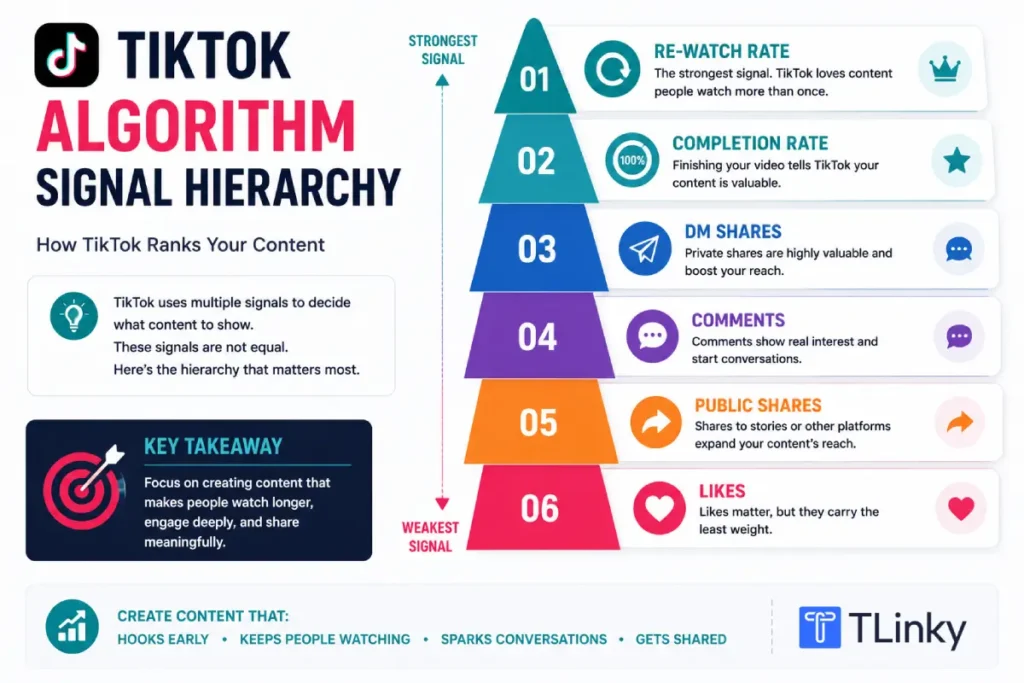
Re-Watch and Loop Rate
Re-watch rate is the top-weighted signal in TikTok’s 2026 ranking model. When a user watches a video more than once without swiping away, the algorithm reads it as strong interest and prioritizes distributing the video further.
Short, loopable videos accumulate multiple replays per viewer, which compounds quickly across a larger audience.
Content that earns rewatches tends to have an ambiguous ending, a rapid information density that rewards a second viewing, or a visual loop where the ending connects back to the beginning without an obvious cut point.
The shift toward re-watch as the primary signal happened gradually through 2024 and 2025 as TikTok refined its model to distinguish between passive watching and genuine interest.
Completion Rate and the 70% Threshold
Video completion rate is the percentage of your video the average viewer watches before swiping.
According to analysis from PostevEverywhere 2026 algorithm research, completion rates consistently at or above 70% signal content quality and trigger a push to the next, larger cohort.
Videos that fall below this threshold after the initial test tend to plateau. The algorithm interprets low completion as a signal that the content did not deliver on whatever prompted the viewer to stop and watch.
This means your video’s first three seconds are the most consequential. A weak opening causes viewers to swipe before they invest enough watch time to count toward your completion rate. A strong hook is the most direct lever you have over this signal.
DM Shares vs. Public Shares
Shares are weighted heavily, and DM shares specifically carry more weight than public shares to Stories or third-party platforms. When a viewer sends your video directly to someone in a private message, TikTok treats it as a high-confidence endorsement, because the viewer trusted your content enough to put their name on it in a private conversation.
Public shares to other platforms still count as a positive signal, but the intent behind a DM share is considered a stronger indicator of content value.
Comments
Comments signal that your video generated enough of a reaction to prompt a written response. The algorithm rewards content that starts conversations. Pinning a comment with an open question often extends this signal over time by inviting replies, which count as continued engagement on the original post.
Likes
Likes are still counted but carry the least weight among active engagement signals. TikTok has deprioritized passive engagement indicators because they are too easily given without genuine interest. Completion, re-watch, and sharing behaviors require stronger viewer intent and are therefore more informative.
How Does TikTok’s Cohort Testing Model Work?
When you publish a video, TikTok does not push it to a massive cold audience immediately. It runs a controlled test first.
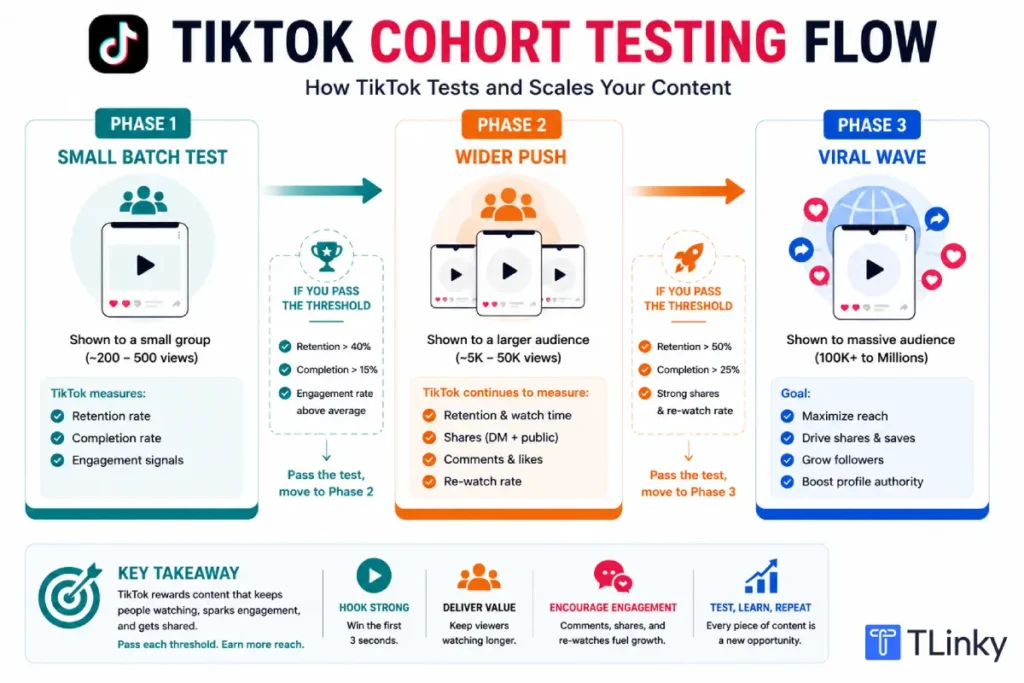
Phase 1 starts with a small initial batch, typically a mix of your existing followers and users who have previously engaged with similar content. TikTok monitors how this group interacts with your video, usually over the first 1 to 4 hours.
If Phase 1 shows strong signals, the video moves to Phase 2, which is a larger distribution wave. Each successive wave is exponentially bigger than the last. A video that maintains strong engagement can cycle through four or five waves before TikTok stops actively pushing it. This explains why videos sometimes gain traction days or weeks after they were originally posted, as a new wave starts.
If Phase 1 engagement is weak, TikTok slows distribution significantly. The video does not disappear, but organic reach becomes minimal unless something external, like a mention from another creator or a trending comment, brings in a fresh batch of viewers that restarts the signal.
The practical implication: the first hour after posting is your most important window. Posting when your followers are most active (visible in TikTok Analytics) improves the quality of your Phase 1 cohort and your chance of clearing the threshold for a wider push.
What Video Metadata Does TikTok’s Algorithm Read?
Metadata shapes which users TikTok targets with your video and is the primary distinction between FYP distribution and TikTok search ranking.
Captions and Keywords
TikTok reads your caption text and uses keywords to classify your content topically. For FYP, caption keywords help match your video to users who have engaged with similar topics. For TikTok search, the first 50 characters of your caption carry more ranking weight than anything that follows.
This is different from how most platforms handle metadata. Most creators put the most important keyword after a general opening line. On TikTok search, that approach costs you ranking priority. Put your primary keyword first.
Audio Transcription
TikTok automatically transcribes spoken audio in your videos. What you say out loud is indexed the same way on-screen text and captions are. Clearly saying your target keyword within the first 10 to 15 seconds of a video signals topic relevance to both FYP and search ranking.
This is one of the most overlooked optimization tactics. Creators who open by stating their keyword out loud consistently outperform those who rely on captions alone in TikTok search rankings.
On-Screen Text
Text overlays, subtitles, and graphic elements containing keywords are indexed alongside captions and audio. Clear, readable on-screen text helps TikTok classify your content and serves the additional function of keeping viewers engaged without sound, which improves completion rate.
Hashtags
Hashtags classify your content and open it to relevant discovery streams. Use 3 to 5 targeted hashtags that accurately describe your content topic. Oversaturated tags like #fyp or #foryoupage have so much competition that they offer no meaningful targeting signal for most accounts.
Use the TikTok Hashtag Generator to identify hashtags with an active but not saturated audience. For a full breakdown of niche versus broad hashtag strategy, the best hashtags for TikTok guide covers what actually moves the needle by content category.
Sounds and Trending Audio
Using a trending audio track places your video in front of users who have previously engaged with that sound. TikTok uses audio as a topical classifier and an audience matching signal. A trending sound can boost Phase 1 reach, but it only helps if the content itself earns engagement once those viewers arrive.
Use the TikTok Sound Finder to identify audio gaining momentum before it peaks. Sounds at 80% of their trajectory perform better than sounds already at maximum saturation.
How Is TikTok’s Search Algorithm Different from the FYP Algorithm?
TikTok runs two distinct ranking systems that share signals but weight them differently.
The FYP algorithm distributes content to users who have not searched for it. It weights real-time engagement, re-watch rate, completion, and DM shares above metadata. The goal is to surface content the user will want before they know they want it.
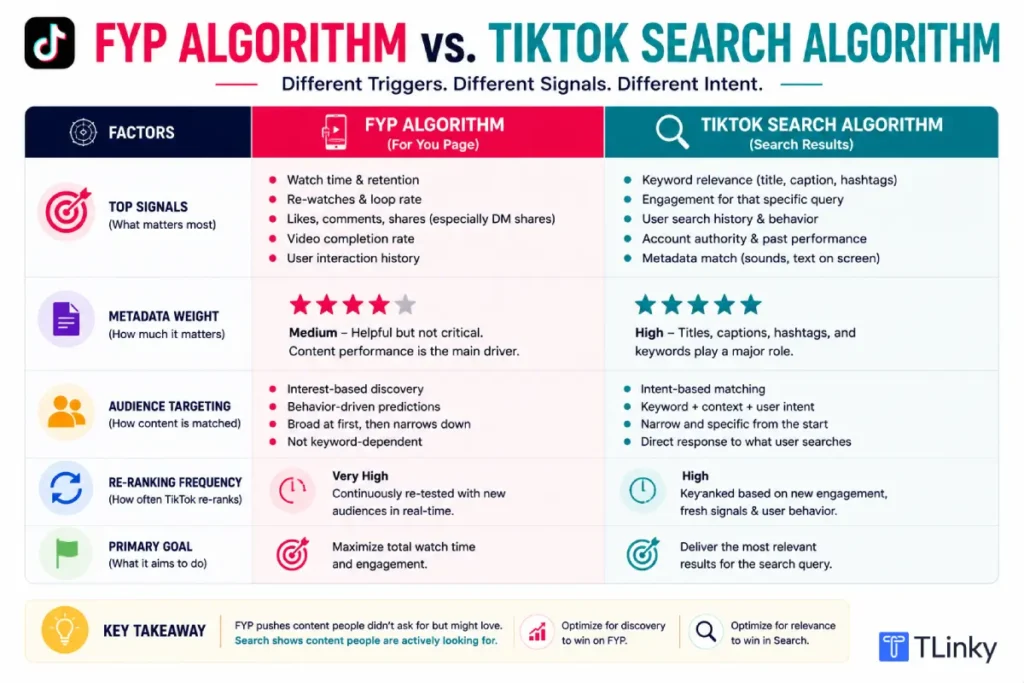
The TikTok search algorithm ranks existing content for specific queries. It weights caption keyword density, audio transcript matching, on-screen text relevance, and comment relevance alongside engagement signals. A video that performs well on FYP may not rank in search results if its caption lacks keyword optimization.
According to data from Voqusa and iMarkInfotech’s 2026 algorithm analysis, 84% of TikTok searches happen in the exploration phase, where users are browsing a topic rather than looking for a specific answer. This means search-ranked content still needs to be engaging enough to hold a viewer once they arrive.
The TikTok Keyword Suggestion tool shows which terms have active search volume on TikTok specifically. TikTok users phrase queries differently from Google searches, often shorter, more conversational, and framed as how-to questions or experience questions.
Practical takeaway: optimize for both systems in the same post. Put your primary keyword in the first 50 characters of your caption for search. Keep your opening three seconds strong for FYP completion signals. The TikTok Caption Analyzer checks your caption structure against both signals before you post.
Does Video Length Affect TikTok’s Algorithm Rankings?
Video length is not a direct ranking factor, but it directly affects completion rate, which is. A 60-second video with 70% completion outperforms a 3-minute video with 30% completion because the completion threshold matters more than total watch time in absolute terms.
In 2026, TikTok has increased its reward for longer videos when completion rates hold. Content between 1 and 3 minutes that maintains strong average view duration signals a higher level of content quality than short content with the same metrics, because sustained attention over a longer period is harder to manufacture.
This has shifted creator behavior on the platform. Creators who previously capped content at 30 to 60 seconds are now producing longer explainers and tutorials, because the algorithm rewards watch time accumulation. But this only works when completion rates hold.
The decision on length should follow the content. If your topic requires 90 seconds to cover well, use 90 seconds. If you can do it in 30 seconds clearly, do not pad it to 3 minutes hoping for more watch time accumulation. Padded content drives up swipe rates, which tanks your completion percentage and offsets any time-based signals.
What Content Does the TikTok Algorithm Actively Suppress?
Understanding what the algorithm penalizes is as important as understanding what it rewards.
Duplicate and reposted content is suppressed. TikTok uses video fingerprinting to detect recycled content, whether it is your own prior video or someone else’s. Reposted videos are flagged, and accounts that recycle content repeatedly can see reduced distribution across their entire output.
Content where users frequently tap “Not Interested” receives reduced reach. Each “Not Interested” input is a direct negative signal for that video and, if it accumulates at an account level, can affect your default starting cohort size going forward.
Content diversity is also enforced algorithmically. TikTok avoids showing multiple videos from the same creator back-to-back in a user’s FYP session. Even if a creator has three high-performing videos, only one will appear in close succession.
This limits the ability of any single account to dominate a user’s feed, which affects brand accounts with high publishing volume more than individual creators.
Community guideline violations receive the most severe suppression, ranging from reduced FYP reach to full removal. This includes misinformation, spam behavior patterns, and prohibited content categories.
Purely promotional content with no entertainment or informational value is flagged and receives minimal organic distribution. If your video is clearly an advertisement with no standalone value, the algorithm will not prioritize its reach.
This is why Spark Ads, which boost organic posts rather than cold ad creative, consistently outperform standard in-feed ads for brands investing in a content-driven strategy.
How Does the TikTok Algorithm Treat New Accounts Differently?
New accounts start with no behavioral history, which means TikTok has no baseline for who to target with their content. Initial cohorts for new accounts are broader and less precise than for established creators with a documented audience profile.
This is not a penalty. TikTok does not reduce distribution for new accounts as a rule.
A strong first video from a new account can earn the same reach as one from a creator with 500,000 followers, because the per-video signals matter more than account authority.
Follower count explicitly carries less weight in TikTok’s model than on Instagram or YouTube.
Established accounts benefit from having a mapped audience profile. TikTok knows which users engage with their content and uses that as a more accurate Phase 1 starting cohort.
This increases the probability of strong Phase 1 signals, which is a real advantage, but one that new creators can overcome with content quality.
How Should Brands Use the TikTok Algorithm Differently from Individual Creators?
The algorithm weights signals identically for brand and creator accounts. What differs is viewer expectation and behavior.
Audiences approach creator content with a lean-back mindset, willing to invest time in personality-driven storytelling. Brand content is held to a higher standard for immediate value delivery.
If a brand’s video does not show clear value in the first three seconds, swipe rates are consistently higher than for comparable creator content, because viewers are predisposed to expect something promotional.
For brands, this means applying creator content structures to brand videos: lead with a problem, a tension, or a specific surprising fact before any product reference.
Brand content that opens with a logo, a product shot, or a promotional headline consistently underperforms on completion rate.
TikTok’s algorithm does not penalize branded content directly. Audiences do, through swipe behavior.
Brands that structure content like creators, being specific, character-driven, and problem-first, see measurably better organic performance.
For brands running paid campaigns alongside organic, organic performance data directly informs paid creative decisions.
Content that already earns strong completion rates as an organic post will outperform cold ad creative in paid distribution.
Spark Ads let you amplify those organic posts while preserving their social proof, which further reinforces completion signals among new viewers.
The TikTok Ads Manager guide walks through how paid and organic signals interact at the campaign level.
How to Align Your Content Strategy With TikTok’s Algorithm
These adjustments produce the most direct impact based on how TikTok’s 2026 ranking model works.
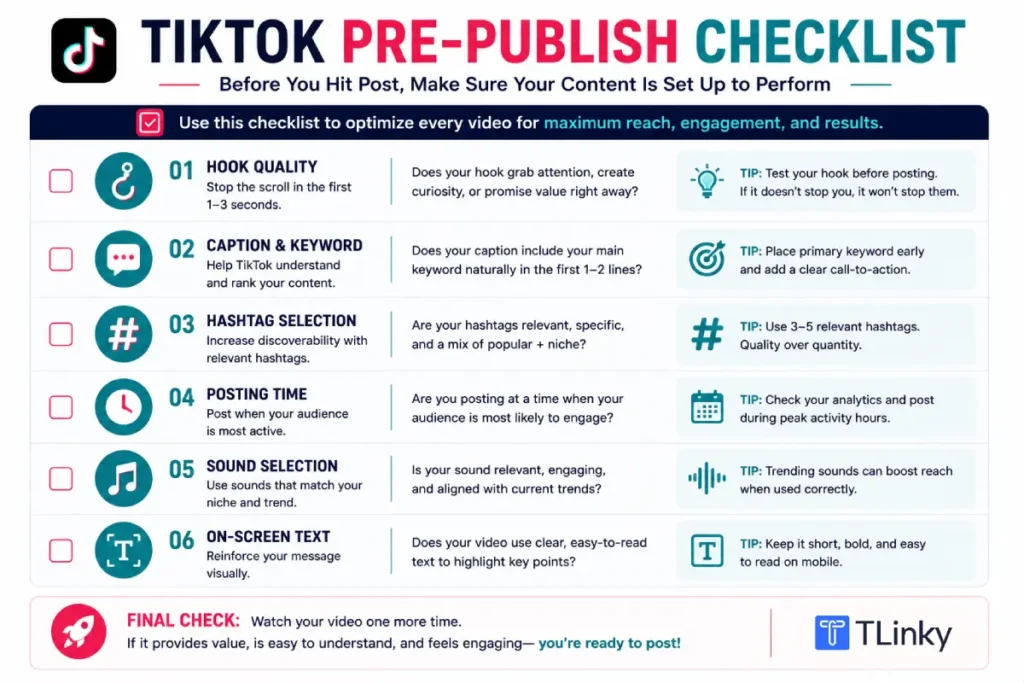
Hook the viewer in the first three seconds: The opening three seconds determine whether the viewer watches long enough to count toward your completion rate. Start with tension, a bold specific claim, or a pattern interrupt. The 3-second hook guide has formats that consistently improve early retention across content categories.
Build loopable endings: If your video ends in a way that connects back to the beginning without an obvious break, viewers who rewatch may not realize they are doing it. This is one of the most reliable ways to accumulate re-watch signals on short content.
Put your primary keyword in the first 50 characters of your caption: This applies to FYP metadata matching and TikTok search ranking simultaneously. Say the same keyword out loud in the first 15 seconds for additional audio transcript indexing.
Use 3 to 5 specific hashtags: Skip generic virality tags. Use hashtags that accurately describe your content topic and have a mid-size engaged audience. The TikTok Hashtag Generator identifies these more precisely than manual searching.
Post when your audience is active: This improves Phase 1 cohort quality and the probability of clearing early signal thresholds. Check TikTok Analytics for your audience activity windows. The best time to post on TikTok guide breaks this down by account type and category.
Reply to comments within the first hour: Comment activity during the initial test window extends the engagement signal period and tells the algorithm that conversation is happening. Comment replies count as new engagement on the original video.
Analyze your retention curve in TikTok Analytics: The retention graph shows you the exact frame where viewers drop. A consistent drop at the 22-second mark tells you where your hook is losing them. Fix that section before publishing the next video. The TikTok Engagement Predictor can model expected performance based on your historical signal patterns before you post.
For a complete framework connecting these tactics into a sustained content approach, the organic TikTok strategy guide covers how to compound these signals over time rather than optimizing individual videos in isolation.
FAQs
Does deleting and reposting a video help its performance?
No. TikTok uses video fingerprinting to detect duplicate content. A reposted video is often flagged as spam or suppressed in distribution. The better approach is to analyze why the original video underperformed using TikTok Analytics, look specifically at the retention curve, and apply those lessons to new content rather than recycling the same video.
Do hashtags like #fyp or #foryou still work in 2026?
No. These tags are so oversaturated that they offer no targeting or discovery advantage. Your caption space is better used on topic-specific keywords and 3 to 5 niche hashtags that accurately classify your content. Oversaturated hashtags add noise to your metadata without improving reach.
Does posting frequency affect how the algorithm treats your account?
TikTok does not reward volume over quality. Posting five average videos per week produces less total reach than posting one well-structured video. What matters is per-video engagement quality. If you are publishing at a pace that compromises the quality of each video, slowing down and improving content will typically improve overall performance.
Why does a video sometimes blow up weeks after posting?
TikTok’s cohort model runs in waves. External engagement, a share from another creator, a trending comment, or a video being linked from another platform can bring in a new batch of engaged viewers that triggers a fresh distribution wave. Each wave is evaluated independently, so even old videos can restart the cycle with strong enough external input.
Is the TikTok algorithm different for business accounts versus personal accounts?
Not meaningfully in terms of ranking signals. Business accounts lose access to some commercial sounds, which is worth noting if trending audio is part of your strategy. Otherwise, both account types experience the same FYP ranking model. Business accounts gain access to more detailed analytics and paid campaign tools, which affects strategy, not algorithmic treatment.
Does watch time matter more than completion rate?
They are related but measure different things. Completion rate measures what percentage of viewers finished your video. Average view duration measures total watch time per view. A 3-minute video with strong completion accumulates far more raw watch time than a 30-second video with the same completion rate, which is one reason TikTok now rewards longer content when completion holds. Both metrics matter, but completion rate determines whether TikTok pushes the video at all. Watch time depth tells the algorithm how much genuine interest there was.
Wrapping Up
TikTok’s algorithm rewards content that people watch twice and send to a friend, not content that earns a passive like and gets swiped away.
The shift toward re-watch as the top signal, combined with the 70% completion threshold and the staged cohort model, creates a system that is very good at finding content worth amplifying.
Understanding both systems, FYP distribution and TikTok search, also changes how you approach content planning.
You need your video to hold attention for FYP and your caption to carry the right keywords for search.
When both are working, a single piece of content can drive discovery across multiple surfaces simultaneously.
The TikTok marketing guide connects algorithm knowledge to broader campaign strategy. The TikTok statistics and facts page has current platform data to frame the scale of what the algorithm is working with.
Sources
- How the TikTok Algorithm Works in 2026, Hootsuite
- TikTok Algorithm 2026: How to Win With Rewatches, Dark Room Agency
- TikTok Algorithm 2026: The 5 Ranking Signals, Voqusa
- How TikTok Search Algorithm Actually Works in 2026, iMarkInfotech
- TikTok Algorithm 2026 Guide, Buffer
- How the TikTok Algorithm Works in 2026, PostEverywhere