
TikTok hashtags do two things. They help the algorithm understand what your content is about, and they make your videos discoverable through TikTok’s search feature. Most creators either ignore hashtags entirely or copy the same generic tags onto every video. Neither approach works.
Getting hashtags right means choosing tags that match your content, your audience, and your growth goals.
This guide breaks down exactly how TikTok hashtags function in 2026, which types to use, how many to include, and the tools that help you find the ones that give your videos the best chance of being discovered.
In this guide, you will learn:
- How TikTok hashtags work as both search signals and content categorization tools
- Which types of hashtags to use and in what combination
- How many hashtags to add per video
- The best free and official tools for hashtag research
- What to avoid: mistakes that waste your caption space
Get Free TikTok Ad Credit Up to $6000 [Limited Time Offer]

Key Takeaways
- Hashtags on TikTok serve a dual function. They categorize content for the algorithm and make videos discoverable through TikTok Search.
- TikTok’s search behavior has grown significantly. According to Pew Research Center data from March 2026, 74% of US TikTok users describe the app as a place to discover new things, which includes using the search bar actively.
- The most effective hashtag strategy mixes broad hashtags (high volume, high competition) with niche hashtags (lower volume, lower competition, more targeted reach).
- TikTok’s Creative Center Keyword Insights tool is the most accurate free source for TikTok-specific hashtag data. It shows volume, trend direction, and audience data for specific tags.
- According to TikTok’s own creator guidance, using 3 to 5 highly relevant hashtags tends to outperform adding 20 to 30 generic tags.
Quick Answer: What Are the Best Hashtags for TikTok?
The best TikTok hashtags include #TikTok, #FYP, #ForYou, #Trending, #SmallBusiness, #Beauty, #FoodTok, #TravelTok, #Fitness, and #LearnOnTikTok, but the right hashtags depend on your video’s topic and audience. For the best results, use a mix of one broad hashtag, two to three niche-specific hashtags, and one trending hashtag when it is relevant. Below, you’ll find 100+ of the best TikTok hashtags organized by category to help you choose the right ones for your content.
How Do TikTok Hashtags Actually Work?
Hashtags as Content Categorization Signals
TikTok’s algorithm processes every signal in your video to determine who to show it to. Hashtags are one input in that process. They provide explicit topic signals that help TikTok classify your content and match it with users who have engaged with similar topics before.
The TikTok algorithm guide explains the full set of distribution signals. Hashtags contribute to content categorization, but they are a secondary signal compared to completion rate and engagement. Accurate, relevant hashtags support distribution, while irrelevant or spammy hashtags provide a weak or confusing signal.
Hashtags as Search Discovery Tools
TikTok’s search function has grown into a primary discovery channel, not just a supplementary feature. When a user searches a term on TikTok, the platform shows both videos and hashtag pages. If your video is tagged with a term someone searches, it has a chance of appearing in those results.
According to the Pew Research Center, 74% of US TikTok users say the app helps them discover new things (March 2026). As TikTok continues developing its search functionality, including AI-powered search features in TikTok One, the search discovery role of hashtags is increasing in importance.
This is covered in more depth in the TikTok Search guide, which explains how TikTok’s search algorithm ranks content.
Hashtag Pages as Discovery Feeds
Each hashtag on TikTok has its own page showing all videos using that tag, sorted by TikTok’s relevance and popularity algorithm. Users browsing these pages are actively exploring a topic.

They have higher intent than passive For You Page viewers. Videos that perform well for a specific hashtag page gain sustained discovery traffic beyond the initial FYP distribution.
The 4 Types of TikTok Hashtags
Broad or Viral Hashtags
Broad hashtags are high-volume tags that cover wide topics. Examples: #tiktok, #viral, #foryou, #fyp, #trending, #explore.
These tags have billions of views combined, which means the competition is enormous. Your video competes with millions of others for visibility on these pages. The benefit of including one or two broad tags is that you signal to TikTok that your content is general-audience appropriate, but the practical discovery value from these pages alone is low for smaller accounts.
Use them sparingly, one per video at most, and rely on niche and mid-tier tags for actual discovery reach.
Niche or Category Hashtags
Niche hashtags target a specific topic, community, or interest area. Examples: #SmallBusinessTikTok, #SkincareTips, #LearnToCode, #FoodTikTok, #MomHacks.
These tags have smaller audiences (tens of thousands to a few million views) but much less competition. A video ranking well for a niche tag reaches an audience that is actively interested in that exact topic. The conversion from view to follow tends to be higher from niche hashtag traffic than from FYP traffic, because the viewer self-selected into that topic.
Niche hashtags are where most of your hashtag effort should go.
Trending or Moment Hashtags
Trending hashtags are temporary, tied to a current event, viral challenge, cultural moment, or platform-specific trend. Examples include a specific challenge tag, a seasonal hashtag, or a tag connected to a trending audio or format.
The upside is captured during a trend’s growth phase. The downside is short shelf life. Once a trend fades, traffic to that tag page drops to near zero. Trending hashtags work best as one of your three to five tags, not the primary focus.
Use the TikTok Trend Tracker to monitor which challenge and moment hashtags are currently gaining traction in your niche.
Branded Hashtags
Branded hashtags are specific to a brand, campaign, or creator identity. Examples include a business running a campaign with a unique hashtag, or a creator building a series under a consistent tag.
For businesses, branded hashtags help users find all content related to a campaign. For creators, a consistent series hashtag trains the algorithm and your audience to associate a set of content with a specific tag.
Branded hashtags take time to build an audience. They work best as long-term consistency plays, not short-term reach strategies.
Best Hashtags for TikTok
There is no universal list of hashtags that works for every TikTok video. The best hashtags depend on your content, audience, and niche. A hashtag that performs well for a beauty tutorial may be irrelevant for a real estate video.
Instead of copying the same hashtags into every post, choose tags that accurately describe your content and match what your audience is likely to search for. Use the categories below as a starting point, then adjust your hashtag mix based on your topic and current trends.
Popular TikTok Hashtags
Popular hashtags have billions of combined views and appear across many different types of content. While they can help categorize your videos, they are also the most competitive. Use one or two broad hashtags alongside more specific niche hashtags.
Examples:
- #TikTok
- #ForYou
- #Trending
- #Explore
- #Video
- #ContentCreator
- #Creator
- #Discover
- #Community
- #SocialMedia
Trending TikTok Hashtags
Trending hashtags are tied to current events, seasonal topics, viral sounds, or emerging conversations. Their popularity changes frequently, so always check TikTok’s Creative Center or Search before using them.
Examples:
- #TrendingNow
- #TrendAlert
- #MustWatch
- #NewTrend
- #CurrentTrend
- #TikTokTrend
- #TrendWatch
- #OnTrend
- #ViralTrend
- #HotTopic
Viral TikTok Hashtags
Viral hashtags are commonly used on highly shared content. They should support your content rather than replace niche-specific hashtags.
Examples:
- #Viral
- #GoViral
- #TrendingVideo
- #MustSee
- #WatchThis
- #Popular
- #ShareThis
- #Amazing
- #ViralVideo
- #DontMissThis
FYP Hashtags
Many creators include FYP hashtags in an attempt to reach the For You Page. TikTok has never confirmed that these hashtags directly improve distribution, but they remain widely used across the platform.
Examples:
- #FYP
- #ForYou
- #ForYouPage
- #FY
- #FYPage
- #Foryoupage
- #FYPシ
- #TikTokFYP
Small Business Hashtags
These hashtags help connect your content with entrepreneurs, local businesses, and shoppers interested in supporting small brands.
Examples:
- #SmallBusiness
- #SmallBusinessOwner
- #SupportSmallBusiness
- #BusinessTips
- #Entrepreneur
- #Startup
- #OnlineBusiness
- #BusinessGrowth
- #ShopSmall
- #BusinessTok
Beauty Hashtags
Use beauty-related hashtags for skincare, makeup, cosmetics, haircare, and personal care content.
Examples:
- #Beauty
- #Makeup
- #Skincare
- #BeautyTips
- #HairCare
- #MakeupTutorial
- #GlowUp
- #SkinCareRoutine
- #BeautyHacks
- #SelfCare
Fashion Hashtags
Fashion hashtags work well for clothing brands, styling tips, outfit inspiration, and accessories.
Examples:
- #Fashion
- #OOTD
- #Style
- #FashionTok
- #StreetStyle
- #OutfitIdeas
- #FashionInspo
- #Wardrobe
- #StyleTips
- #LookBook
Food Hashtags
Food creators, restaurants, and recipe accounts can use these hashtags to improve topic relevance.
Examples:
- #Food
- #FoodTok
- #Recipe
- #Cooking
- #HomeCooking
- #EasyRecipes
- #FoodLover
- #DinnerIdeas
- #Dessert
- #HealthyFood
Travel Hashtags
Travel hashtags help categorize destination guides, travel tips, and adventure content.
Examples:
- #Travel
- #TravelTok
- #Adventure
- #Vacation
- #TravelGuide
- #ExploreMore
- #BucketList
- #RoadTrip
- #Nature
- #Wanderlust
Fitness Hashtags
Fitness hashtags work well for workouts, health advice, and active lifestyle content.
Examples:
- #Fitness
- #Workout
- #Gym
- #FitnessMotivation
- #HealthyLifestyle
- #Exercise
- #Training
- #WeightLoss
- #FitLife
- #FitnessJourney
Gaming Hashtags
Gaming creators can use these hashtags to reach audiences interested in gameplay, livestreams, and esports.
Examples:
- #Gaming
- #Gamer
- #GameTok
- #PCGaming
- #MobileGaming
- #ConsoleGaming
- #Esports
- #GamingCommunity
- #Gameplay
- #Streamer
Music Hashtags
Music hashtags help organize singing, instrument, production, and performance content.
Examples:
- #Music
- #MusicTok
- #Singer
- #Song
- #Musician
- #Producer
- #LiveMusic
- #CoverSong
- #NewMusic
- #MusicVideo
Marketing Hashtags
Marketing hashtags are useful for agencies, freelancers, and business educators sharing digital marketing content.
Examples:
- #Marketing
- #DigitalMarketing
- #ContentMarketing
- #SocialMediaMarketing
- #SEO
- #Branding
- #MarketingTips
- #Advertising
- #BusinessMarketing
- #MarketingStrategy
Ecommerce Hashtags
These hashtags help categorize online selling, product marketing, and ecommerce business content.
Examples:
- #Ecommerce
- #OnlineStore
- #Shopify
- #Dropshipping
- #OnlineBusiness
- #ProductMarketing
- #SellOnline
- #EcommerceTips
- #Retail
- #BusinessGrowth
Real Estate Hashtags
Real estate professionals can use these hashtags for listings, home buying tips, and property content.
Examples:
- #RealEstate
- #Realtor
- #HomeForSale
- #Property
- #HouseHunting
- #RealEstateTips
- #InvestmentProperty
- #HomeBuying
- #LuxuryHomes
- #OpenHouse
Education Hashtags
Educational hashtags are suitable for tutorials, online learning, and knowledge-sharing videos.
Examples:
- #Education
- #LearnOnTikTok
- #StudyTips
- #Learning
- #TeacherTok
- #StudentLife
- #HowTo
- #OnlineLearning
- #EducationTips
- #Knowledge
Tech Hashtags
Technology hashtags help organize software, gadgets, AI, programming, and technology news.
Examples:
- #Technology
- #Tech
- #AI
- #Programming
- #Coding
- #Software
- #TechNews
- #Innovation
- #Developer
- #Gadgets
Finance Hashtags
Finance hashtags work well for investing, budgeting, and personal finance education.
Examples:
- #Finance
- #PersonalFinance
- #Investing
- #MoneyTips
- #FinancialEducation
- #Budgeting
- #StockMarket
- #PassiveIncome
- #SavingMoney
- #FinTok
Local Business Hashtags
Local businesses can combine these hashtags with city, state, or neighborhood hashtags to improve local discovery.
Examples:
- #LocalBusiness
- #ShopLocal
- #SupportLocal
- #SmallBusiness
- #LocalCommunity
- #LocalShop
- #CityName
- #YourCityBusiness
- #Neighborhood
- #LocalDeals
Seasonal Hashtags
Seasonal hashtags help your content align with holidays, shopping events, and yearly trends.
Examples:
- #Spring
- #Summer
- #Fall
- #Winter
- #BackToSchool
- #BlackFriday
- #CyberMonday
- #HolidayDeals
- #Christmas
- #NewYear
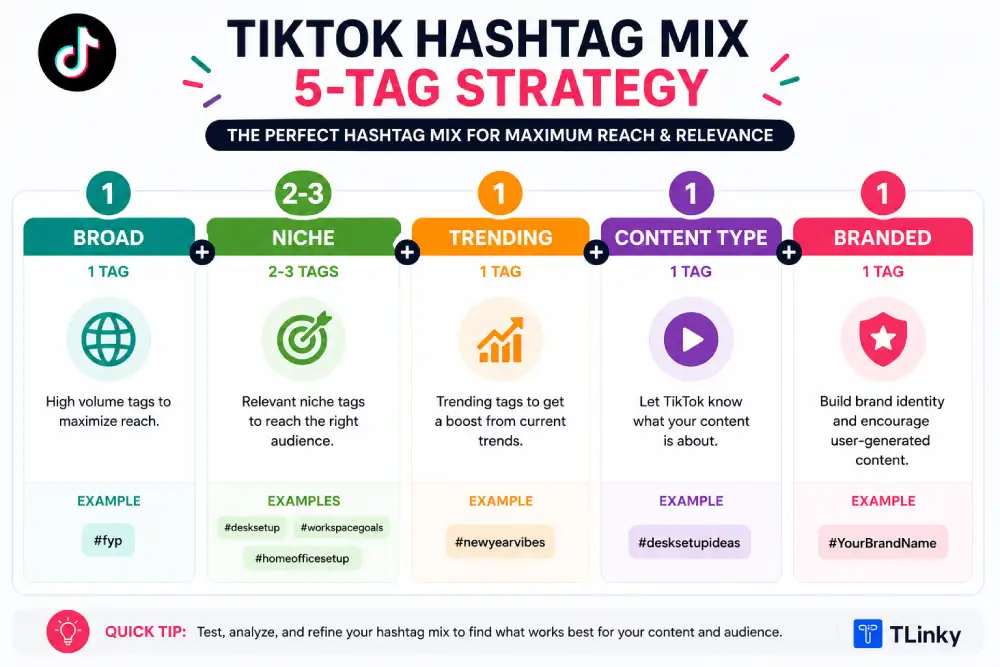
Tip: Don’t copy an entire category into every post. Choose three to five hashtags that accurately describe your content. A mix of one broad hashtag, two or three niche hashtags, and one trending hashtag (when relevant) is generally more effective than using a long list of unrelated tags.
One important recommendation: verify each hashtag inside TikTok’s Creative Center or Search before publishing. Trending hashtags, seasonal hashtags, and even some popular hashtags change over time. Keeping these lists updated will make this section much more useful and trustworthy than a static list.
How Many Hashtags Should You Use on TikTok?
TikTok allows hashtags within the 2,200-character caption limit. There is no official cap on the number of hashtags you can use.
TikTok’s own creator guidance recommends using 3 to 5 relevant hashtags rather than filling the caption with 20 to 30 tags. The reasoning is that highly relevant tags send clearer categorization signals than a scatter-approach with many loosely related tags.
Practical recommendation:
- 1 broad hashtag (reach signal)
- 2 to 3 niche hashtags (targeted discovery)
- 1 trending hashtag when directly relevant to your content
- 1 branded hashtag if you are building a campaign or series
This approach keeps your hashtag usage focused and clean without wasting caption space on tags that provide no meaningful signal.
How to Find the Best Hashtags for Your Niche
TikTok Creative Center Keyword Insights
TikTok’s Creative Center includes a Keyword Insights tool that shows actual TikTok search data, including which terms are being searched, how often, and whether search volume is growing or declining.
This is the most accurate free source for TikTok-specific hashtag and keyword research because it pulls from TikTok’s own platform data.
To access it: go to ads.tiktok.com/business/creativecenter and navigate to the Keyword Insights section. You can filter by country, industry, and time period.
Use this tool to:
- Find high-volume keywords and hashtags in your specific niche
- Identify trending search terms before they peak
- See what your target audience is actively searching for on TikTok, not just on Google
The TikTok Hashtag Generator generates niche-specific hashtag suggestions based on your content topic, useful for building your initial list to then validate in Creative Center.
TikTok’s Search Bar Auto-Suggest
Type your topic into TikTok’s search bar and observe the auto-suggestions that appear. These auto-suggestions are populated by actual user search behavior. They show what people are searching for right now. Every auto-suggestion is a potential hashtag for your content.
The advantage of this method is immediacy. It reflects current search trends without any tool login required.
TikTok Keyword Suggestion Tool
The TikTok Keyword Suggestion tool surfaces relevant keywords and hashtag ideas mapped to your content topic, helping you identify variations and long-tail terms you might not think of independently.
Analyzing Top Performers in Your Niche
Search your niche topic on TikTok and look at the top-performing videos. Note which hashtags they use consistently. If multiple high-performing creators in your niche use the same two or three tags, those tags are likely strong performers for your category.
This is not a reason to copy their exact hashtag list. It is a signal that those tags are active and indexed. Combine their highest-performing niche tags with your own branded and trending tags.
TikTok Hashtag Strategy by Account Size
Different hashtag strategies make sense at different stages of account growth.
For accounts with fewer than 10,000 followers, broad viral hashtags offer minimal practical benefit. Focus on niche and mid-tier tags where your content can rank without competing against accounts with millions of followers. The goal is to own a discoverable space in a specific topic area.
For accounts with 10,000 to 100,000 followers, a mix strategy becomes more effective. Your account has enough engagement velocity to compete on mid-tier tags, and your content quality has been validated. Adding one or two broader tags makes sense here.
For accounts above 100,000 followers, broad tags are more viable because your engagement rate provides enough signal to rank within crowded tag pages. Branded hashtag development becomes more valuable as your audience size makes campaign tags worth building.
Regardless of account size, niche hashtags connected to TikTok Search behavior are the highest-return use of your hashtag slots.
Common Hashtag Mistakes to Avoid
Using the same hashtags on every video is one of the most common errors. It signals to the algorithm that every video is the same type of content, regardless of the actual topic. Tailor your hashtag set to each video specifically.
Using banned or restricted hashtags can suppress distribution. Some hashtags have been restricted by TikTok due to content policy violations associated with them. Before using an unusual hashtag, check whether it has an active page by searching it on TikTok. A restricted hashtag shows limited or no public content.
Hashtag stuffing, which means packing 20 or more generic tags into a caption, does not improve reach and can make your caption look spammy to viewers. It also dilutes the categorization signal you send to the algorithm.
Ignoring TikTok Search intent is an increasingly costly mistake. As TikTok’s search features grow, hashtags that do not match actual user search queries miss the growing search discovery channel. Research what your audience searches, not just what tags are popular among creators.
How to Measure Hashtag Performance
TikTok Analytics provides a breakdown of traffic sources for each video, including what percentage came from TikTok Search versus the For You Page versus profile visits versus following feeds. When your hashtag strategy is working, you will see a growing share of traffic from the Search and Hashtag traffic sources.
Check this data for your best-performing videos to identify which hashtag combinations drove search traffic, then replicate those combinations on similar content.
The TikTok Analytics guide covers how to read traffic source data and other performance metrics in detail.
Frequently Asked Questions (FAQ)
Do hashtags help TikTok videos go viral?
Hashtags alone cannot make a video go viral. They improve discoverability and send categorization signals to the algorithm, but the primary drivers of viral distribution are watch time, completion rate, shares, and engagement quality. A video with poor retention will not go viral regardless of its hashtags. A video with outstanding retention will find distribution even with average hashtag choices. Use relevant hashtags to support distribution, not as a substitute for strong content.
Does #fyp or #foryou actually get you on the For You Page?
TikTok has not confirmed that #fyp or #foryou tags directly influence For You Page placement. These are extremely high-volume, low-specificity tags with billions of videos. They provide weak categorization signals compared to niche-specific hashtags. Many top-performing creators use them as one of their tags for reach signaling, but they should not replace niche tags that carry actual search value.
How often should I change my hashtags?
Change your hashtags with each video to match the specific content of that post. Using identical hashtag sets across all videos reduces the algorithm’s ability to categorize individual pieces of content accurately. For a content series, you can keep one or two consistent series-specific hashtags while rotating the other tags based on the specific topic of each video in the series.
Can hashtags hurt your reach on TikTok?
Yes, in two specific cases. First, using restricted or shadowbanned hashtags associated with content policy violations can suppress the distribution of videos using those tags. Second, using irrelevant hashtags creates a misalignment between the categorization signal and the content, which can result in your video reaching the wrong audience and producing poor engagement, limiting further distribution.
Should I put hashtags in the caption or comments?
TikTok’s official creator guidance recommends placing hashtags in the caption rather than the comments. TikTok’s search algorithm indexes caption hashtags and creates the strongest categorization signal. Hashtags in comments may have limited or no indexing effect. TikTok has not confirmed whether comment hashtags are processed the same way as caption hashtags. Put your hashtags in the caption where they are most clearly visible to both the algorithm and your viewers.
How do hashtags on TikTok differ from Instagram?
On Instagram, hashtags function primarily as discovery tools on dedicated hashtag pages. On TikTok, hashtags serve a dual role: content categorization for the recommendation algorithm and search discovery. TikTok’s recommendation system is significantly more powerful than Instagram’s, which means TikTok’s algorithm can distribute your content broadly based on content signals alone, making hashtags less critical to distribution than they are on platforms that rely more heavily on hashtag-based discovery.
Wrapping Up
The best hashtag strategy for TikTok in 2026 is built on specificity, not volume. Three to five accurately chosen hashtags that reflect your content and match your audience’s search behavior outperform lists of generic tags every time.
Research your hashtags using TikTok’s Creative Center Keyword Insights and your niche’s top-performing content. Mix broad, niche, and trending tags in a deliberate combination.
Track which hashtag combinations drive search and hashtag traffic through TikTok Analytics, and refine your approach based on that data.
For the full picture of how TikTok’s search algorithm processes your content, the TikTok Search guide explains the ranking factors in detail.
For the organic content strategy that connects hashtags to consistent reach growth, the organic TikTok strategy guide covers the complete system.
Sources
- TikTok Creative Center Keyword Insights, Official TikTok Tool
- TikTok Creator Academy, Hashtags and Discovery
- TikTok Business Help Center, Content Best Practices
- Pew Research Center, 8 Facts About Americans and TikTok
- DataReportal, TikTok Users Stats Data and Trends