
TikTok marketing is the practice of using TikTok’s organic content, paid advertising, influencer partnerships, and in-app commerce tools to build brand awareness, generate leads, and drive sales.
In 2026, it also means treating TikTok as a search engine, a shopping platform, and a live commerce channel, all at the same time.
The numbers make the case clearly. TikTok now has 1.99 billion monthly active users globally, users spend an average of 95 minutes per day on the app, and the platform’s average engagement rate of 3.70% is the highest among all major social platforms, according to Sprout Social. Yet, only 26% of marketers are currently running TikTok campaigns (SocialPilot).
That gap is your opportunity, and this guide shows you exactly how to use it.
You will learn:
- How TikTok’s 2026 algorithm actually ranks and distributes content
- How to build a content strategy that works for your brand, not just for trends
- How to optimize your videos for TikTok Search
- How to run paid ads without wasting your budget
- How TikTok Shop and live commerce generate revenue inside the app
- How to find and brief creators who drive real sales
- How to measure results and track every link back to business outcomes
Get Free TikTok Ad Credit Up to $6000 [Limited Time Offer]
Whether you are just getting started or scaling what you already have, this guide gives you the complete picture.
I’ve been running TikTok campaigns and tracking creator performance across TLinky’s partner brands for the past two years. The patterns here come from real campaigns.
Key Takeaways
- TikTok’s re-watch rate has become the platform’s top algorithmic signal in 2026, outweighing likes and follower count.
- TikTok SEO is now a non-negotiable part of your content strategy because more than 60% of younger users search on TikTok before making a purchase decision.
- TikTok Shop’s global GMV reached $64.3 billion in 2025 and is projected to surpass $112 billion in 2026, making in-app commerce a core revenue channel, not a side experiment.
- Micro-influencers (10,000 to 100,000 followers) deliver a 3.86% average engagement rate at 40% lower cost per engagement than macro-influencers.
- Every URL you place in your TikTok bio or ad creative should be a tracked short link so you can attribute traffic and conversions back to specific content.
Quick Answer: What Is TikTok Marketing?
TikTok marketing is the use of TikTok’s content tools, paid ads, creator partnerships, and shopping features to grow a brand and drive sales. It spans organic video content, TikTok SEO, advertising through TikTok Ads Manager, TikTok Shop, and influencer campaigns. Brands use TikTok to reach audiences across awareness, consideration, and purchase, often within a single session.
Why TikTok Marketing Matters in 2026
To build an effective strategy, you need to understand the environment first. TikTok in 2026 operates across four distinct roles simultaneously.
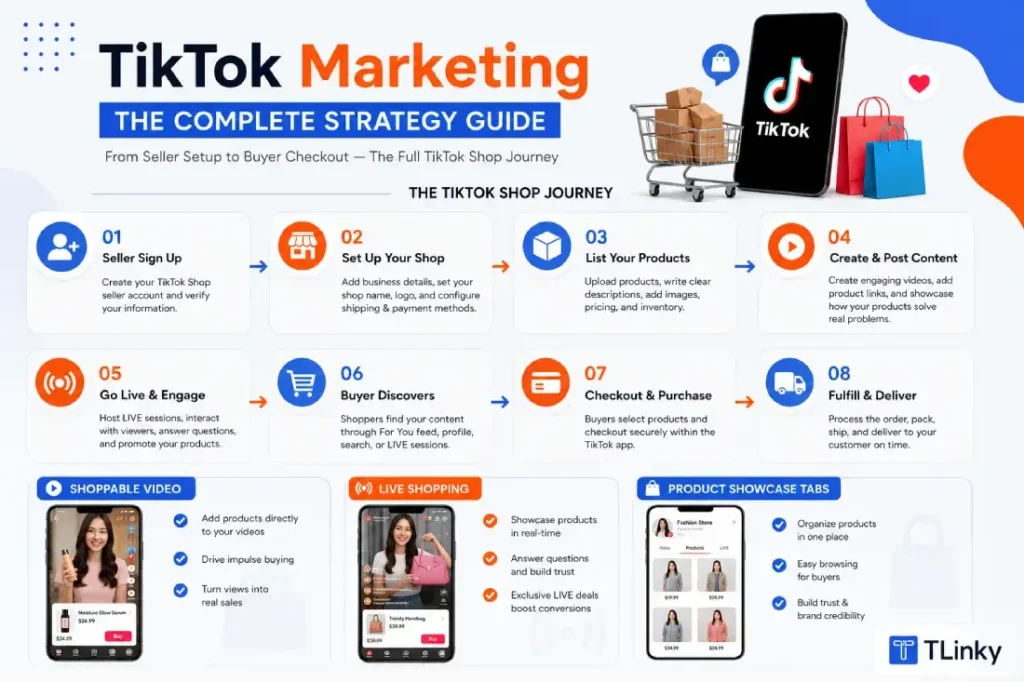
A search engine. According to Hootsuite’s TikTok marketing research, over 60% of younger users now go to TikTok before Google when researching products, how-to topics, or brand reviews. Your content must be findable, not just entertaining.
A commerce platform. TikTok Shop’s US GMV grew 407% in 2024 and another 108% in 2025, reaching $15.82 billion. US sales will surpass $20 billion in 2026, according to eMarketer. The path from discovery to checkout now happens inside the app.
An advertising channel. TikTok generated $33.1 billion in global ad revenue in 2025 (up 43% year-over-year), with US ad revenue at $11 billion and projected to reach $14.5 billion in 2026, according to estimates from Business of Apps. Brands report 40% higher brand recall from TikTok ads compared to non-TikTok placements.
A community ecosystem. Niche subcultures like #BookTok, #CleanTok, #FinTok, and #FoodTok have built loyal, self-sustaining communities. Brands that embed themselves authentically in the right subculture gain audiences that the algorithm repeatedly surfaces to, at zero paid cost.
For a deeper look at the numbers behind these trends, see TLinky’s TikTok statistics and facts page.
Setting Up Your TikTok Business Account
Switch to a Business Account
A personal account does not give you access to analytics, the commercial music library, advertising capabilities, or a clickable website link in your bio.
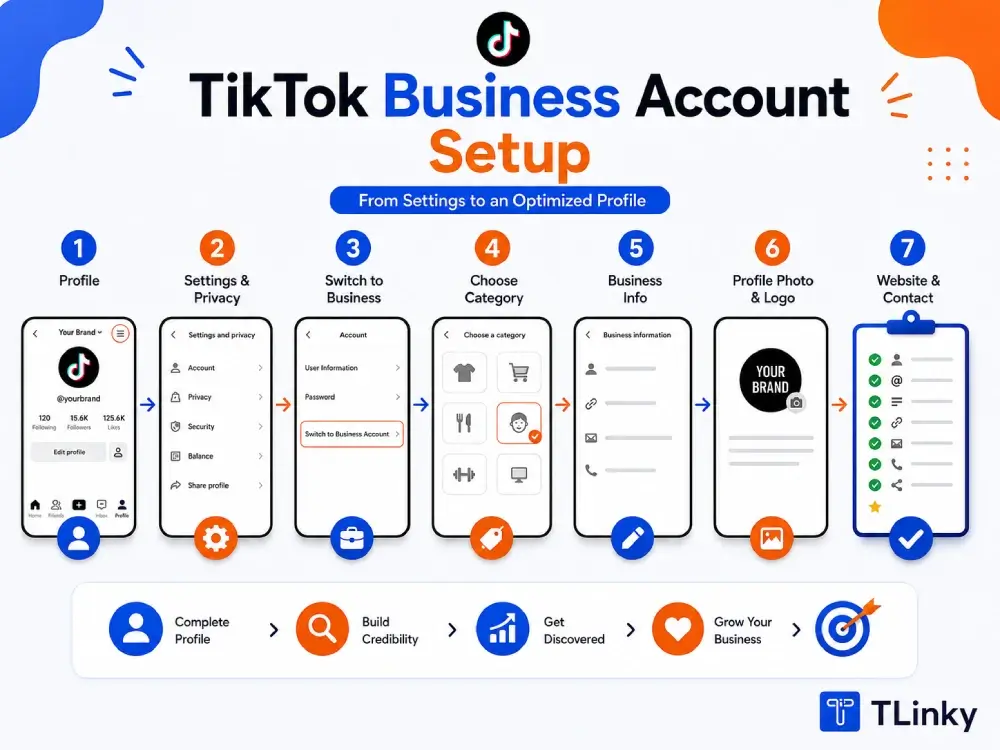
Switching takes about 30 seconds: go to Settings and Privacy, then Account, then Switch to Business Account. There is no cost.
For a step-by-step walkthrough of the full setup process, TLinky’s guide on how to create a TikTok Business Account covers everything you need.
Optimize Your Profile
Your profile works as your organic landing page. Every element either builds trust or loses it.
Profile photo: Use your brand logo at high resolution. TikTok compresses images, so export at 2x size before uploading.
Username: Keep it consistent with your handles on other platforms. Consistency aids brand recognition in search results and cross-platform recall.
Bio (80 characters): State clearly what you do, who you serve, and what they should do next. Include one or two keywords your audience would actually search. Example: “URL shortener + QR codes for creators | Track every click.”
Website link: This is your highest-value piece of real estate on TikTok. Do not waste it on your homepage. Link to a purpose-built Link in Bio page that routes visitors to your most important destinations based on what they need.
A well-structured bio page consistently converts better than a generic homepage link because it removes friction for visitors arriving from different content topics.
If you need a multi-link bio page with real analytics, TLinky’s guide to the best Linktree alternatives compares tools that offer branded links, click tracking, and retargeting built in.
For a full overview of what TikTok for Business unlocks at each tier, read TLinky’s TikTok for Business guide.
How the TikTok Algorithm Works in 2026
Understanding the algorithm is not optional. Every content decision you make, from topic selection to video length to caption structure, either works with the algorithm or against it.
For a complete breakdown of all ranking signals, read TLinky’s TikTok algorithm guide. Here are the five signals that matter most in 2026.
Re-watch Rate (The Top Signal)
TikTok now weights immediate re-watches above all other signals. When a viewer replays your video within three seconds of it ending, the system treats it as strong evidence of content quality and accelerates distribution. A video with a 15% re-watch rate will out-distribute one with 100,000 likes but a 2% re-watch rate.
The practical implication: end your videos with something that rewards a second viewing, a reveal, a punchline, a visual detail that requires another pass.
Engagement Velocity
The algorithm tracks how fast a video accumulates likes, comments, shares, and watch time in the first 1 to 24 hours after posting. Fast early accumulation signals quality content and triggers broader distribution. Slow starts suppress reach even if engagement eventually picks up.
Shares and Saves Over Likes
A share carries more weight than a like. A DM share (where someone sends your video privately to a friend) carries even more weight than a public share, because it signals a genuine recommendation rather than passive engagement. If your content strategy is not actively earning saves and shares, you are leaving distribution on the table.
Content Relevance Over Follower Count
TikTok tests every video with a small initial sample audience. It then expands distribution based on how that sample responds, regardless of your follower count. A new account can reach millions with a single well-made video. Follower count does not predict reach. Content quality does.
Watch Time and Completion Rate
The percentage of your video viewers who finish tells the algorithm whether your content delivers on its promise. A video that 80% of viewers complete is a strong signal. A video where 70% of viewers abandon in the first three seconds is suppressed immediately. This is why the first one to three seconds of every video is your most important moment.
To understand how content surfaces on the For You Page specifically, TLinky’s guide to the TikTok For You Page explains exactly how distribution works at each stage.
Building Your TikTok Content Strategy
The Four Content Pillars
The strongest TikTok strategies are built on four recurring content types that balance entertainment value with business objectives.
Education: Tutorials, how-to videos, industry explainers, and product walkthroughs. Educational content performs well in TikTok Search, stays relevant longer than trend-based content, and drives saves, which are a high-value algorithmic signal.
Authenticity: Behind-the-scenes footage, founder stories, employee spotlights, customer reactions, and unboxing moments. This content builds trust because it shows the people behind the product. Audiences in 2026 are highly attuned to inauthenticity and disengage from content that feels scripted or performative.
Entertainment: Trend participation, humor, storytelling, and creative formats that deliver an emotional response. This is how you stop the scroll. Entertainment-focused content drives shares and profile visits, feeding the top of your funnel.
Community: Duets, stitches, response videos, comment engagement, and participation in niche subcultures. Brands that embed themselves authentically within #BookTok, #FinTok, or #FitTok gain loyal audiences that the algorithm repeatedly surfaces to, often without any paid amplification.
Aim for a rough 40/40/20 mix: 40% education, 40% entertainment, 20% direct promotion.
For a full breakdown of organic-first approaches, TLinky’s organic TikTok strategy guide covers content planning, publishing cadence, and community-building in detail.
Video Formats That Drive Results
TikTok offers several distinct video formats, each with different audience behaviors.
In-Feed Videos (15 seconds to 10 minutes): The default format. Shorter clips (15 to 30 seconds) stop the scroll; longer videos (2 to 5 minutes) build deeper authority and earn higher completion rates when the content justifies the length. TikTok actively expanded distribution for longer-form content in 2026.
Duets and Stitches: Collaborative formats where you respond to or build on someone else’s content. These are effective for joining trending conversations without needing to create original trend content from scratch.
TikTok Live: Real-time sessions for direct audience interaction, product demonstrations, and live shopping. Lives reach your existing followers immediately and attract new viewers through Live discovery, bypassing the initial algorithmic test that pre-recorded videos go through.
Photo Carousels: Swipeable image posts that function similarly to Instagram carousels. These generate strong save rates and work well for list-based educational content.
For video content ideas tailored to different brand types, see TLinky’s TikTok video ideas resource.
Writing Hooks That Stop the Scroll
The first three seconds of your video determine whether it gets watched or skipped. A strong hook makes a bold claim, asks a provocative question, or creates immediate visual intrigue.
Weak hook: “Today I’m going to show you how to use TikTok for marketing.” Strong hook: “This one TikTok change doubled our sales in 30 days. Here’s what we did.”
TLinky’s 3-second hook guide gives you proven hook structures organized by content type and industry.
Use TLinky’s TikTok Video Title Generator to generate hook formulas for your specific topic and niche.
Posting Frequency and Timing
TikTok officially recommends 7 to 28 posts per week. Research from Buffer’s 2026 social media report places the best ROI for most brands at 3 to 5 posts per week, enough to build algorithmic momentum without sacrificing content quality.
Consistency matters more than frequency. A brand posting five strong videos weekly for three months will outperform one posting 20 mediocre videos in a burst and then going quiet.
Check your TikTok Analytics under Follower Activity to see the exact days and times your specific audience is most active.
TikTok SEO: How to Rank Higher in TikTok Search
TikTok search is one of the most underused channels in most brands’ content strategies. The platform now functions as a discovery engine for product reviews, how-to guides, and purchase decisions, particularly for audiences under 35.
For a full explanation of how TikTok’s search ranking system works, TLinky’s TikTok search guide covers all the ranking factors in detail.
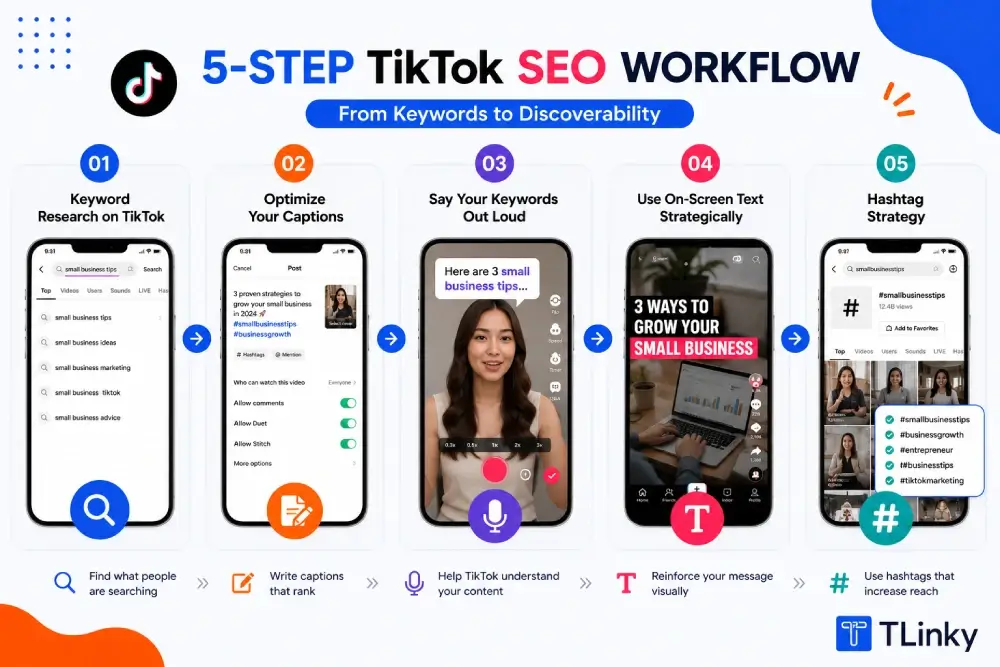
Step 1: Keyword Research on TikTok
Open TikTok and type your core topic into the search bar. The auto-suggest results are TikTok’s own data on what real users search. Screenshot the top 10 auto-fills for your primary keyword. Also, check the “Others searched for” panel that appears at the top of search results pages. These are your content targets.
Use TLinky’s TikTok Hashtag Generator to identify keyword-hashtag combinations that align with your content topics and have real search volume.
Step 2: Optimize Your Captions
TikTok’s search algorithm reads your caption for topical relevance. Place your primary keyword in the first sentence, before the “See more” cutoff.
Caption that underperforms: “Marketing tips for small businesses #marketing” Caption that ranks: “How to run TikTok ads with a $20 budget and get real results — save this for your next campaign”
Run your captions through TLinky’s TikTok Caption Analyzer to score them for keyword strength, engagement triggers, and save-worthiness before you post.
Step 3: Say Your Keywords Out Loud
TikTok automatically transcribes spoken audio and uses it as a search ranking input. If your video covers TikTok marketing for small businesses, say those words clearly on camera, not just in the caption or text overlay. The algorithm reads what you say.
Step 4: Use On-Screen Text Strategically
Text overlays are processed by TikTok’s computer vision and contribute to topical relevance signals. Bold, clear on-screen text that includes your target keyword at the start of the video immediately communicates what the content is about to both viewers and the algorithm.
Step 5: Hashtag Strategy
Use three to five hashtags per post. Combine one broad term, one niche term, and one branded term.
- Broad: #tiktokmarketing
- Niche: #smallbusinesstiktok
- Branded: #YourBrandName
Stacking 20 generic hashtags does not improve reach and makes captions look cluttered.
TikTok Advertising in 2026
Organic content builds your brand. Paid advertising scales it. Running TikTok ads without a structured approach means spending budget on content that reaches the wrong people at the wrong time.
Campaign Structure
TikTok Ads Manager uses a three-tier structure. The TikTok Ads Manager guide on TLinky explains each level in detail.
Campaign: Set your objective. Common choices include Awareness (reach), Traffic (website clicks), App Installs, Lead Generation, and Conversions or Product Sales. Choose the objective that matches where you are in your funnel. For most brands, Conversions or product sales are the end goal.
Ad Group: Define your targeting (demographics, interests, behaviors, device type), budget, schedule, and bidding strategy. Build Custom Audiences from your website visitors or email lists for retargeting.
Ad: The creative, your video, headline, caption, and call-to-action button. TikTok’s performance data consistently shows that the creative is the biggest variable in ad performance. Targeting and budget matter far less than the video itself.
Ad Formats
In-Feed Ads: Standard video ads that appear between organic content in the For You feed. These blend naturally with organic content when executed well.
TopView: Full-screen ads that appear when a user first opens the app. High visibility, high cost. Best for major product launches or brand moments.
Spark Ads: The most important format for most brands in 2026. Spark Ads let you boost an existing organic post from your account or from a creator’s account with their permission. Because the post looks native, it generates higher engagement and lower costs than traditional in-feed ads. If you have a high-performing organic video, Spark Ads should be your first paid move.
For a comparison of when to use Spark Ads versus standard in-feed ads, see TLinky’s Spark Ads vs regular ads breakdown.
For a full reference on ad formats, specs, and technical requirements, see TLinky’s TikTok ad formats guide.
Budgeting and Key Benchmarks
TikTok’s minimum daily budget is $20 at the ad group level. Start there. Test three to five creative variations against the same audience. Identify which creative wins, then scale its budget while pausing the others.
Key benchmarks from industry data:
- Average CPM (cost per 1,000 impressions): $10 to $20, varying by targeting and competition
- According to DigitalApplied, TikTok ads drive 40% higher brand recall than non-TikTok placements
- According to Influencer Marketing Hub, the average influencer-driven TikTok campaign has an ROI of $5.78 for every $1 spent.
Before launching, use TLinky’s TikTok Competitor Ads Finder to see the creative concepts, hooks, and formats that competitors in your niche are running successfully. Use TLinky’s TikTok Ad Schedule Optimizer to identify the peak activity windows for your specific audience.
TikTok Shop and Social Commerce
TikTok Shop has changed what “marketing” means on the platform. The goal is no longer just to drive traffic elsewhere. TikTok has become a point of sale.
Why TikTok Shop Matters
TikTok Shop captured 18.2% of all US social commerce in 2025, up from near-zero share just two years prior. The live shopping conversion rate of 7.4% is more than three times the benchmark for traditional ecommerce checkouts, according to ringly.io. That gap exists because TikTok Shop eliminates every step between seeing a product and buying it.
Setting Up TikTok Shop
To open a TikTok Shop, visit the TikTok Shop Seller Center and complete business verification. You need a valid business registration, a bank account, and product inventory that meets TikTok’s seller policies.
Once active, you can tag products directly in videos and Lives. When a viewer taps a product tag, they see pricing, reviews, and a direct checkout without leaving TikTok.
Live Shopping
Live shopping combines the immediacy of a TV shopping channel with the interactivity of social media. During a Live, you can demonstrate products, answer questions in real time, offer limited discounts, and pin products to the screen for instant purchase.
Effective Live sessions typically run 30 to 90 minutes, are promoted through regular content in advance, and use countdown timers and limited offers to create genuine urgency.
For best practices on running Live shopping events, TLinky’s TikTok Live shopping ads guide covers format, timing, and conversion optimization.
TikTok Shop Affiliate Program
TikTok’s affiliate program lets creators promote your products in exchange for a commission on each completed sale. You pay nothing up front and only when a conversion happens. Brands in beauty, fashion, and food consistently report the highest GMV through affiliate-driven creator content. This is one of the lowest-risk customer acquisition channels available for e-commerce brands in 2026.
Influencer and Creator Marketing
The influencer marketing industry reached $32.6 billion in 2026 and is projected to grow to $52.1 billion by 2030, according to Influencer Marketing Hub. TikTok is at the center of that growth.
Why Micro-Influencers Outperform Larger Accounts
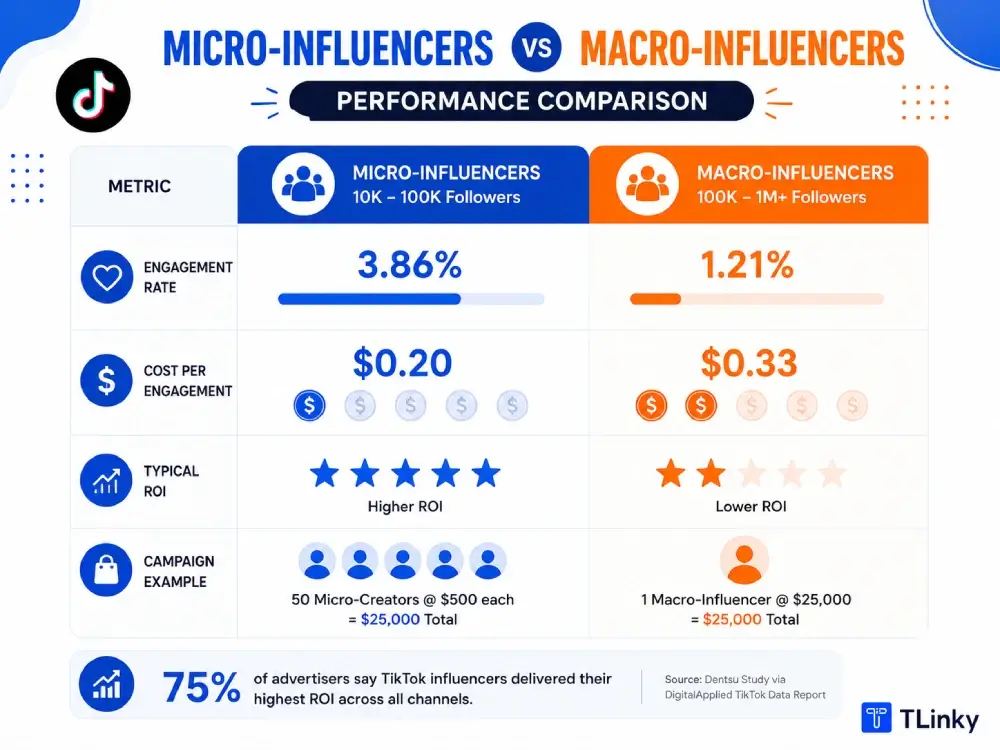
The data is clear on this point. Micro-influencers (10,000 to 100,000 followers) generate an average engagement rate of 3.86% compared to 1.21% for mega-influencers with over 1 million followers, per House of Marketers. Their audiences trust them more because they feel like peer recommendations rather than paid endorsements.
The cost efficiency is also significant. Micro-creators cost $0.20 per engagement compared to $0.33 for macro-influencers, a 40% efficiency gap. A campaign with 50 micro-creators at $500 each typically outperforms a single $25,000 macro deal on both engagement and attributed sales for TikTok Shop and direct-to-consumer brands.
75% of advertisers say TikTok influencers delivered their highest ROI across all channels, according to a Dentsu study cited in DigitalApplied’s 2026 TikTok data report.
Finding the Right Creators
TikTok’s Creator Marketplace (inside TikTok Ads Manager) lets you search creators by category, audience size, engagement rate, location, and audience demographics. You can view a creator’s average views per post, engagement trends, and audience breakdown before reaching out.
For faster discovery, use TLinky’s TikTok Influencer Finder to surface relevant creators in your niche without manually searching the Creator Marketplace.
TLinky’s TikTok influencers guide explains how to evaluate creator fit beyond follower count, including niche alignment, audience quality, and content style match.
What to Brief Creators On
Effective creator briefs are short and specific. Provide: the product’s core benefit, the one outcome you want viewers to remember, any claims they cannot make, your brand hashtag, and whether they should link to your TikTok Shop or bio page. Do not script the video. Over-scripted content looks like an ad rather than a recommendation, and TikTok audiences reject it quickly.
User-Generated Content as a Strategy
UGC (content created by real customers) is among the most trusted content formats on TikTok. A customer unboxing video, a genuine product review, or a before-and-after result drives higher conversion than branded content in almost every product category.
Build UGC into your strategy deliberately: encourage it through packaging inserts, post-purchase email follow-ups, and community challenges. When a customer creates content about your product, engage with it publicly. Stitch it, duet it, or pin it to your profile.
Analytics, Measurement, and Link Tracking
The biggest mistake in TikTok marketing is optimizing for vanity metrics: views and follower count. These numbers look impressive in screenshots and tell you very little about business impact.
For a full breakdown of TikTok’s native analytics tools, TLinky’s TikTok analytics guide covers every metric and how to interpret it.
Content Performance Metrics
Video completion rate: The percentage of viewers who watch your entire video. A completion rate above 60% is strong. Below 30% typically signals a hook problem.
Re-watch rate: Available in TikTok Analytics under Video Insights, this is the platform’s primary trust signal in 2026. Track it consistently.
Shares: Divided by video views, shares reveal how share-worthy your content is. Content shared via DMs reaches a new audience without any paid spend.
Saves: Saves indicate your content has enough practical value that viewers want to return to it. Tutorial and list-based content consistently earns the highest save rates.
Profile visits from a video: This tells you which pieces of content are strong enough to make viewers want to know more about your brand. It is a critical awareness conversion signal.
Paid Campaign Metrics
Cost Per Click (CPC): What you pay each time someone clicks your link. TikTok CPC typically ranges from $0.50 to $2.00, depending on industry and targeting.
Cost Per Acquisition (CPA): The total cost to generate one customer, lead, or conversion. This is your true paid media ROI metric.
Return on Ad Spend (ROAS): Revenue generated divided by ad spend. A ROAS above 3x is generally considered strong for direct-response campaigns.
Video View Rate at 2 Seconds and 6 Seconds: These micro-metrics reveal exactly where in the video you are losing viewers.
Closing the Attribution Gap with Link Tracking
TikTok’s native analytics do not tell you what happens after someone leaves the app. For that, you need tracked links.
Every URL you place in your bio, TikTok Shop, or ad creative should be a trackable short link so you can see which videos, campaigns, and creators are driving clicks and conversions. See TLinky’s guide to tips for creating effective short URLs for how to set up proper UTM tracking for your TikTok campaigns.
For offline-to-online campaigns (product packaging, event signage, print materials that connect to your TikTok content), branded QR codes give you the same attribution power. Each QR code can point to a unique destination, making it straightforward to measure which physical placements are driving scans and traffic. TLinky’s guide on benefits of QR codes for business covers practical setup for this use case.
TikTok Marketing for B2B Brands
A common assumption: TikTok is only for consumer brands. The data does not support this.
B2B decision-makers use TikTok. The platform reaches buyers who are not in active consideration mode, building brand familiarity that warms later LinkedIn touches and sales calls. TikTok creates brand associations that shorten the sales cycle even when the final conversion happens on a different channel.
What Works for B2B on TikTok
Expert-led education: Short explainers on industry problems, misconceptions, or best practices. Position your company’s experts as the most trustworthy voice on a specific topic. This is the B2B equivalent of thought leadership, delivered in 60-second increments.
Behind-the-scenes process content: Show how your product is built, how your service is delivered, or how your team solves hard problems. This builds credibility with buyers evaluating vendors at an early research stage.
Founder and executive content: Executives who post on TikTok consistently reach audiences their brand account never would. Authentic individual voices outperform corporate brand channels in B2B contexts because they feel human rather than institutional.
Customer proof: Short testimonials, case studies in video form, or reaction clips of customers seeing results. Buyer confidence is the primary barrier in B2B sales, and social proof reduces it faster than any white paper or case study PDF.
B2B Lead Generation on TikTok
TikTok is the awareness and interest layer for most B2B funnels. The conversion (a demo request, form fill, or sales call) typically happens off-platform. This makes link tracking essential: every TikTok video driving traffic to your site or landing page should use a tracked short link so you can attribute leads to specific content.
TikTok’s Lead Generation objective in Ads Manager lets you collect contact information directly in the app via pre-filled forms, eliminating the drop-off that happens when users click through to an external landing page.
Staying Current with TikTok Trends
One of TikTok’s defining characteristics is how quickly trends emerge, peak, and saturate. A sound, a visual format, a challenge, or a meme that is dominating the For You Page today may be exhausted in 72 hours.
The brands that do well on TikTok are not the ones reacting to trends. They are the ones identifying them early enough to publish before saturation sets in. Early trend participation earns disproportionate algorithmic rewards: the same content posted three days early can out-distribute the same content posted one day late.
Use TLinky’s TikTok Trend Tracker to monitor rising trends, trending sounds, and emerging content formats in your category before they peak.
For a curated look at the formats and topics driving the most engagement across categories, TLinky’s TikTok trends guide is updated regularly.
Frequently Asked Questions
How much does TikTok marketing cost in 2026?
Costs depend on your approach. Organic content costs only time and equipment. Paid ads start at $20 per day at the ad group level. Micro-influencer partnerships typically range from $200 to $2,000 per post, depending on audience size and category. TikTok Shop affiliate partnerships cost nothing upfront; you pay a commission only on completed sales.
Does TikTok marketing work for small businesses?
Yes. TikTok’s algorithm distributes content based on quality and relevance, not follower count or budget. A small business with zero followers can reach millions with a single well-made video. TLinky’s TikTok ideas for small businesses guide covers the content formats that work best for smaller brands with limited resources.
What is TikTok SEO and why does it matter?
TikTok SEO is the practice of optimizing your video content, captions, on-screen text, and spoken audio so that your videos appear in TikTok’s search results for relevant queries. It matters because more than 60% of younger users now search on TikTok before making a purchase decision, per Hootsuite research. Brands that do not optimize for TikTok Search are invisible to a large segment of their target audience.
How do you measure TikTok marketing ROI?
Track performance across three levels: content performance (completion rate, shares, saves), paid campaign performance (CPA, ROAS, video view rate at 2 and 6 seconds), and business impact (website traffic from TikTok, conversions attributed to TikTok, TikTok Shop revenue). Use trackable short links on every URL in your bio and ads to close the attribution gap between TikTok activity and business outcomes.
Is influencer marketing on TikTok worth it?
Yes, particularly with micro-influencers. Creators with 10,000 to 100,000 followers drive average engagement rates of 3.86% compared to 1.21% for mega-influencers, at 40% lower cost per engagement, per data from House of Marketers. The average ROI across influencer-driven TikTok campaigns is $5.78 for every $1 spent, according to Influencer Marketing Hub’s 2026 Benchmark Report. TikTok Shop integration gives TikTok a structural advantage in conversion-focused influencer campaigns because purchases happen without leaving the app.
What is the biggest mistake brands make with TikTok marketing?
The biggest mistake brands make with TikTok marketing is treating it like traditional advertising. Polished, sales-heavy content often underperforms. TikTok users respond better to authentic, entertaining, and useful videos that match the platform’s style, follow trends naturally, and encourage genuine engagement instead of focusing only on promotions.
How long does it take to see results from TikTok marketing?
Most brands see early signals such as views, engagement, and follower growth within days or weeks. Meaningful business results like consistent traffic, leads, or sales usually take 2 to 6 months of regular posting, audience testing, and content improvements. Success depends on content quality, consistency, audience fit, and your marketing goals.
Conclusion
TikTok marketing in 2026 covers the full funnel: organic content strategy, search optimization, paid amplification, in-app commerce, creator partnerships, and attribution infrastructure.
Brands that approach it as a serious channel, with documented strategy, consistent publishing, and proper measurement, consistently outperform those treating it as an experiment.
Five things define successful TikTok marketing right now. First, you need algorithm-first thinking, understanding that re-watch rate, shares, and engagement velocity drive distribution more than follower count or post frequency.
Second, TikTok SEO is now as important as your content calendar.
Third, TikTok Shop integration shortens the path from discovery to revenue.
Fourth, micro-influencer partnerships consistently outperform celebrity deals on both engagement and ROAS. Fifth, proper link tracking closes the attribution gap between TikTok activity and business results.
The opportunity is real. Only 26% of marketers are currently running TikTok campaigns. That gap will not stay open indefinitely. Start with one content pillar, publish consistently, track everything, and build from there.
Source & Reference:
Hootsuite’s TikTok marketing research
eMarketer TikTok Shop Social Commerce research
Business of Apps TikTok Revenue data