
Posting time on TikTok is one of the most searched and most misunderstood topics in content strategy.
Third-party tools publish confident-sounding charts. Most of them are based on aggregated data from other accounts, not yours.
The honest answer is that no universal “best time” applies to every account. The best time to post on TikTok is when your specific followers are most active. TikTok tells you that directly, inside the Analytics dashboard.
This guide covers what the research says about general posting windows, how to read your own follower activity data, and what actually has more impact on reach than timing.
In this guide, you will learn:
- What general posting windows tend to perform well across TikTok
- How to use TikTok Analytics to find the best time for your specific account
- Why posting time matters less than most creators think
- What factors actually drive distribution more than timing
- How to build a posting schedule around your audience’s behavior
Get Free TikTok Ad Credit Up to $6000 [Limited Time Offer]

Key Takeaways
- TikTok’s algorithm can distribute content hours or days after posting, which reduces the impact of timing compared to real-time platforms like Twitter/X
- The highest-impact factor for early distribution is whether your initial viewer cohort engages; posting when your followers are active improves this Phase 1 signal
- TikTok Analytics’ Followers tab shows your specific audience’s activity pattern by hour and day. This is more reliable than any published “best times” list
- General data consistently shows higher engagement midweek (Tuesday through Thursday) and during evening hours in the poster’s target timezone
- Consistency of schedule matters more than precision of timing, as posting at a predictable cadence trains your audience to expect your content
When Is the Best Time to Post on TikTok?
Based on patterns across TikTok content performance, videos posted between 7 PM and 9 PM local time in your target audience’s timezone tend to see stronger initial engagement than off-peak times. Tuesday, Wednesday, and Thursday evenings consistently show above-average performance. However, your account’s specific best time is visible in TikTok Analytics under the Followers tab, where you can see exactly when your followers are most active by hour and day.
Does Posting Time Actually Matter on TikTok?
How TikTok’s Distribution Model Works
Unlike platforms where content appears chronologically, TikTok distributes content through a recommendation algorithm.
A video posted at 11 PM can receive its largest traffic spike the following morning, or even two days later, depending on how it performs in each distribution wave.
TikTok’s cohort testing model works in stages: your video is first shown to a small test group (which often includes your existing followers), and if that group engages positively, the video is pushed to progressively larger audiences.
The timing of your post affects the composition and responsiveness of that first test group, not the algorithm’s overall capacity to distribute the content.
Posting when your followers are active gives you a better first cohort. A highly engaged first cohort triggers wider distribution.
In that sense, timing matters, but it matters as an input to your first wave of engagement, not as a direct signal to the algorithm.
The TikTok algorithm guide covers the cohort testing model in full detail.
What Matters More Than Posting Time
These factors have a larger impact on reach than the hour you post:
Completion rate: How many viewers watch your video to the end. This is TikTok’s strongest quality signal. A video posted at the “wrong” time with a 75% completion rate will outperform a video posted at the “right” time with a 30% completion rate in every distribution wave after the first.
Hook quality: Whether viewers commit to watching past the first three seconds. The 3-second hook guide covers this in detail.
Consistency of posting: Accounts that post on a regular schedule develop an audience expectation. TikTok’s algorithm also learns your posting patterns and adapts distribution accordingly. An account that posts every Tuesday and Thursday at 7 PM builds a more responsive initial audience than one that posts unpredictably.
Niche authority: Consistent posting in a specific topic area builds topical signals that affect how TikTok categorizes and distributes your content. This is a longer-term factor but more durable than timing optimization.
General Best Times to Post on TikTok
The following windows reflect patterns from published content performance research. These are starting points, not guarantees; your personal TikTok Analytics data is always more accurate for your account.
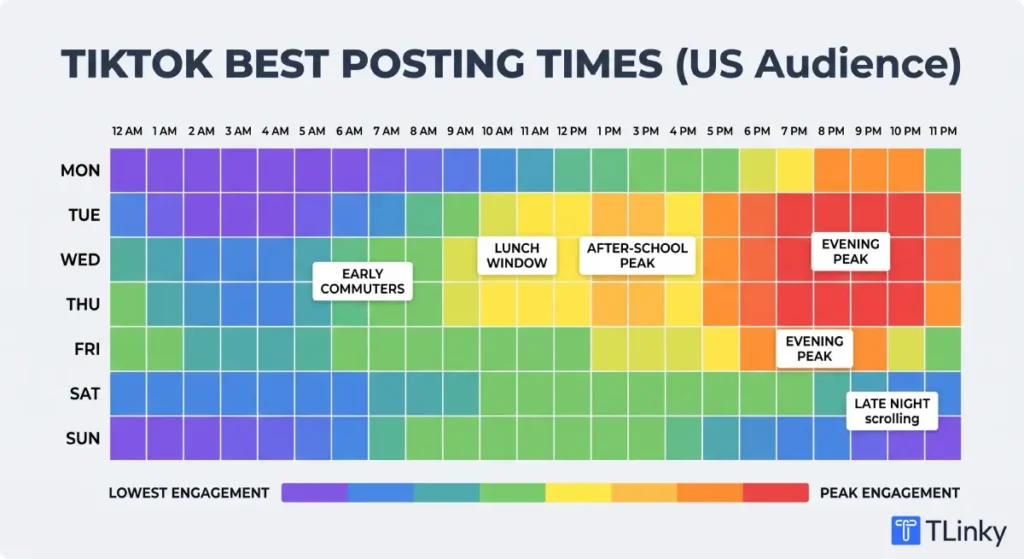
By time of day (all times local to your target audience’s timezone):
- Early morning (6 AM to 9 AM): active for commuters and early risers, lower competition from other creators posting at this time
- Lunch window (11 AM to 1 PM): break-time scrolling behavior drives midday engagement spikes
- Late afternoon (3 PM to 5 PM): school dismissal and post-work transition window creates a secondary traffic peak
- Evening (7 PM to 10 PM): consistently the highest-traffic window across most audience categories, peak leisure time for most demographics
- Late night (10 PM to midnight): active for younger audiences (18 to 24), lower content volume from most brands and creators
By day of week:
- Tuesday, Wednesday, and Thursday: midweek consistently outperforms weekend days for most professional and educational content
- Friday evening: strong for entertainment and lifestyle content as audiences shift into weekend mode
- Saturday and Sunday: lower overall engagement for B2B and professional content; stronger for entertainment, travel, food, and personal lifestyle niches
- Monday morning: consistently the weakest window for most account types; audiences are typically less likely to engage deeply with content at the start of the work week
By audience demographic:
According to Pew Research Center data, 63% of adults aged 18 to 29 use TikTok; this demographic tends to be most active in the evening hours. Adults aged 30 to 49 (44% TikTok usage rate) skew toward commute-time and lunch-window activity. Teen users (68% of 13 to 17-year-olds on TikTok) are most active in the after-school window and late evening.
How to Find Your Best Posting Time in TikTok Analytics
This is the most reliable method. TikTok shows you exactly when your own followers are active, no third-party tool required.
Step 1: Open TikTok Analytics
On mobile: Go to your profile → tap the three horizontal lines → Creator Tools → Analytics. On desktop: Log in at business.tiktok.com → Analytics in the left sidebar.
You need a Creator or Business account to access Analytics. The TikTok Analytics guide covers switching accounts and navigating the dashboard in full detail.
Step 2: Go to the Followers Tab
Select the Followers tab from the Analytics navigation. Scroll down to the section labeled “Follower Activity.”
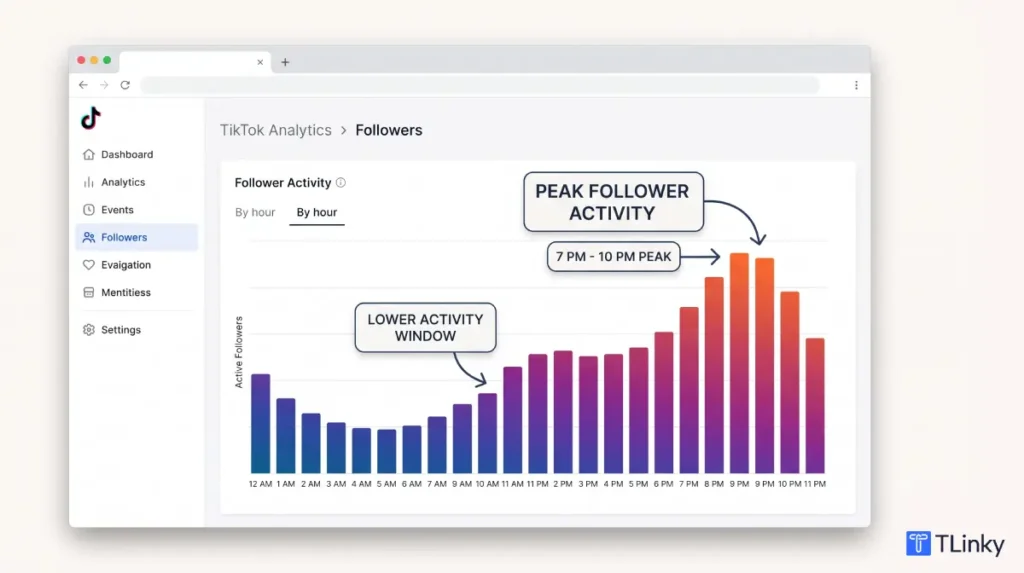
Step 3: Read the Activity Chart
The Follower Activity chart shows two data views:
By hour: A bar chart showing the relative activity level of your followers at each hour of the day. The tallest bars are your highest-activity hours. These are the hours when your content is most likely to reach engaged followers in its first distribution wave.
By day: A weekly view showing which days your followers are most active overall. The hours and days with the highest bars are your account-specific best times. Write these down and build your posting schedule around them.
Step 4: Consider Your Timezone
The Follower Activity chart displays times in your account’s set timezone, not necessarily the timezone where most of your followers live. If your account is set to EST but most of your followers are on the West Coast (PST), adjust your posting times accordingly.
Check the “Top Territories” section in the same Followers tab to see where your audience is geographically concentrated.
Building a Posting Schedule Around Your Data
Match Posting Time to Your Follower Activity Peak
Once you have identified your two or three highest-activity hours, build your posting schedule around those windows. Aim to publish content 30 to 60 minutes before your follower activity peak; this gives the video time to begin loading and indexing before the highest-traffic window begins.
Maintain a Consistent Cadence
TikTok’s recommendation system learns from patterns. Accounts that post consistently, on the same days, roughly the same time windows, develop a more predictable initial audience response. This does not mean rigid precision (posting exactly at 7:03 PM every Tuesday), but it does mean building a schedule and sticking to it within a reasonable window.
A realistic posting cadence for most accounts:
- Minimum: 3 to 4 times per week to maintain algorithmic visibility
- Optimal for growth: daily posting if content quality can be maintained
- For brands: 4 to 5 times per week across a mix of formats (shoppable video, educational, entertainment)
Test and Refine Over Time
Your audience’s activity patterns change over time, seasonally, as your account grows, and as your audience demographic shifts. Review your Follower Activity data once per month and adjust your schedule if the peak windows have shifted.
Compare posts made at different times to see whether timing is actually affecting your early retention and FYP traffic percentage.
In most cases, you will find that content quality has more variance than timing; a strong video at a suboptimal time still outperforms a weak video at a perfect time.
Time Zone Considerations for Global Audiences
If your TikTok content targets a specific country (for example, a US-based e-commerce brand targeting US buyers), post in the target audience’s timezone, not your own, if you are based elsewhere.
If your content reaches a genuinely global audience, for example, entertainment or humor content that crosses language barriers, there is no single optimal timezone. In this case, focus on engagement quality over timing, since TikTok’s algorithm will distribute high-completion content across time zones regardless of when it was posted.
How Posting Frequency Interacts With Timing
Frequency and timing work together. Posting once per week at the “perfect” time will not compensate for infrequent posting. TikTok’s algorithm needs enough content to learn what your account produces and who to distribute it to.
Accounts that post more frequently build stronger algorithmic profiles faster. TikTok has more data to work with, can categorize your content more accurately, and can match it to the right audience cohort more reliably.
The risk of high-frequency posting is a drop in content quality. A lower volume of high-completion-rate videos will consistently outperform a higher volume of low-retention videos.
If you can only maintain quality at three posts per week, three high-quality posts outperform seven mediocre ones.
FAQs
Does it matter if I post on the TikTok app vs. schedule through a third-party tool?
TikTok has its own built-in scheduling feature available in the Creator Center, which allows you to schedule posts natively up to 10 days in advance. Native scheduling is always preferable to third-party tool uploads since it uses TikTok’s own infrastructure. Whether native scheduling affects algorithmic distribution compared to direct posting is not officially confirmed by TikTok, but many creators report consistent results using the native scheduler.
Should I delete and repost if I posted at the wrong time?
Generally, no. Deleting a post removes its existing engagement, shares, and comment data permanently. If a video is underperforming due to timing, it is better to wait 24 to 48 hours and see whether a later distribution wave picks it up. TikTok’s algorithm can resurface content after an initial slow period if it encounters a strong engagement signal. Reposting the same content also risks being flagged as duplicate, which can suppress distribution.
Does posting at 3 AM ever work?
For US-based creators targeting a US audience, late-night posting (1 AM to 5 AM) sees the lowest follower activity and typically produces weaker first-wave engagement. However, some niches, particularly content targeting night-shift workers, insomnia audiences, or international time zones, may find late-night posting effective. Check your Follower Activity data before assuming this window is universally bad for your account.
How long does TikTok’s algorithm take to distribute a video after posting?
Most of a video’s distribution happens in the first 24 to 48 hours after posting, with the largest traffic spike typically within the first 6 hours if the content performs well. However, TikTok can resurface content weeks or months later if it encounters a new engagement signal; for example, a single comment from a large account can restart distribution. This delayed-distribution behavior is what makes TikTok’s platform different from time-sensitive platforms where old content becomes essentially invisible.
Does the best time to post change for paid TikTok ads?
For paid campaigns in TikTok Ads Manager, you can control ad delivery schedule manually or allow TikTok to optimize delivery automatically. TikTok’s Dayparting feature lets you restrict ads to specific hours of the day. For most conversion campaigns, allowing TikTok’s automated delivery to find your best-performing windows outperforms manual time selection, since the ad algorithm has broader data than your organic analytics provide.
Wrapping Up
The best time to post on TikTok is the time when your specific followers are most active, and TikTok shows you that data directly in the Followers tab of Analytics.
Third-party charts are a reasonable starting point if you are new to the platform and have no Analytics data yet, but should be replaced with your own account data as soon as you have a meaningful follower base to measure.
More importantly, timing is an amplifier, not a foundation. A weak video posted at the optimal time is still a weak video. Prioritize hook quality, completion rate, and consistent posting cadence. Optimize timing on top of that foundation.
For the content strategy that determines what you post, the organic TikTok strategy guide covers the full planning framework. For the analytics skills to read your retention and traffic data, the TikTok Analytics guide covers every metric that matters.
Sources
- TikTok Analytics, Followers Tab, Follower Activity
- TikTok Creator Academy, Growing Your Audience
- Pew Research Center, “8 Facts About Americans and TikTok,” March 2026