Most TikTok ad formats work from scratch: you upload new creative, target an audience, and pay for distribution.
Spark Ads work differently. Instead of creating a new ad, you amplify an organic post that already exists on TikTok, keeping the original engagement, profile attribution, and social proof intact.
That distinction changes how the content feels to viewers and how the engagement compounds over time.
In this guide, you will learn:
- What Spark Ads are and how they differ from standard in-feed ads
- What advertising objectives Spark Ads support
- How to use your own posts and creator content in Spark campaigns
- When Spark Ads make strategic sense over other ad formats
- How to set up a Spark Ad in TikTok Ads Manager
Get Free TikTok Ad Credit Up to $6000 [Limited Time Offer]

Key Takeaways
- Spark Ads are a native ad format that amplifies existing organic TikTok posts rather than running separate ad creative
- All engagement from a Spark Ad, including likes, comments, shares, and follows, is attributed to the original organic post, not a standalone ad
- You can run Spark Ads on your own account’s posts or on creator posts, with their authorization
- Spark Ads support eight advertising objectives, including Sales, Conversions, Lead Generation, and Video Views
- Engagement persists on the original post after the campaign ends, building lasting social proof
What Are TikTok Spark Ads?
According to TikTok’s official Business Help Center, Spark Ads are a native ad format that allows advertisers to leverage organic TikTok posts in their advertising. All views, comments, shares, likes, and follows gained during the promotion are attributed to the original organic post, not to a separate ad unit. Brands can boost their own posts or run Spark Ads on creator content with the creator’s authorization.
How Are Spark Ads Different from Regular In-Feed Ads?
A standard TikTok in-feed ad is a purpose-built ad creative. It appears in the feed, generates metrics tracked in Ads Manager, and leaves no trace on any organic account once the campaign ends. Engagement on a standard ad does not accumulate on your TikTok profile.
A Spark Ad is the reverse. According to TikTok’s official Spark Ads documentation, all engagement generated by a Spark Ad, such as likes, shares, comments, and new followers, is attributed to the original organic post.
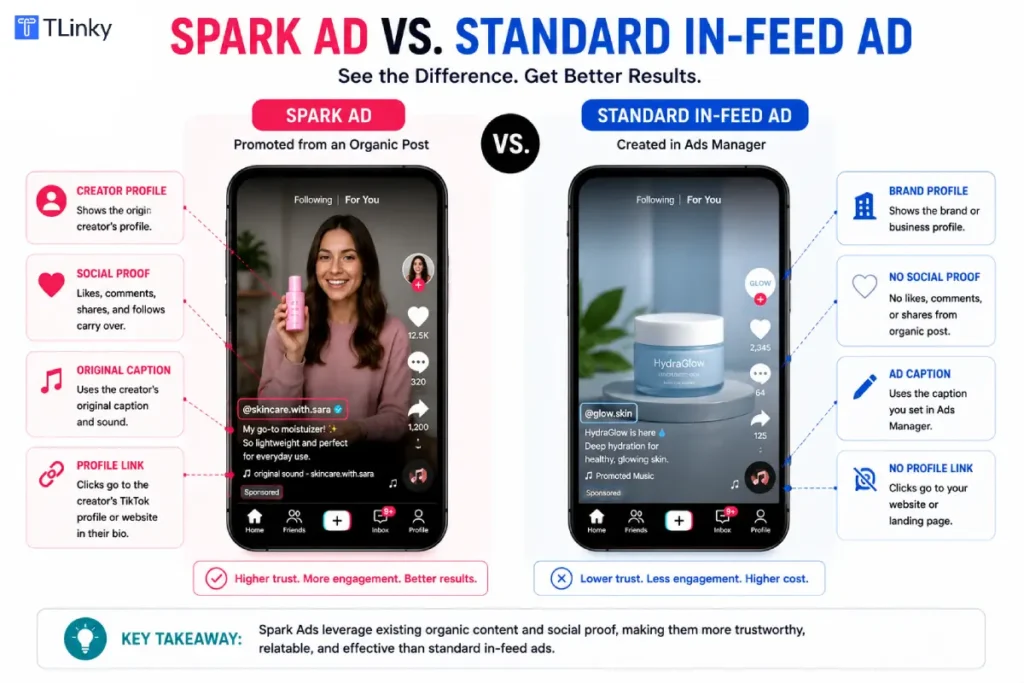
When the campaign ends, that engagement stays on the post. Your profile gains followers, the comment thread continues, and the social proof compounds. The user experience also differs.
With a Spark Ad, viewers can:
- Click the creator’s profile photo or username and land on the organic account
- Tap the “+” on the profile photo to follow the account directly
- Click the music disc and go to the sound page
- Duet or Stitch the original post (if enabled)
A non-Spark in-feed ad does not enable profile follows or music engagement in the same way.
What Advertising Objectives Do Spark Ads Support?
According to TikTok’s Business Help Center, Spark Ads support the following objectives:
Auction buying type: Reach, Traffic, Video Views, Community Interaction, App Promotion, Conversions, Lead Generation, and Sales.
Reach and Frequency buying type: Reach, Traffic, and Video Views.
This covers the full funnel, from awareness (Reach, Video Views) to consideration (Traffic, Community Interaction) to conversion (Conversions, Lead Generation, Sales, App Promotion). Spark Ads are not limited to awareness campaigns, which is a common misconception.
Can You Run Spark Ads on Creator Content?
Yes. TikTok’s Spark Ads system supports two post sources:
Your own account’s posts. Any video published from your TikTok business or creator account can be turned into a Spark Ad. The original post stays on your profile, and all campaign engagement is attributed to it.
Organic posts from other creators. With a creator’s authorization, you can run a Spark Ad on their organic content. TikTok generates an authorization code with a customizable duration. The creator controls how long the authorization is active and can revoke it. The campaign engagement goes to the creator’s post.
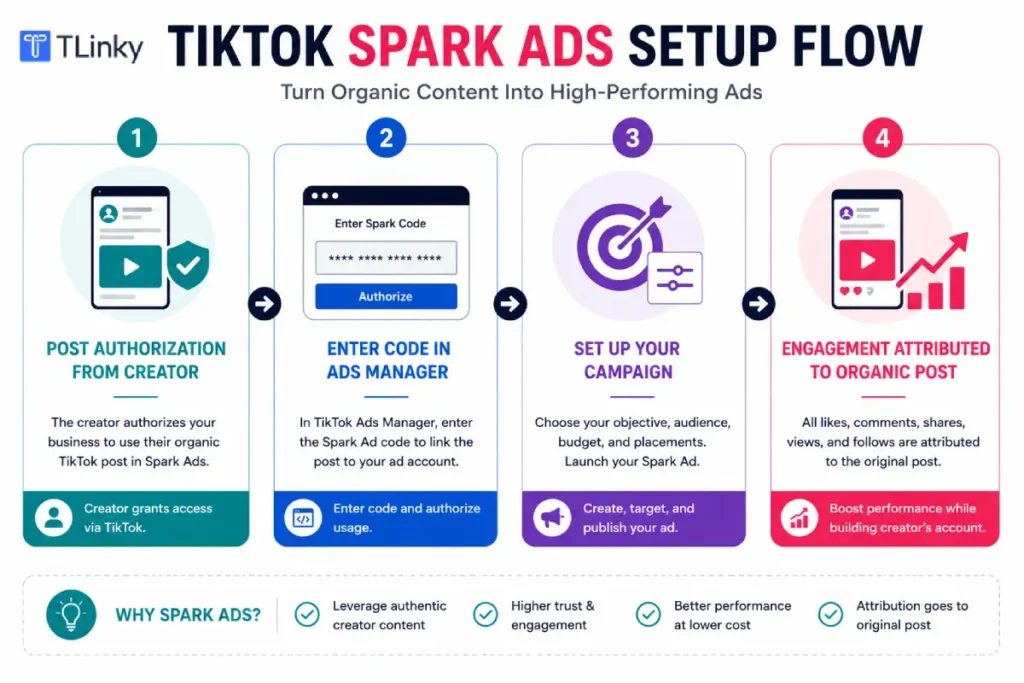
This second option is how brands work with TikTok creators for paid collaborations without producing separate ad creative.
The creator’s original video, with its existing engagement, comments, and audience connection, becomes the ad unit. It is more credible than a produced brand video because it started as genuine content.
For finding the right creators for this type of collaboration, the TikTok Influencer Finder helps identify creators with audiences that match your product category.
What Are the Technical Specifications for Spark Ads?
TikTok’s official Spark Ads documentation specifies:
- No restrictions on video ratio, resolution, file type, or bitrate for organic posts used in Spark Ads
- Maximum video duration: 10 minutes
- Up to 10,000 Spark Ads per TikTok Ads Manager account
- Posts that have been banned on TikTok are automatically rejected in Ads Manager
- A video must be unauthorized as a Spark Ad before it can be deleted from the organic account
- Ad captions can be left blank; account tagging, emoji, and hashtags are allowed
Why Use Spark Ads Instead of Standard In-Feed Ads?
The case for Spark Ads is rooted in what happens after the campaign ends. With a standard in-feed ad, the engagement disappears when you stop paying.
With Spark Ads, every like, comment, share, and new follower stays on your organic post permanently.
This creates compounding value. A video boosted as a Spark Ad with 4,000 comments and 80,000 likes shows those numbers to every future viewer of that post, whether paid or organic.
High engagement counts increase viewer trust before they have watched a single second of the video. For conversion-oriented content, that social proof layer is meaningful.
Spark Ads also perform differently in the feed. Because they link back to an organic account profile, viewers who click through can see your full content library, follow your account, and engage with other posts. A standard in-feed ad’s click goes directly to a landing page and ends there.
The strategic fit for Spark Ads is clear: if you have an organic video that is already performing well, with a strong completion rate, high save rate, and active comment thread, amplifying it as a Spark Ad compounds what is already working. If your organic content is not performing, a Spark Ad will not fix the underlying content problem.
The TikTok Ads Manager guide covers the full campaign setup workflow, including how Spark Ads fit into broader campaign structures.
When Should You Use Spark Ads vs. Standard In-Feed Ads?
Use Spark Ads when:
You have an organic video that has already demonstrated strong engagement signals, such as a good completion rate, saves, and comments. Amplifying proven content is more efficient than paying for distribution on unvalidated creative.
You want engagement to build your organic profile long-term. If growing your follower count, building comment-thread social proof, or adding to your music clicks matters for your brand, Spark Ads produce those outcomes and retain them.
You are running a creator collaboration. Instead of producing separate ad creative, authorize the creator’s original post as a Spark Ad. It is more authentic and typically earns stronger engagement because the content was designed for the creator’s audience.
Use standard in-feed ads when:
Your content is purely promotional and would not naturally earn organic engagement. Standard in-feed ads give you more control over the creative and do not require an organic post to exist first.
You want to test a new creative format quickly without affecting your organic post metrics. In some testing scenarios, keeping ad performance isolated in Ads Manager metrics is useful.
You need ad creative that would not be appropriate to live permanently on your organic profile.
How to Set Up a Spark Ad in TikTok Ads Manager
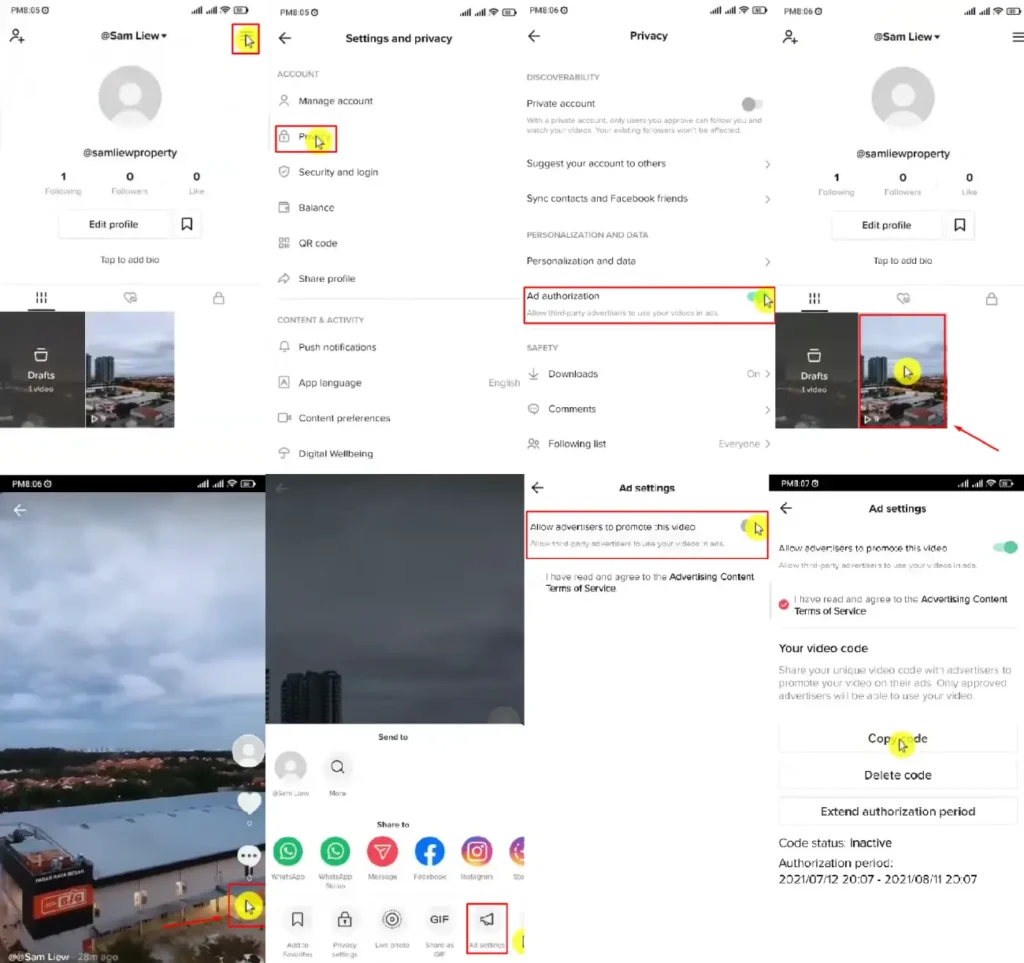
Setting up a Spark Ad requires a post authorization code, which you generate from the organic TikTok account that published the post.
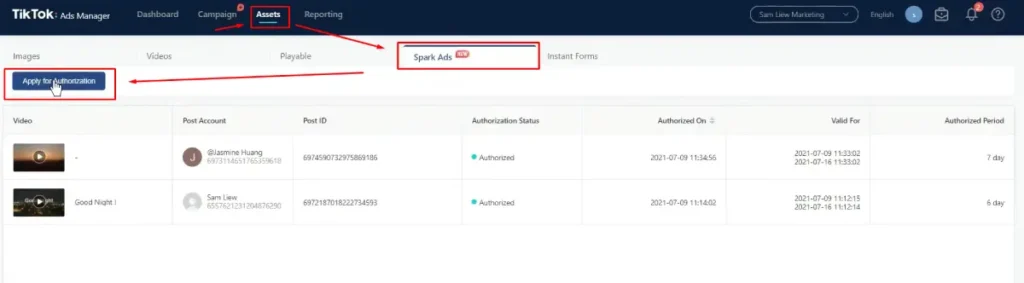
Step 1: Log in to the TikTok account whose post you want to boost. Go to Settings → Privacy → Ad Authorizations (or the equivalent path in your app version). Generate an authorization code for the specific post you want to spark. Set the duration (customizable to match your campaign window).
Step 2: Log in to TikTok Ads Manager. Create a new campaign, select your objective, and proceed to ad group setup.
Step 3: At the ad level, select “Spark Ads” as your ad format. Enter the authorization code from Step 1. TikTok will pull in the organic post as your ad creative.
Step 4: Complete your targeting, budget, and schedule settings. Because the creative is the organic post, you do not need to upload new assets.

Step 5: Launch the campaign. Monitor performance in Ads Manager using Spark Ads-specific metrics: paid followers, paid profile visits, music clicks, and anchor click rate alongside standard metrics like CTR and CPA.
For creator-authorized Spark Ads, the creator generates the authorization code from their account settings and shares it with you. The process is otherwise the same.
What Metrics Are Unique to Spark Ads?
TikTok’s official documentation lists several metrics that only apply to Spark Ads and are not tracked for standard in-feed ads:
Paid followers: New followers gained within one day of a user seeing the Spark Ad.
Paid profile visits: Profile visits driven by the campaign.
Music clicks: Clicks on the music disc icon or music title within the ad.
Anchor clicks and anchor click rate: Clicks on any anchor link embedded in the Spark Ad video.
These metrics reflect the expanded user interaction model that Spark Ads enable, meaning users can go beyond the ad itself and into your TikTok ecosystem during the campaign.
FAQs
Do Spark Ads cost more than standard in-feed ads?
Spark Ads are priced through the same auction system as standard in-feed ads. There is no inherent premium for using the Spark format. Your CPM, CPC, and CPA will vary based on your targeting, audience competition, and campaign objective, rather than on whether you chose Spark or non-Spark.
Can I run a Spark Ad on a video that has low views?
Technically yes, but the strategic benefit is reduced. Spark Ads gain their main advantage from amplifying content that already has social proof, such as existing likes, comments, and shares. Boosting a video with zero engagement means there is no pre-existing social proof to leverage. You are essentially running a standard ad, just with a slightly different profile behavior. Use Spark Ads on content that has already demonstrated engagement quality organically.
What happens to my Spark Ad campaign if I delete the original post?
According to TikTok’s official documentation, a video must be un-authorized as a Spark Ad before it can be deleted from the organic account. If you delete the post while a Spark Ad campaign is running, the campaign will be disrupted. Deactivate the authorization before removing the organic post.
Can I edit the creative in a Spark Ad?
TikTok Ads Manager includes a text edit feature for Spark Ads that allows some caption adjustments. However, the ad’s display name and core video content reflect the chosen organic post and cannot be substantially altered. The video itself remains as the creator originally published it.
Do comments on a Spark Ad appear on the original organic post?
Yes. Because Spark Ads are amplified versions of organic posts, all paid comments appear in the original post’s comment thread and remain there after the campaign ends. This is one of the reasons Spark Ads build more visible social proof than standard in-feed ads.
Wrapping Up
Spark Ads occupy a specific, valuable role in TikTok advertising: they are the format to use when you have organic content worth amplifying.
The engagement persists, the social proof compounds, and the viewer experience is closer to organic content than any standard ad format.
The simplest rule of thumb: if a video is already performing well organically, with a strong completion rate, saves, and comment engagement, it is a candidate for Spark Ads. If it is not performing organically, fixing the content quality is a more effective use of budget than paying to amplify a weak signal.
For a complete view of how Spark Ads fit into paid TikTok strategy, the TikTok Ads Manager guide covers campaign structure across all ad formats. The TikTok advertising cost guide explains how budget and bidding interact with different ad types.
Sources