The first three seconds of your video determine whether anyone sees the rest of it. On TikTok, Instagram Reels, and YouTube Shorts, the algorithm measures how quickly viewers swipe away.
A video that loses people in the opening seconds gets buried. One that grabs attention earns wider distribution.
That opening moment is your hook, and understanding how to write one is the most important skill in short-form video content.
In this guide, you will learn:
- What a 3-second hook is and why it controls your video’s algorithmic reach
- The five main types of hooks and when to use each
- Proven hook formulas that work across niches
- How to write hooks for different content goals: education, entertainment, and product sales
- How to test and improve your hooks using analytics data
Get Free TikTok Ad Credit Up to $6000 [Limited Time Offer]

Key Takeaways
- A 3-second hook is the opening moment of a short-form video designed to stop a viewer from swiping and commit them to watching
- TikTok’s algorithm uses early viewer retention as a key distribution signal; videos that lose viewers in the first few seconds receive less reach
- The most effective hooks create an open loop: they imply a payoff the viewer has not received yet
- A hook works on three simultaneous layers: visual, verbal (spoken words), and text overlay; all three should reinforce each other
- Testing multiple hook variations on the same core content is the fastest way to identify what works for your specific audience
What Is a 3-Second Hook?
A 3-second hook is the opening of a short-form video: the first visual, spoken words, and on-screen text that appear before a viewer decides to keep watching or swipe away. An effective hook creates immediate curiosity, tension, or relevance that gives the viewer a reason to stay. On TikTok, Reels, and Shorts, where swiping to the next video takes less than a second, the hook is the single most important element of any video.
Why Do the First 3 Seconds Matter So Much?
How TikTok’s Algorithm Uses Early Retention Data
TikTok’s recommendation system evaluates each video’s performance during an initial test period. According to TikTok’s creator resources, watch time and completion rate are among the primary signals the algorithm uses to decide how widely to distribute a video.
When a video loses a large percentage of its viewers in the first two to three seconds, the algorithm interprets this as a signal that the content is not relevant or compelling to that audience; distribution narrows.
When a video retains a high percentage of its opening viewers past the first few seconds, the opposite happens: the algorithm sees a positive engagement signal and pushes the content to a wider audience.
Your hook is not just a creative choice. It is a direct input into TikTok’s distribution model.
The TikTok algorithm guide covers all the distribution signals in detail. The retention curve in TikTok Analytics shows you exactly where your current videos are losing viewers, often within the first three to five seconds.
The Scroll Decision Happens Instantly
On a mobile feed, the decision to keep watching or swipe takes less than one second. Viewers do not consciously evaluate your video; they respond to a visual or auditory signal before their analytical brain engages. This means your hook must work at a gut level, not a rational one.
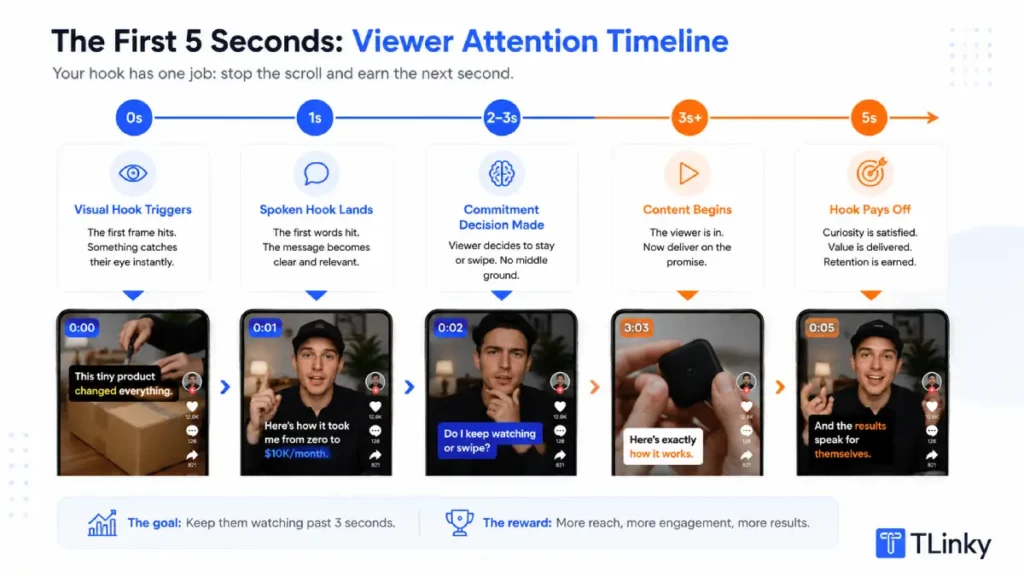
The hook needs to trigger one of three immediate responses: curiosity (“I need to know how this turns out”), self-relevance (“this is about me”), or social urgency (“everyone is talking about this”). Any of these responses stops the thumb from swiping.
The 5 Types of Short-Form Video Hooks
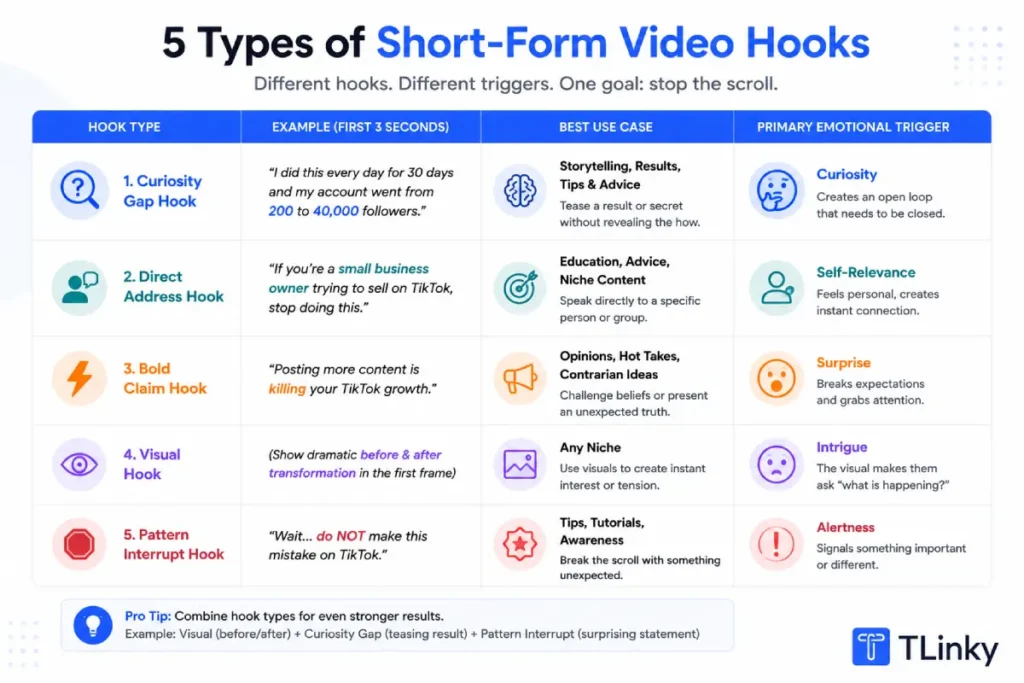
1. The Curiosity Gap Hook
The curiosity gap hook reveals part of a story or result while withholding the rest. It creates an information gap the viewer needs to close by continuing to watch.
Examples:
- “I did this every day for 30 days, and my account went from 200 to 40,000 followers.”
- “The reason your TikTok videos are stuck under 500 views has nothing to do with the algorithm.”
- “This product sold out in four hours. Here’s why.”
The key mechanic: state an outcome without explaining the cause. The cause is what keeps them watching.
2. The Direct Address Hook
The direct address hook calls out a specific person or situation, creating immediate self-relevance. Viewers who match the description feel like the video was made for them.
Examples:
- “If you’re a small business owner trying to sell on TikTok, stop doing this.”
- “This is for anyone who has ever posted a video and gotten zero views.”
- “Attention creators with under 1,000 followers.”
The key mechanic: the more specific the person you call out, the stronger the hook, even if it narrows your audience; the viewers who match feel directly spoken to.
3. The Bold Claim Hook
The bold claim hook makes a statement that challenges conventional wisdom or surprises the viewer. The boldness earns a second look.
Examples:
- “Posting more content is killing your TikTok growth.”
- “The best time to post on TikTok is not when you think.”
- “I made $8,000 from a TikTok video that took 10 minutes to film.”
The key mechanic: the claim must be genuinely surprising. A predictable statement does not create the pattern interruption that stops a scroll.
4. The Visual Hook
The visual hook uses the first frame itself, before any words, to create curiosity or tension. An unusual object, an unexpected setting, a dramatic before/after comparison, or an action mid-sequence that raises an obvious question.
Examples of visual setups that work as hooks:
- A product surrounded by cash or a dramatic result that raises the question of how
- A before/after transformation captured in the first frame
- An action already in progress that implies a story the viewer does not have context for
The key mechanic: the opening frame should raise a visual question. Viewers stay to see the answer.
5. The List or Numbered Hook
The list hook promises a specific quantity of value, setting a clear expectation that the viewer will receive multiple useful items by watching.
Examples:
- “Three things I wish I knew before running TikTok ads.”
- “Five TikTok mistakes that cost me 100,000 views.”
- “Here are seven video ideas for small businesses that actually work.”
The key mechanic: the number sets a commitment expectation. Viewers know they are getting a finite amount of content, which reduces the psychological barrier to starting.
[IMAGE: COMPARISON TABLE (5 hook types with example, best use case, and primary emotional trigger for each)]
How to Write a Hook in 3 Layers
Every effective short-form video hook works simultaneously on three channels:
Visual layer: What appears on screen in the first frame. This is what triggers the snap decision to stop scrolling before any words are processed. Consider: unusual composition, a result being shown before the explanation, or a reaction that implies a strong emotion.
Spoken layer: The first words out of your mouth or in voiceover. These should reinforce or extend the visual signal, not repeat it. If your visual shows a dramatic result, your spoken words should immediately explain why the viewer should care about it.
Text overlay layer: The on-screen text that appears in the first one to two seconds. This serves viewers who watch with sound off (a significant portion of TikTok’s audience) and also reinforces the hook for viewers with sound on. TikTok’s search algorithm also indexes on-screen text, so including your main keyword in the first text overlay serves double duty.
A weak hook usually fails on at least one of these layers. A strong hook creates alignment: all three channels point toward the same question or promise.
Hook Formulas That Work in 2026
These are structured templates you can adapt to your own content. Fill in the brackets with your specific topic, product, or result.
The Reveal Formula: “I [did X thing] for [time period] and here’s what happened.” Works for: transformation content, experiment results, product reviews
The Mistake Formula: “[Number] [topic] mistakes that [consequence].” Works for: educational content, how-to guides, industry commentary
The Permission Formula: “Stop [common behavior] if you want [desired result].” Works for: advice content, niche-specific guidance, direct-address audiences
The Comparison Formula: “[Option A] vs [Option B]: here’s the one that actually works.” Works for: product comparisons, strategy debates, tool reviews
The Specificity Formula: “How I got [specific result] in [specific timeframe] without [common obstacle].” Works for: case studies, personal experience content, results-driven claims
The Question Formula: “What happens when you [unusual action or experiment]?” Works for: curiosity-driven content, surprising demonstrations, product showcases
The Contrarian Formula: “Everyone says [common advice]. Here’s why that’s wrong.” Works for: thought leadership, niche expertise, audience who already knows basics
Hook Writing for Different Content Goals
Hooks for Educational Content
Educational hooks work best when they frame the information as urgently needed rather than generally interesting. The viewer should feel that not knowing this is costing them something.
Effective pattern: “You’re losing [specific thing] because you don’t know [specific information].”
Avoid: “In this video, I will explain…” (this opening tells the viewer what they will receive, but gives them no reason why they need it now).
Hooks for Product and Sales Content
Product hooks fail when they open with the product itself. Viewers who do not already know and want the product will swipe away immediately. Instead, open with the problem the product solves, or with the result the product produces, and introduce the product as the explanation.
Effective pattern: Show the result first. Introduce the product as the cause.
Weak: “Check out this new [product name].” Strong: “My skin cleared up in 11 days. Here’s what changed.”
The TikTok video ideas guide covers product-specific content formats in detail, including how to structure demonstration videos for TikTok Shop.
Hooks for Brand Awareness Content
Brand awareness hooks should create emotional connection or entertainment rather than information delivery. Humor, authenticity, or an unexpected take on a familiar situation work better than feature lists.
Effective pattern: Open with a moment that feels real, relatable, or surprising. The brand appears as part of the story, not as the point of the story.
How to Test and Improve Your Hooks
Use the Retention Curve
TikTok Analytics shows you the video retention curve: the percentage of viewers who are still watching at each moment in your video.
A sharp drop in the first two to three seconds means your hook is not working. A gradual decline after three seconds means the hook worked but the content after it is losing people.
Focus hook testing exclusively on videos where the retention curve shows a steep early drop. That is the hook failing. Watch your own video as if you were seeing it for the first time: identify what question your opening creates (or fails to create).
A/B Test Hook Variations
The fastest way to improve hook performance is to post the same core content with two different opening approaches and compare retention data. Keep the body of the video identical and change only the first three seconds.
After 48 to 72 hours, compare:
- Average watch time
- Completion rate
- FYP traffic percentage (a proxy for how the algorithm responded)
The hook with the higher retention past the three-second mark is the stronger performer. Apply those learnings to future content.
The TikTok Engagement Predictor can help estimate performance before you post based on your historical content patterns.
Watch Your Drop-Off Points
If your analytics show a sharp drop at the same point across multiple videos, say, at the four-second mark, the issue may not be the hook itself but the transition from hook to body content. The hook created a promise, but the content immediately after it failed to deliver on that promise.
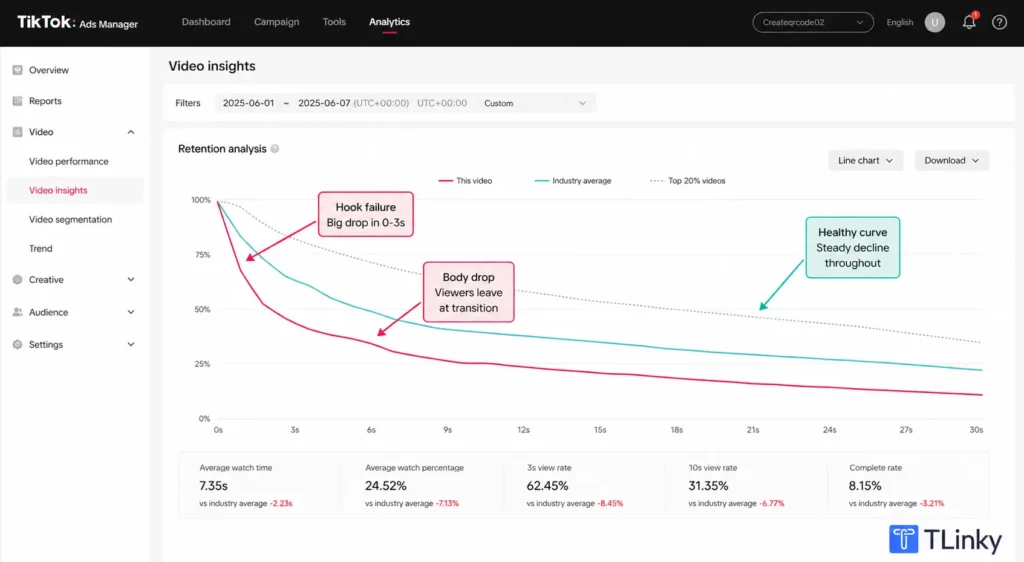
Fix: review the first line of your body content after the hook. Does it immediately fulfill what the hook implied? Or does it stall, introduce new context, or change direction?
Common Hook Mistakes
Starting with your name or brand introduction:
“Hey guys, welcome back to my channel” costs you the first two seconds of the most valuable attention window in the video. Introduce yourself at the end, not the beginning.
Describing what the video is about:
“Today I’m going to show you…” is a meta-description of the content, not a hook. It provides information about what is coming without creating any desire to see it.
Starting with a question that has an obvious answer:
“Have you ever wondered how to grow on TikTok?”Every viewer watching growth content has already answered yes. The question adds no tension.
Using a slow visual opener:
Text appearing on a plain background, a logo animation, or a wide establishing shot gives the viewer nothing to engage with in the critical first frame. Start with action, a close-up, or your highest-visual-impact moment.
Being vague:
“This changed my life” without any context about what “this” is does not create curiosity; it creates confusion. Specificity is what makes bold claims believable, and curiosity hooks compelling.
FAQs
How long should a TikTok hook actually be?
The hook itself, the moment that creates the viewer’s decision to stay, should land within the first two to three seconds. However, the hook can continue past that point as a setup phase: the opening three seconds create the question, and the next five to ten seconds frame what the viewer is about to receive. The commitment window is three seconds, but the full setup can extend slightly longer.
Can the hook be text-only without speaking?
Yes. Many high-performing TikTok videos use a text overlay in the first frame as the primary hook, with no spoken words in the opening. This format works especially well for content watched on mute (common in public spaces) and for creators who want to build suspense before their voice appears. The text hook should be short enough to read in under two seconds.
Does the same hook style work on TikTok, Instagram Reels, and YouTube Shorts?
Hook mechanics are similar across all three platforms because the viewer behavior is the same: a vertical feed where swiping takes less than a second. The formulas translate. What differs is the audience context: TikTok trends toward entertainment and discovery, Reels leans toward aspirational and lifestyle content, and Shorts tends to capture viewers already familiar with the creator from YouTube. Adapt the tone, not the structure.
How do I know if my hook worked?
Check the retention curve in TikTok Analytics within 24 to 48 hours of posting. If more than 50% of viewers are still watching at the three-second mark, the hook is doing its job. If you see a sharp drop before that point, the hook is losing viewers before they commit. Completion rate and re-watch rate (visible as a bump at the end of the retention curve) are the secondary indicators of hook and overall video quality.
Wrapping Up
The 3-second hook is the highest-leverage element of any short-form video. Everything else, like your content, your production, your call to action, depends on the hook first earning the viewer’s attention.
Most creators spend the majority of their time on the body of their content and treat the opening as an afterthought. Reversing that priority: writing the hook first, testing it deliberately, and using retention data to improve it, is the clearest path to better algorithmic distribution on TikTok, Reels, and Shorts.
The TikTok algorithm guide explains how early retention data feeds into TikTok’s cohort testing model and wider distribution. The organic TikTok strategy guide connects hook strategy to a full content planning system.
Sources
- TikTok Creator Academy, Video Performance and Retention
- TikTok Newsroom, Creator Resources
- TikTok Business Help Center, Ads Best Practices