
TikTok Shop is a built-in eCommerce feature that lets sellers list products, run live shopping events, and process payments entirely within the TikTok app; no external website required.
Buyers discover products through videos and live streams, tap a product tag, and complete checkout without ever leaving TikTok.
That frictionless path matters. TikTok Shop generated $66 billion in global GMV in 2025, doubling from $33.2 billion the year prior, according to eMarketer.
In the US, it captured 18.2% of all social commerce in 2025 and is on track to surpass $20 billion in US sales in 2026.
If you sell a physical product and you have not yet figured out TikTok Shop, this guide covers everything you need to make that decision with real information.
You will learn:
- How TikTok Shop works and why it converts differently than Amazon or Shopify
- Exact fees you will pay as a seller in 2026
- Step-by-step account setup, including new fulfillment requirements
- What product categories are driving the most sales
- How live shopping and the affiliate program actually work
- How to write product listings that rank inside TikTok’s search
- The mistakes that consistently sink new TikTok Shop sellers
I’ve worked with TikTok Shop sellers across beauty, home goods, and fashion through TLinky’s partner network for the past two years. What you’ll find here comes from that direct experience, not just TikTok’s seller documentation.
Get Free TikTok Ad Credit Up to $6000 [Limited Time Offer]

Key Takeaways
- TikTok Shop’s live shopping conversion rate is 7.4%, more than three times the benchmark for traditional eCommerce, per data from ringly.io.
- As of March 2026, independent shipping is no longer available for US sellers. You must use Fulfilled by TikTok (FBT), Upgraded TikTok Shipping, or Collections by TikTok.
- The standard seller fee is a 6% referral fee plus approximately 1.02% to 3.78% payment processing, bringing your true platform take-rate to around 7% before affiliate commissions.
- New sellers get a reduced 3% referral fee for the first 30 days, then revert to standard rates.
- Beauty and fashion lead TikTok Shop GMV, but any visually demonstrable product with 50% or higher gross margin can perform well.
What Is TikTok Shop?
TikTok Shop is TikTok’s native commerce infrastructure that combines product discovery, checkout, and fulfillment inside a single app.
Sellers list products in a Seller Center, tag them in videos and live streams, and buyers complete the full transaction without visiting an external site.
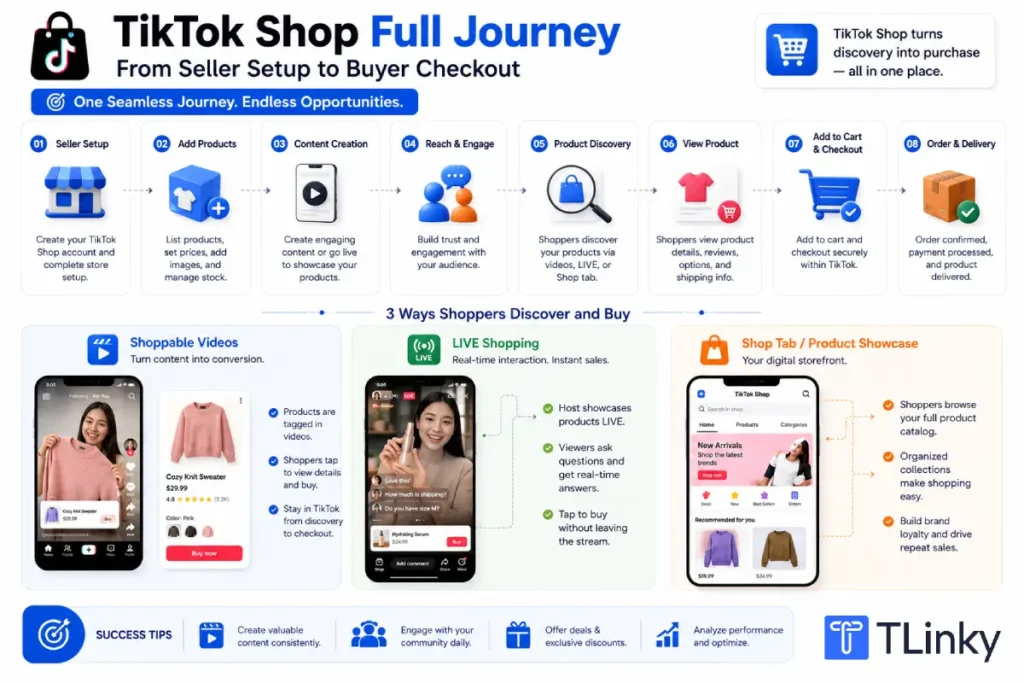
What makes it different from listing a product on Amazon or linking to your Shopify store is the nature of discovery. On Amazon, buyers search for what they already want.
On TikTok Shop, a buyer watches a creator’s video, sees the product in use, and makes an impulse decision to purchase, all in under 60 seconds.
That is why TikTok calls it “discovery commerce,” and it is why the platform’s conversion rates outperform traditional eCommerce in specific product categories.
Is TikTok Shop Available in Your Country?
TikTok Shop operates in more than 16 countries as of mid-2026. US and UK sellers have access to the full feature set, including live shopping, shoppable videos, and the affiliate program.
TikTok expanded into six European markets in late 2025, adding France, Germany, Ireland, Italy, Spain, Austria, Belgium, the Netherlands, and Poland.
Markets with full TikTok Shop access: United States, United Kingdom, Indonesia, Malaysia, Thailand, Vietnam, the Philippines, Singapore, and the new European markets above.
If your country is not yet listed, TikTok’s international rollout is ongoing. Check TikTok Shop Seller Center for the current availability list, as new markets are added on a rolling basis.
How to Set Up a TikTok Shop Account
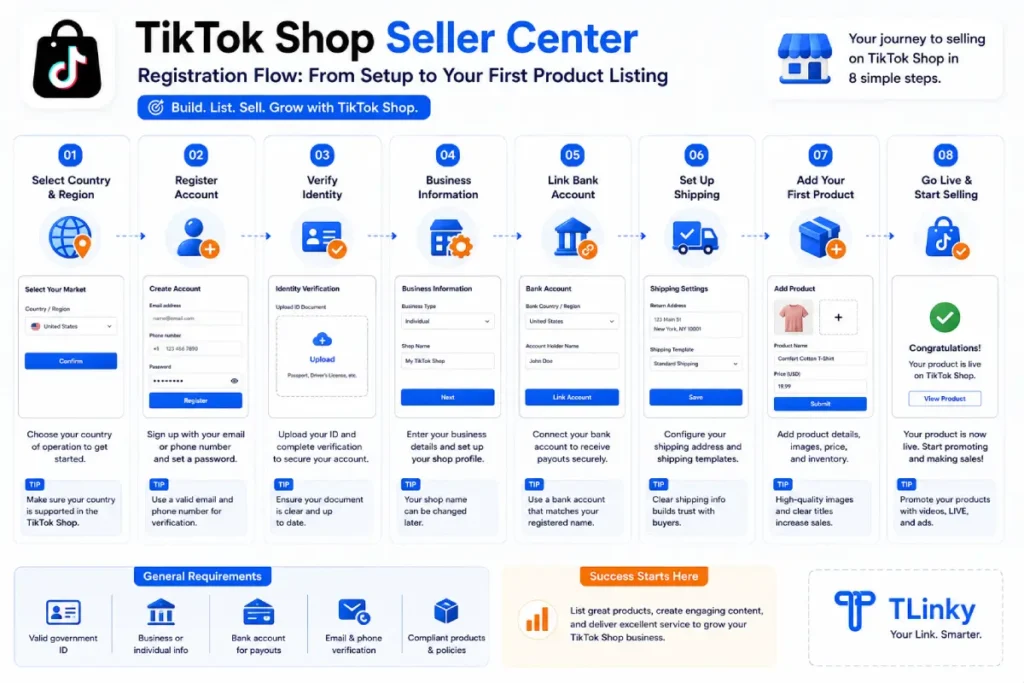
Step 1: Register at the Seller Center
Go to seller-us.tiktok.com and sign up using your TikTok account, email address, or phone number. Select your country at this stage.
Your country selection determines which product categories are available, what currency you operate in, and which fulfillment options apply to your account.
Step 2: Choose Your Business Type
Specify whether you are registering as an individual seller or a registered business. Individual sellers typically need a government-issued ID for verification.
Businesses need a business license, Employer Identification Number (EIN) in the US, and documentation for the legal representative of the entity. TikTok verifies all accounts before granting selling permissions.
Step 3: Configure Fulfillment
This step changed significantly in early 2026. Independent shipping ended for US sellers on March 31, 2026.
Your available fulfillment options now are:
- Fulfilled by TikTok (FBT): You send inventory to TikTok’s warehouse. TikTok handles pick, pack, and ship. This is the fastest option for buyers, and the one TikTok’s algorithm gives preference in search results.
- Upgraded TikTok Shipping: You ship orders yourself but use TikTok’s partnered carrier rates and labels.
- Collections by TikTok: For sellers with physical retail locations, this allows local pickup.
Most high-volume sellers use FBT for their top products and upgraded shipping for slower-moving SKUs.
Step 4: Link Your Bank Account
Go to Settings, then Payment, then Link Bank Account in the Seller Center. Enter your bank details and confirm that the account name exactly matches your registered business or personal name. Mismatched names delay payment processing.
Step 5: Add Your Products
Go to Product Management and select Add Product. For each product, you need a title (use keywords your buyers search for), category selection, price, stock quantity, at least three product images, and a description.
A short video demonstrating the product in use significantly improves conversion rates compared to image-only listings.
Once published, your products appear in your Shop tab, can be tagged in videos, and are available for affiliate creators to promote.
For a deeper walkthrough of selling mechanics, TLinky’s how to sell on TikTok Shop guide covers inventory, pricing strategy, and shop settings in detail.
How Much Does TikTok Shop Charge Sellers?
TikTok Shop’s fee structure changed in 2026. The old model charged a separate commission and transaction fee. The current structure in the US works as follows.
Referral Fee (Marketplace Commission)
The standard referral fee is 6% of the final sale value for most product categories. Select jewelry categories carry a lower 5% rate. This fee covers both TikTok’s platform commission and a portion of payment processing.
New sellers who make at least one sale within 60 days of registering receive a reduced 3% referral fee for their first 30 days of active selling, after which rates revert to 6%.
Payment Processing Fee
On top of the referral fee, TikTok charges a separate payment processing fee ranging from 1.02% to 3.78% depending on the payment method the buyer uses. Your true platform take-rate is therefore approximately 7% to 9.78% total before any affiliate commissions you set.
Fulfilled by TikTok (FBT) Costs
FBT fulfillment is priced by weight tier and units per order, ranging from roughly $2.86 to $3.58 per unit for standard-weight items, according to rate schedules published by Printify and Dashboardly.
Affiliate Commissions
If you use TikTok’s affiliate program (which most successful sellers do), you set the commission rate yourself. Standard ranges by category: beauty 15 to 30%, fashion 10 to 15%, home goods 12 to 18%, tech and electronics 5 to 10%. These are not platform fees — they are payouts to the creators who drive your sales.
What this means for your margins: TikTok Shop works best for products with 50% or higher gross margins. If your cost of goods is already 60% of your sale price, after the referral fee, processing fee, fulfillment, and affiliate commission, you may have little left. Build your pricing with these costs in mind before you list.
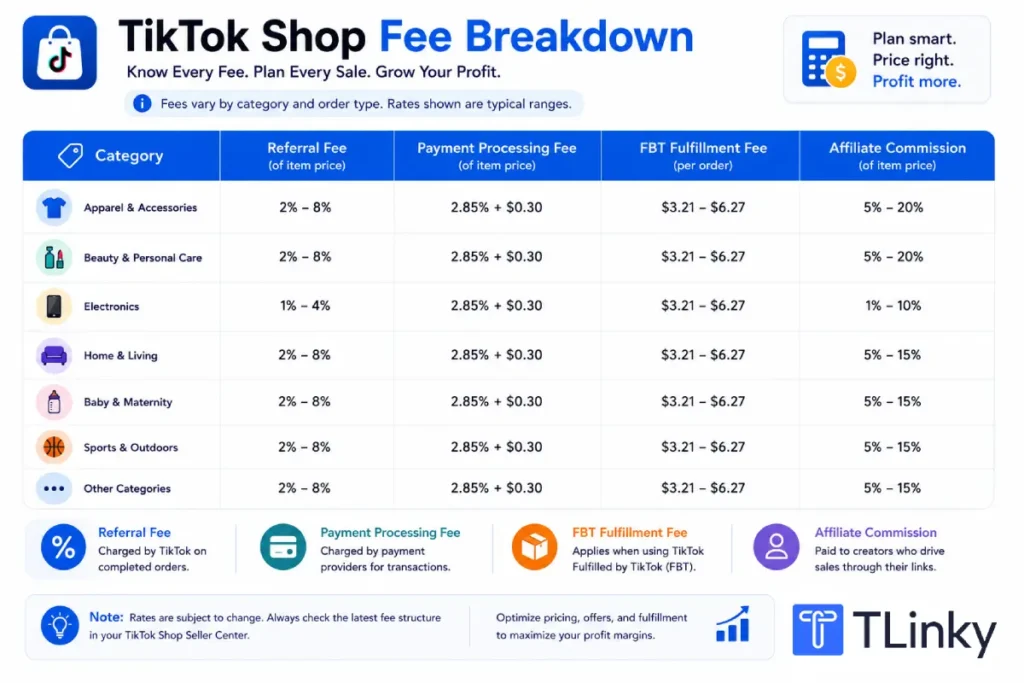
Use TLinky’s TikTok Shop Fee Calculator to model exact costs for your specific products, and the TikTok Shop Profit Calculator to check whether your margins work before committing to a launch.
What Products Sell Best on TikTok Shop?
Not all products perform equally on TikTok Shop. The platform favors products that are visually demonstrable, solve a recognizable problem, and can be explained or shown in under 60 seconds.
Top Categories by GMV
Based on US sales data compiled by eMarketer and industry research from ringly.io:
- Beauty and Personal Care: Leads all categories, generating $2.49 billion in US GMV, over 22% of total platform sales. Skincare, hair care, and cosmetics dominate because results can be shown on camera in real time.
- Fashion and Apparel: Second-largest category by GMV. Try-on videos and outfit transformations drive strong impulse purchases. Category GMV share is approximately 24%.
- Food and Beverage: Growing rapidly, particularly for snacks, specialty foods, and drinks that can be taste-tested or reviewed on camera.
- Home and Kitchen: Products that demonstrate a clear problem-solution dynamic (gadgets, organization tools, cleaning products) perform well in this category.
- Health and Wellness: Supplements, fitness tools, and wellness accessories with clear before-and-after use cases.
What Makes a Product Work on TikTok Shop
Three product characteristics consistently predict TikTok Shop success. First, the product must be easy to demonstrate on video. Second, results or value need to be visible within the video’s first 15 seconds.
Third, the purchase decision should not require deep research — it should be something a viewer can decide on emotionally while watching.
Products requiring detailed technical comparison, large purchase commitments, or long consideration cycles tend to underperform without a strong organic content library built first.
For a curated look at what is selling, see TLinky’s best-selling products on TikTok Shop resource, updated regularly with category trends.
How to Create Content That Sells on TikTok Shop
Content on TikTok Shop is not advertising. It is demonstration. The videos that drive the most sales show the product being used, not described.
Shoppable Videos
Shoppable videos are your standard in-feed posts with product tags overlaid on the video. When a viewer taps the tag, a product card appears showing price, reviews, and an Add to Cart button. They can check out without stopping the video.
The formula that consistently works: show a problem in the first three seconds, demonstrate your product as the solution in the next 15 to 20 seconds, include a product tag placed near the problem moment (not at the end).
Viewers tap when they feel the problem is theirs, not when they see a buy button at the end.
For hook writing techniques specific to shopping content, TLinky’s 3-second hook guide covers the formats that stop the scroll in product-focused videos.
Product Showcase Tab
Your shop’s product showcase tab displays all your listings in a browsable grid. Buyers who visit your profile after watching a video land here.
Your product thumbnail, title, and price are the only elements they see before clicking through.
Treat this tab like a storefront window: use images that show the product in use, not on a white background.
Live Shopping
Live shopping is TikTok Shop’s highest-converting format. During a live session, you demonstrate products, answer questions, pin items to the screen for one-tap purchase, and run time-limited offers. The 7.4% live shopping conversion rate cited by ringly.io reflects this — most eCommerce channels do not get close to that number.
How Does Live Shopping Work on TikTok Shop?
Live shopping on TikTok Shop combines real-time product demonstration with in-stream checkout. Viewers watch your live feed, see pinned products on screen, and complete purchase without leaving the stream.
What Makes a Live Session Convert
Successful live sessions in 2026 share four characteristics:
Duration: Sessions under 30 minutes consistently underperform. TikTok’s algorithm begins distributing live content to non-followers after a stream has been running for roughly 20 to 30 minutes and has shown sustained engagement. Most high-converting sessions run 90 minutes to three hours.
Host presence: Scripted or low-energy hosts perform poorly. TikTok’s live algorithm weights engagement signals (comments, shares, gifts) in real time, and viewers disengage quickly from streams that feel like recorded ads.
Live-only pricing: Exclusive discounts or bundles available only during the live create the urgency that drives immediate purchases. Standard-priced items without any live incentive convert at roughly half the rate of items with a session-specific offer.
Pre-promotion: Your existing followers need advance notice of your live schedule. Post two to three teaser videos in the 48 hours before a live session, mention the time and what products you will feature, and pin a comment in each video directing viewers to set a reminder.
We ran a 75-minute live session for a home goods seller in early 2026; sales were minimal for the first 22 minutes, then viewer count tripled and conversion jumped from 1.9% to 6.2% once TikTok’s algorithm started pushing the stream to non-followers around the 25-minute mark. Plan your strongest offer for after that threshold, not at the open.
For a detailed breakdown of live shopping ad formats and best practices, read TLinky’s TikTok Live shopping ads guide.
How Does the TikTok Shop Affiliate Program Work?
The TikTok Shop affiliate program lets creators earn a commission on sales they generate by featuring your products in their content. You set the commission rate, creators apply to promote your products, and TikTok tracks every sale back to the creator who drove it.
Why Affiliate Is the Best Starting Point for New Sellers
When you launch a TikTok Shop with no reviews, no organic content library, and no follower base, paid advertising is expensive and typically unprofitable.
The affiliate program solves this by letting creators take on the content production cost in exchange for a share of sales revenue. You pay nothing upfront — you only pay when a sale converts.
This also seeds your product reviews and social proof. A creator with 50,000 followers posting an honest product video generates sales and reviews simultaneously, which improves your product listing’s conversion rate for future traffic.
How to Recruit Affiliates
Go to your Seller Center, then Affiliate Program, then Open Plan. Set your commission rate for each product. Creators who browse TikTok Shop’s affiliate marketplace can then apply to promote your products.
To attract quality creators, keep your commission competitive for your category (beauty at 15% minimum, fashion at 10% minimum).
Send samples proactively to creators in your niche who already post content in your product category.
Do not send scripts. Brief them on the product’s core benefit and the one outcome you want viewers to understand, then let them create in their own voice.
Use TLinky’s TikTok Influencer Finder to identify creators in your product niche who have audiences that match your buyer profile.
For finding creators who are already producing UGC in your category, TLinky’s TikTok UGC Finder surfaces relevant existing content creators without requiring you to search manually.
How to Get Your Products Found on TikTok Shop (Product Listing SEO)
TikTok Shop has its own search algorithm, separate from the video For You Page algorithm. When a buyer types “vitamin C serum” or “cable organizer desk” into TikTok’s search bar, the results they see are influenced by your product title, category, description, and sales velocity.
Product Title Optimization
Your product title is the most important ranking signal in TikTok Shop search. Use the format: Primary Keyword + Key Attribute + Brand Name, up to the character limit.
Avoid filler words like “best,” “amazing,” or “high quality” — use specific descriptors buyers actually search for (fragrance-free, refillable, 2-pack, XL).
Example: “Vitamin C Serum with Hyaluronic Acid, 30ml, Cruelty-Free” outperforms “Best Vitamin C Serum for Glowing Skin” because the first matches specific search queries; the second matches nothing specific.
Product Description
Write descriptions for buyers who are scanning, not reading. Lead with the primary benefit in the first line. Use bullet points for features.
Mention key use cases, who the product is designed for, and what problem it solves. Include your target keywords naturally — do not repeat them excessively.
Reviews and Sales Velocity
TikTok Shop’s algorithm weights products with more reviews and consistent sales above new listings. Getting your first 10 to 20 reviews quickly is a priority.
Encourage buyers to leave reviews through post-purchase follow-up messaging in the Seller Center.
A product with 50 reviews at 4.5 stars will consistently outrank a newer product at 5 stars with three reviews.
Use TLinky’s TikTok Hashtag Generator when creating product-related video content to identify the keyword and hashtag combinations that align with what buyers search on the platform.
TikTok Shop vs Amazon vs Shopify: Which Is Better for Sellers?
These three platforms serve different roles, and the answer depends on what stage your business is at and what type of product you sell.
| Platform | Strength | Weakness | Best For |
| TikTok Shop | Discovery commerce, zero upfront ad cost via affiliates, impulse purchase | Low repeat purchase rate (8 to 15%), content dependency | Visual products, new brands with no customer base |
| Amazon | Massive buyer intent traffic, trusted checkout, Prime | High advertising costs, fee stacking, limited brand control | Established SKUs with search demand, high-volume commodities |
| Shopify | Full brand ownership, customer data, repeat purchase rate (25 to 40%) | You pay for all traffic, higher CAC | Brands building long-term customer relationships |
The brands growing fastest in 2026 are not choosing one platform. They use TikTok Shop to prove product-market fit through affiliate-driven content, build initial reviews and GMV, then reinvest into Shopify for customer retention and Amazon for intent-based search capture.
For sellers already on Shopify, you can sync your product catalog directly to TikTok Shop. TLinky’s TikTok Shopify integration guide walks through the setup, inventory sync, and order management.
If you are deciding between the two platforms independently, TLinky’s Shopify vs TikTok Shop comparison breaks down fees, reach, and use cases side by side.
What Mistakes Kill TikTok Shop Sales?
Most TikTok Shop failures come down to four mistakes that are entirely avoidable once you know to look for them.
Starting With Paid Ads Before Organic Content Works
Running TikTok Shop ads on a product with zero reviews and no organic content library is one of the most common and expensive mistakes new sellers make.
TikTok’s ad algorithm favors products that already have social proof: views, reviews, and affiliate-generated content. Spending on ads before you have this foundation produces high CPMs and poor ROAS.
Spend your first 30 days building organic content and seeding the affiliate program. Once you have 20 or more product reviews and at least one piece of creator content that is generating organic sales, paid amplification becomes significantly more efficient.
Ignoring Unit Economics Before Launch
If your product has less than 50% gross margin, TikTok Shop’s fee structure will compress your profitability to near zero.
After the 6% to 7% referral and processing fee, FBT fulfillment at $2.86 to $3.58 per unit, and a 15% affiliate commission on a beauty product, a $25 product with $10 COGS leaves very little. Run the numbers before you list.
I saw this with a skincare seller in late 2025: a $28 product at 38% margin was losing $1.50 per sale after fees, fulfillment, and a 20% affiliate commission.
We shifted their lead to a $64 bundle at 56% margin, and they were profitable per order within 45 days.
Treating TikTok Shop as an Isolated Channel
The sellers consistently generating the most GMV are using TikTok Shop as the discovery layer, not the entire business.
They capture email addresses at checkout, run retargeting campaigns, and build a Shopify presence for repeat buyers.
TikTok Shop’s average repeat purchase rate of 8 to 15% (compared to 25 to 40% on owned stores) means you lose most buyers after the first purchase if you do not have a way to stay in contact with them.
Inconsistent Content Output
TikTok Shop rewards sellers who publish content consistently, not in bursts. Three to five product videos per week is the minimum for building algorithmic momentum.
Accounts that post heavily for two weeks and then go quiet see reach collapse quickly.
If you cannot commit to consistent video output in-house, the affiliate program becomes more important, not less — it outsources content production to creators who are already posting daily.
For a broader look at TikTok advertising strategy to complement your organic shop content, TLinky’s TikTok Ads Manager guide covers campaign setup, bidding, and how to integrate paid with your TikTok Shop.
Frequently Asked Questions
Does TikTok Shop charge sellers monthly fees?
No. TikTok Shop does not charge a monthly subscription fee. You only pay when you make a sale, through the referral fee (6% standard), payment processing fee (1.02% to 3.78%), and FBT fulfillment costs if you use TikTok’s warehouse. There are no listing fees or setup fees.
Do you need a large following to sell on TikTok Shop?
No. There is no minimum follower count to open a TikTok Shop as a seller. You need a verified business registration and documentation to pass identity verification. A new account with zero followers can generate sales through the affiliate program by recruiting creators to promote your products.
How long does TikTok Shop take to pay sellers?
TikTok Shop pays sellers on a 14-day settlement cycle after order completion. Funds typically reach your linked bank account within two to five business days after the settlement date. Settlement timelines can extend during high-volume periods like Q4.
Can I connect Shopify to TikTok Shop?
Yes. TikTok’s official Shopify app syncs your product catalog, inventory levels, and orders between Shopify and TikTok Shop. When a sale happens on TikTok Shop, it automatically updates your Shopify inventory and creates an order in your Shopify dashboard. TLinky’s guide on how to sell on TikTok Shop using Shopify covers the full integration setup.
What happens if a buyer returns a product on TikTok Shop?
Buyers can request returns within 30 days of delivery for most product categories. TikTok Shop handles the return logistics for FBT orders. The refund is deducted from your next settlement. You are responsible for the return shipping cost if the return is due to a product defect or incorrect item. If the return is due to a buyer preference change, the cost is split according to TikTok’s current return policy, which you should confirm in your Seller Center as policies are updated periodically.
Conclusion
TikTok Shop is a genuine sales channel, not a social media experiment. The platform’s GMV doubled year-over-year in 2025, its affiliate program enables new sellers to generate sales without an existing audience, and its live shopping conversion rates consistently outperform traditional eCommerce.
The sellers who do well treat TikTok Shop as a discovery engine with specific economics.
They understand the fee structure before they price products, they build organic content and affiliate relationships before running paid ads, and they design their product lineup around categories that work on video.
The sellers who struggle treat it like a store listing site and wonder why nothing sells without effort.
If you have a visual product with strong margins, an existing social commerce presence is not a prerequisite.
The affiliate program and the algorithm give new brands a path to visibility that is faster and cheaper than most paid acquisition channels. Use both.
For more on the broader TikTok marketing strategy that sits alongside your TikTok Shop, see TLinky’s TikTok marketing guide.
Sources
- eMarketer: TikTok Shop Makes Up Nearly 20% of Social Commerce in 2025
- ringly.io: 47 TikTok Shop Statistics You Need to Know in 2026
- Printify: TikTok Shop Fees Explained (2026)
- Dashboardly — TikTok Shop Seller Fees 2026: US Rates