
TikTok Shopify dropshipping combines TikTok’s product discovery engine with Shopify’s commerce infrastructure to sell physical products without holding inventory. When a buyer places an order, your supplier ships it directly to the customer; you never touch the stock.
What makes TikTok different from other channels for dropshipping is how buyers find products. On Google or Amazon, they search for something they already want. On TikTok, a buyer sees a product mid-scroll, feels an immediate pull to own it, and buys in the same session.
That impulse-first behavior is why the model works when executed correctly, and why it fails when sellers treat TikTok like any other ad platform.
In 2026, running this model profitably requires understanding two distinct operating modes, knowing what TikTok’s policies actually allow, and building the right supplier and content foundation before spending on ads.
You will learn:
- The two TikTok Shopify dropshipping models, and which one fits your situation
- What TikTok’s policies allow and what gets stores suspended
- How to find products that convert on TikTok specifically
- How to connect Shopify to TikTok Shop and set up your Pixel correctly
- What content strategy drives sales organically and through paid ads
- How to scale without resetting your algorithm or losing margins
- The real profit math behind a TikTok Shopify dropshipping store
Get Free TikTok Ad Credit Up to $6000 [Limited Time Offer]

Key Takeaways
- TikTok Shop dropshipping and TikTok Ads to Shopify are two different models with different fee structures, policy requirements, and customer experiences. Most guides treat them as the same thing.
- Retail arbitrage, buying from AliExpress and shipping in AliExpress packaging, violates TikTok Shop policy and is one of the fastest ways to get a store suspended in 2026.
- Suppliers must provide valid tracking within 48 hours of purchase and meet a six-business-day delivery window for US TikTok Shop orders.
- The profitable AOV range for TikTok dropshipping is $30 to $80. Products under $25 rarely survive the fee and fulfillment math.
- Well-run stores in 2026 operate at 8% to 18% net margins after referral fees, fulfillment, ad spend, and affiliate commissions, per data from branvas.
What Is TikTok Shopify Dropshipping?
TikTok Shopify dropshipping is an eCommerce model where you sell products through TikTok’s platform while your supplier handles inventory and shipping.
You create content or run ads to drive buyers to your product, process the order in Shopify, and your supplier fulfills it directly to the customer.
The “Shopify” part of this model serves two purposes.
First, it acts as your order management system, inventory sync layer, and payment processor.
Second, it connects to TikTok via an official app that installs the TikTok Pixel, syncs your product catalog, and enables TikTok Shop checkout.
For a broader overview of how the dropshipping model works before applying it to TikTok, TLinky’s what is dropshipping guide covers the fundamentals.
If you want to use a print-on-demand model instead of traditional dropshipping, see TLinky’s print-on-demand for TikTok Shop guide for a closer look at how POD works with TikTok Shop.
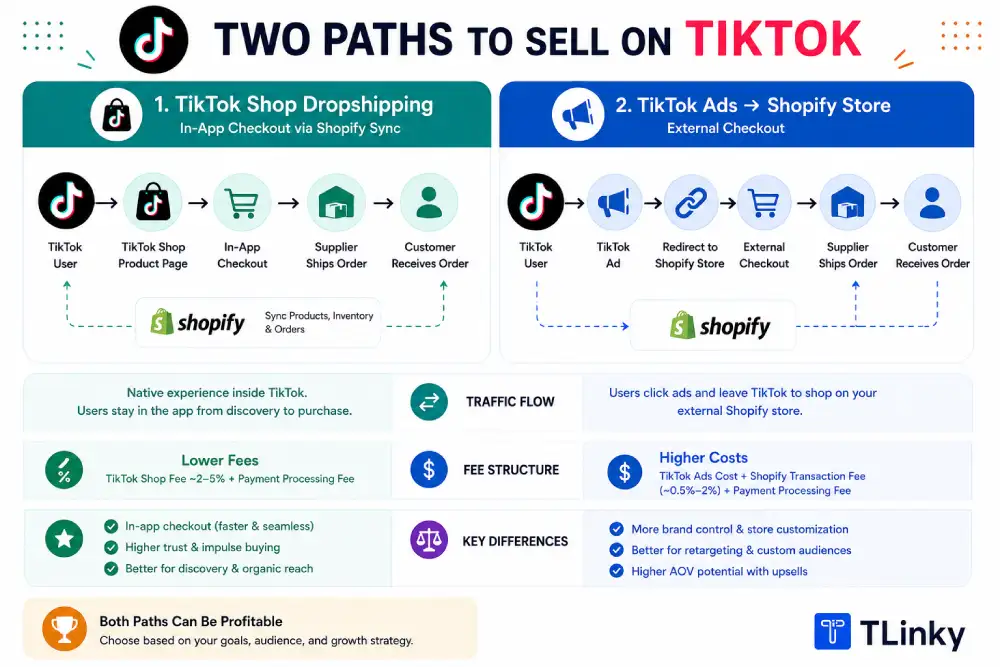
TikTok Shop Dropshipping vs TikTok Ads to Shopify: What Is the Difference?
These are two distinct approaches, and confusing them leads to wrong supplier choices, wrong fee calculations, and wrong content strategy.
Model 1: TikTok Shop Dropshipping (in-app checkout) Buyers discover your product in a video or live stream, tap a product tag, and complete checkout without leaving TikTok.
The order comes into your Shopify dashboard and routes to your supplier for fulfillment.
TikTok charges a 6% referral fee per sale. You are operating a TikTok Shop, which means you are subject to TikTok’s seller policies, delivery speed requirements, and account health scoring.
Model 2: TikTok Ads to Shopify (external checkout) You run TikTok ads or post organic content, drive traffic to your Shopify store, and buyers complete checkout on your site. No TikTok Shop is required.
TikTok does not charge a per-sale fee on this model; your costs are ad spend only. You have full control over the checkout experience, customer data, and post-purchase flow.
Most successful dropshippers in 2026 run both in parallel: TikTok Shop for organic and affiliate-driven sales, and the Shopify store for paid traffic campaigns where owning the customer relationship matters.
For a side-by-side breakdown of the two platforms’ strengths, TLinky’s Shopify vs TikTok Shop guide covers fees, reach, and use cases in detail.
Is Dropshipping Allowed on TikTok Shop in 2026?
Yes, but with specific rules that disqualify the most common dropshipping approaches.
TikTok allows dropshipping on TikTok Shop as long as your supplier can meet its fulfillment standards and the buyer experience matches what your listing promises.
What it does not allow is retail arbitrage: buying a product from AliExpress or another retailer and shipping it to the customer in that retailer’s packaging.
TikTok classifies this as a policy violation because the buyer receives a parcel branded by a different company than the one they purchased from.
I’ve seen stores get suspended within two weeks of launch for shipping orders in AliExpress-branded packaging. TikTok’s review process catches this faster than most new sellers expect.
The three policy areas that cause the most TikTok Shop dropshipping suspensions in 2026 are:
Tracking compliance: Every order must receive a valid, carrier-recognized tracking number within 48 hours of purchase. “Processing” or delayed uploads violate account health standards and trigger automated warnings.
Delivery speed: US TikTok Shop orders must be delivered within six business days. Suppliers based overseas who cannot meet this window will consistently push you into policy violation territory, regardless of how good your content is.
Product authenticity: Selling items that infringe intellectual property or that arrive in materially worse condition than shown in your listing leads to immediate listing removal and, on repeat violations, account suspension.
How Do You Find Winning Products for TikTok Dropshipping?
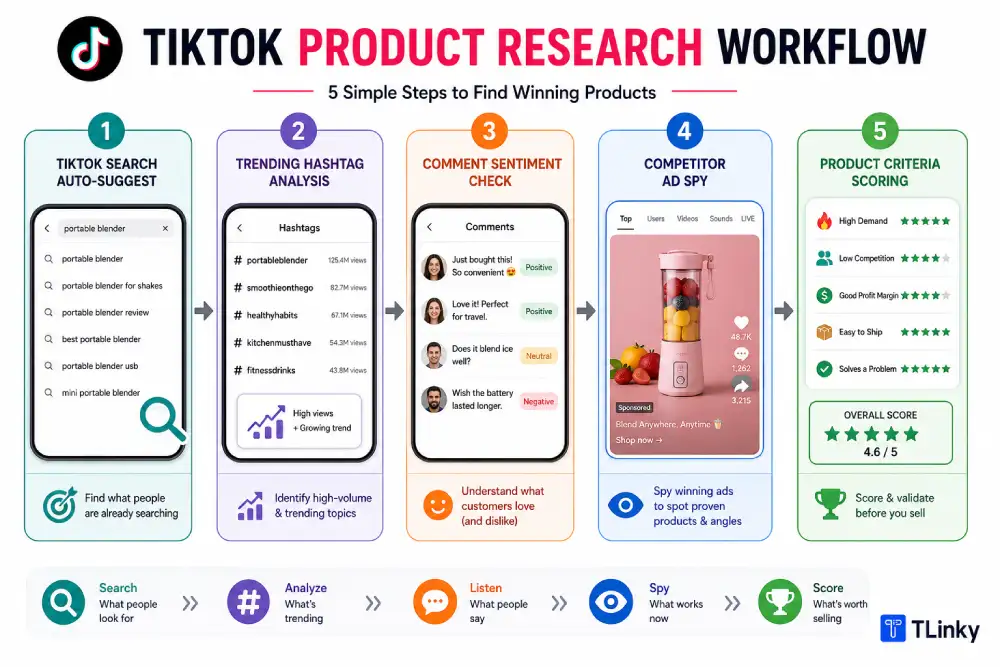
Not every product that sells well on Amazon or Shopify converts on TikTok. The platform rewards products that communicate their value in under five seconds of video.
What Makes a Product Work on TikTok
Three characteristics predict TikTok dropshipping success consistently.
- First, the product must demonstrate its value visually without explanation. If you need more than a few seconds to show why it is useful, it will underperform.
- Second, the result or transformation must be visible on camera, a before-and-after, a satisfying action, or an obvious problem being solved.
- Third, the price point should sit between $30 and $80. Below $25, the math rarely works after fees, fulfillment, and ad spend. Above $100, impulse purchase behavior drops sharply.
Product categories that consistently generate TikTok Shop GMV in 2026: beauty and personal care (leading with $2.49 billion in US GMV according to branvas.com), fashion and apparel, home and kitchen gadgets, health and wellness tools, and food and beverage products that can be tasted or reacted to on camera.
How to Research Products Before You List
Start with TikTok’s own search bar. Type your product category and check the auto-suggest results; these reflect actual search behavior on the platform. Look at the top videos in each result for posts from the last 30 days with high engagement. Old viral products from 12 months ago are usually saturated.
Check the comments on high-performing product videos. Comments asking “where can I get this?” or “link?” posted recently signal live demand, not historical interest.
Use TLinky’s TikTok Trend Tracker to monitor rising product trends and trending sounds in your category before they peak, giving you a content and listing head start.
For finding specific viral products already generating organic sales, TLinky’s guide on how to find viral products on TikTok covers the full research process. For what is already selling on TikTok Shop by category, see TLinky’s best-selling products on TikTok Shop resource.
Use TLinky’s TikTok Competitor Ads Finder to see which product ads competitors in your niche are currently scaling. Products with consistent spend over multiple weeks are proven converters, not experiments.
How to Set Up Your Shopify Store for TikTok Traffic
TikTok sends 99% mobile traffic. Your Shopify store must load fast, display cleanly on a phone screen, and reduce friction between tap and purchase to near zero.
Essential Store Settings Before Running Traffic
Use a fast, minimal Shopify theme. Dawn (Shopify’s free default theme) outperforms cluttered premium themes because it loads faster and focuses attention on the product. Enable Apple Pay and Google Pay, TikTok buyers expect one-tap checkout and abandon at a standard card form at a higher rate than on other platforms.
Your shipping, returns, and privacy policy pages must be live before you run TikTok ads. TikTok’s ad review process checks for these pages, and missing policies cause ad rejection.
Send traffic directly to the product page shown in your video, not your homepage. A buyer who watched a video about a specific cable organizer and lands on a general “Shop All” page will leave immediately.
How to Connect Shopify to TikTok
Install the official TikTok app from the Shopify App Store. Connect your TikTok Business Account and your TikTok Ads Manager account. During setup, select Maximum data sharing for your Pixel configuration. This activates the TikTok Events API, which tracks conversions server-side in addition to browser-side.
The Events API matters because iOS privacy restrictions block a significant share of browser-side pixel fires. Server-side tracking recovers those lost signals, giving TikTok’s algorithm more accurate data to optimize your ad delivery. Without it, your campaigns are working with incomplete conversion data from day one.
TLinky’s TikTok Pixel Setup Helper walks through verifying that your Events API and Pixel are firing correctly before you spend on ads.
For a full walkthrough of the Shopify-to-TikTok connection process, TLinky’s how to connect Shopify to TikTok guide covers each step in sequence.
How to Choose Suppliers for TikTok Shop Dropshipping
Your supplier determines whether your TikTok Shop account stays healthy or gets flagged. The product research and content strategy are irrelevant if your orders consistently arrive late or in the wrong packaging.
For TikTok Shop compliance in 2026, your supplier must meet three non-negotiable criteria. Delivery within six business days to US buyers.
A valid, carrier-recognized tracking number uploaded within 48 hours of each order. Neutral or branded packaging with no third-party retailer branding on the outside of the parcel.
AliExpress standard shipping does not meet these requirements for US orders. If you want to use AliExpress suppliers, use DSers (AliExpress’s official Shopify partner) to find suppliers who have US warehouse stock or who can ship via ePacket or AliExpress Standard Shipping with actual carrier tracking.
Zendrop and AutoDS also offer supplier networks with US-based warehouse options that meet TikTok’s delivery window.
For the TikTok Ads to Shopify model (external checkout), supplier requirements are less strict because TikTok’s account health system does not directly monitor your fulfillment.
However, fast shipping still matters for ROAS; customers who wait three weeks for a product ordered on impulse dispute charges at higher rates.
What Content Strategy Works for TikTok Dropshipping?
You have two approaches: organic content (zero ad spend) and paid ads. The most effective dropshipping stores in 2026 use organic content to prove which products convert, then use paid ads to scale the ones that work.
Organic TikTok Dropshipping Strategy
Organic works by posting product demonstration videos consistently until one gets algorithmic distribution.
The formula: show a recognizable problem in the first three seconds, demonstrate your product as the solution in the next 15 to 20 seconds, and include a product tag or bio link CTA at the end.
Post three to five times per day when testing a new product organically. The goal is to get enough content into the algorithm’s testing pool to find one video that earns strong early engagement.
Once you find a video format that generates comments and saves, double down on that format before moving to new products.
Use trending audio in every video. TikTok’s audio algorithm groups your content with other videos using the same sound, which can expose it to new audiences independently of your follower count.
Keep the sound audible enough to trigger the grouping even if it sits low in the mix behind your voiceover.
For a detailed organic-first strategy, including posting cadence and community building, TLinky’s organic TikTok strategy guide covers the full framework.
For hook writing specific to product videos, the three-second opening that determines whether your content gets watched or skipped, TLinky’s 3-second hook guide breaks down the formats that stop the scroll.
TikTok Paid Ads for Dropshipping
Do not run paid ads until you have organic content that converts. Running ads on a product with no reviews, no organic proof, and no social proof produces expensive CPMs and poor conversion rates.
Spend your first 30 days on organic and affiliate seeding. Once you have at least one organic video generating sales and 15 or more product reviews, paid amplification becomes significantly more efficient.
Spark Ads are the best entry point for most dropshippers. Instead of creating a separate dark ad, Spark Ads boosts an existing organic post from your account. This preserves all existing likes, comments, and shares on the post, which acts as social proof for new viewers.
A video with 847 likes and 90 comments converts better than the same video with no engagement history, even with identical targeting.
For broader campaigns, use broad targeting rather than interest-based audiences. TikTok’s algorithm in 2026 finds your buyers better than manual interest stacking when your creative is specific enough. Narrow interest targeting limits distribution and often raises CPMs without improving conversion quality.
TLinky’s TikTok paid ads vs organic guide explains when to switch between the two modes and how to use each to feed the other. For full campaign structure, TLinky’s TikTok Ads Manager guide covers campaign objectives, ad group setup, and bidding strategies for e-commerce.
For running ads specifically to your Shopify store (Model 2), TLinky’s How to run TikTok ads for Shopify covers the setup differences from a TikTok Shop campaign.
For a deeper look at the paid advertising side of this strategy, see our guide to TikTok Paid Ads for Dropshipping.
How to Scale a TikTok Shopify Dropshipping Store
Scaling on TikTok requires a different approach than most ad platforms. Raising a campaign’s daily budget by more than 20 to 30% in a single change resets the algorithm’s learning phase, which usually destroys the efficiency you built.
The way to scale horizontally is to duplicate winning ad groups rather than raising their individual budgets.
When an ad group is generating profitable ROAS consistently for three or more days, duplicate it into a new ad group with the same creative and settings. Run both simultaneously. Add a third duplicate 48 hours later if performance holds.
This approach maintains the learning efficiency of each ad group while increasing overall spend and reach.
Content volume is the other scaling bottleneck most sellers underestimate. TikTok creative fatigue sets in faster than any other platform; winning ad creatives typically see declining CTR within seven to fourteen days.
You need a continuous pipeline of new videos to sustain paid performance. If you cannot produce that volume in-house, the affiliate program solves it: recruit creators to post about your products, and their content refreshes your creative pool automatically.
TLinky’s TikTok Ads Budget Planner helps you model spend levels across duplicate ad groups before committing budget. For a full scaling framework, TLinky’s scale TikTok ads guide covers the horizontal duplication method and creative refresh cadence in detail.
For budgeting and bidding strategy across campaign stages, see TLinky’s TikTok budgets and bidding strategies guide.
What Are the Profit Margins in TikTok Shopify Dropshipping?
The honest answer: thinner than most guides show, and very dependent on your model and product price point.
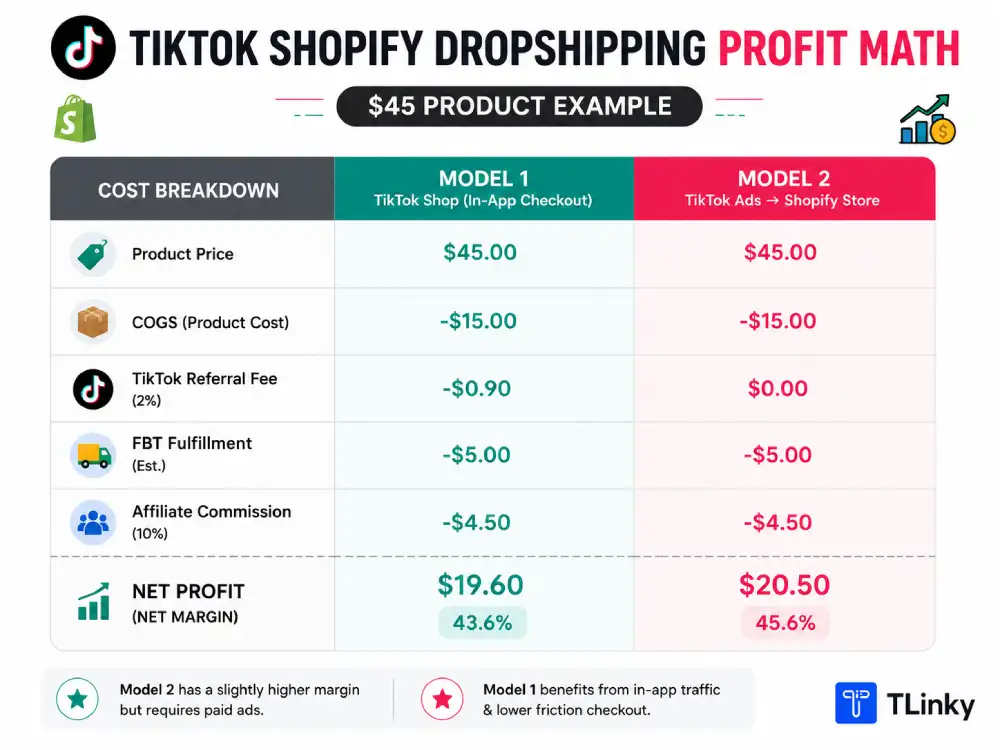
For TikTok Shop dropshipping (Model 1), your cost stack per order includes: 6% referral fee, 1% to 3.78% payment processing, fulfillment cost ($2.86 to $3.58 via FBT for standard items, or your supplier’s shipping cost if using upgraded shipping), any affiliate commission you set (typically 10% to 20% for dropshipped products), and your COGS.
Well-run TikTok Shop dropshipping stores in 2026 operate at 8% to 18% net margins after all costs, according to data compiled by ringly.io. Products priced under $25 rarely clear the math.
The profitable AOV sweet spot is $30 to $80, where you have enough margin after platform fees and fulfillment to run affiliates and still retain profit per order.
For TikTok Ads to Shopify (Model 2), you eliminate the 6% TikTok referral fee but add ad spend as a cost. Typical blended CAC on TikTok ad campaigns for dropshipping runs $15 to $35, depending on product and competition level.
Your ROAS target needs to account for this, a 2x ROAS is rarely profitable when your product margin is already compressed.
Use TLinky’s TikTok Shop Profit Calculator to model exact margins for your product at different price points, affiliate commission rates, and fulfillment options before you commit to a product launch.
What Mistakes Get TikTok Dropshippers Suspended or Unprofitable?
Shipping in Third-Party Branded Packaging
Sending orders in AliExpress, Amazon, or any other retailer’s branded packaging is a direct policy violation. TikTok Shop buyers see a parcel from a company they have never heard of, and TikTok’s review process flags accounts with consistent reports of this. Use suppliers who ship in neutral or white-label packaging, or arrange for your own branded inserts.
Sending Traffic to the Homepage Instead of the Product Page
Every TikTok video creates a specific expectation in the viewer’s mind. If your video features a portable blender and your bio link goes to a general store homepage, you lose the buyer at the moment of highest intent.
Always link directly to the product page shown in the video. If you sell multiple products, use a Link in Bio page that routes different audiences to their relevant product based on which content they came from.
Running Ads Before Organic Proof Exists
Paid ads amplify what already works. They cannot manufacture conversion where none exists. Launching a paid campaign on a product with zero organic performance, no reviews, and no affiliate-seeded content produces expensive data with no signal.
The first 30 days of a new product launch should be organic content and affiliate outreach. Add paid spend once you have proof the product converts.
Ignoring Attribution
TikTok’s native analytics show you what happens inside the app. They do not tell you which specific videos, campaigns, or creators drove purchases on your Shopify store. Every URL in your bio, TikTok Shop, and ad creative should be a tracked short link so you can attribute traffic and sales to specific content. Without this, you are scaling blind.
TLinky’s how to sell on TikTok Shop using Shopify covers the full integration setup including product sync and order routing. For adding your product catalog to TikTok Shop from Shopify, TLinky’s how to add Shopify products to TikTok Shop guide walks through the catalog setup step by step.
Additional useful resources for you:
👉 How to Claim Your TikTok Ad Credit (Up to $6,000)
👉 High-Converting TikTok Ad Scripts (Examples & Templates)
👉 Best AI UGC Video Creation Tools for TikTok, Facebook, Instagram Reels
Frequently Asked Questions (FAQ)
Can you do dropshipping on TikTok Shop in 2026?
Yes. TikTok Shop allows dropshipping as long as your supplier meets its fulfillment requirements: valid tracking uploaded within 48 hours and delivery within six business days for US orders. What is not allowed is retail arbitrage, where you source from AliExpress or another retailer and ship in their branded packaging. You need a supplier who ships in neutral or custom packaging and can meet TikTok’s delivery speed standards consistently.
How much does it cost to start TikTok Shopify dropshipping?
You can start the organic model for under $100. You need a Shopify subscription ($39 per month on the Basic plan), a product sample ($20 to $50 to film your own content), and the TikTok app installed (free). Paid ads add $20 per day minimum at the ad group level. Most sellers start organic, find a converting product, then reinvest early profits into paid amplification.
Do you need a business license to dropship on TikTok Shop?
To open a TikTok Shop in the US, you need a valid business registration (LLC or equivalent), a US bank account, and a government-issued ID for verification. You can run TikTok Ads to an external Shopify store without a TikTok Shop account, which has lower registration requirements. Most serious dropshippers register an LLC before opening a TikTok Shop, it also protects your personal assets if disputes arise.
What is the best supplier for TikTok Shop dropshipping in 2026?
For US TikTok Shop compliance, suppliers with US-based warehouse stock outperform overseas-only suppliers on delivery speed. Zendrop, DSers (for AliExpress suppliers with US warehouse options), and AutoDS are the most commonly used platforms. The key criteria: neutral packaging, tracking upload within 48 hours, and consistent six-business-day US delivery. Test a supplier with 10 to 20 orders before scaling any product.
How do you find winning products for TikTok dropshipping without spending money?
Use TikTok’s search auto-suggest for your product category to identify what buyers are actively searching. Check the comments on high-performing product videos from the last 30 days for phrases like “where can I buy this?” Filter by recent posts, not total views, to avoid saturated products. TikTok’s free Creative Center shows trending ads and products in real time. Start with a product you can film yourself with a $20 to $50 sample before committing to inventory or ad spend.
Conclusion
TikTok Shopify dropshipping works in 2026 when you understand which of the two models fits your situation, choose suppliers who can meet TikTok’s compliance requirements, and build organic proof before scaling with paid ads.
The stores that fail do so at predictable points: wrong supplier leading to policy violations, ads launched before organic conversion is proven, or profit margins calculated without the full fee stack.
The stores that grow do the boring operational work first, compliance, pixel setup, supplier vetting, organic testing, and then use paid amplification to scale what already converts.
If you are starting from zero, pick one product in a category you understand, order a sample, and film five organic videos before anything else. The data from those first videos tells you more about whether the product works on TikTok than any research tool can.
For the broader TikTok marketing strategy that sits alongside your dropshipping operation, TLinky’s TikTok marketing guide covers organic content, paid ads, and creator partnerships in full. For a complete look at TikTok Shop as a commerce platform, TLinky’s TikTok Shop guide covers fees, setup, and live shopping in detail.