
You scroll past a $4 phone stand, a $6 kitchen gadget, a $9 pair of wireless earbuds, and the same question hits every time: how is this so cheap?
TikTok Shop prices are not a glitch, and they are not a scam. There is a real, structured system behind those numbers, and once you understand it, the prices start making complete sense. Some of them are genuinely good deals. Others are cheap for reasons you need to know before you buy.
Get Free TikTok Ad Credit Up to $6000 [Limited Time Offer]
This guide breaks down every factor behind TikTok Shop’s low prices, what has changed in 2026, and how to tell the difference between a real bargain and a deal that will disappoint you.

Key Takeaways
- TikTok Shop is cheap primarily because sellers ship directly from the factory, TikTok charges lower platform fees than Amazon, and viral content replaces expensive advertising.
- TikTok actively subsidises discounts to grow its platform. This is a temporary competitive strategy, not a permanent pricing structure.
- The 2026 tariff changes have increased prices on Chinese-sourced products significantly. U.S.-warehoused products are not affected.
- Low price is not automatically a quality signal. Verify sellers, check buyer photo reviews, and compare against similar listings before buying.
- The same structural advantages that make TikTok Shop cheap for buyers also create thin margins for sellers, which is why some sellers cut quality to maintain profitability at scale.
Why Is TikTok Shop So Cheap?
TikTok Shop is cheap because sellers ship directly from manufacturers, cutting out every middleman markup. TikTok subsidises discounts to grow the platform, charges lower seller fees than Amazon (6-8% vs up to 17%), and allows sellers to replace expensive ads with free viral content. Unbranded products, minimal packaging, high competition, and volume-driven pricing all push costs lower. But not every low price signals a great deal. Some reflect genuinely thin supply chains, while others reflect thin quality.
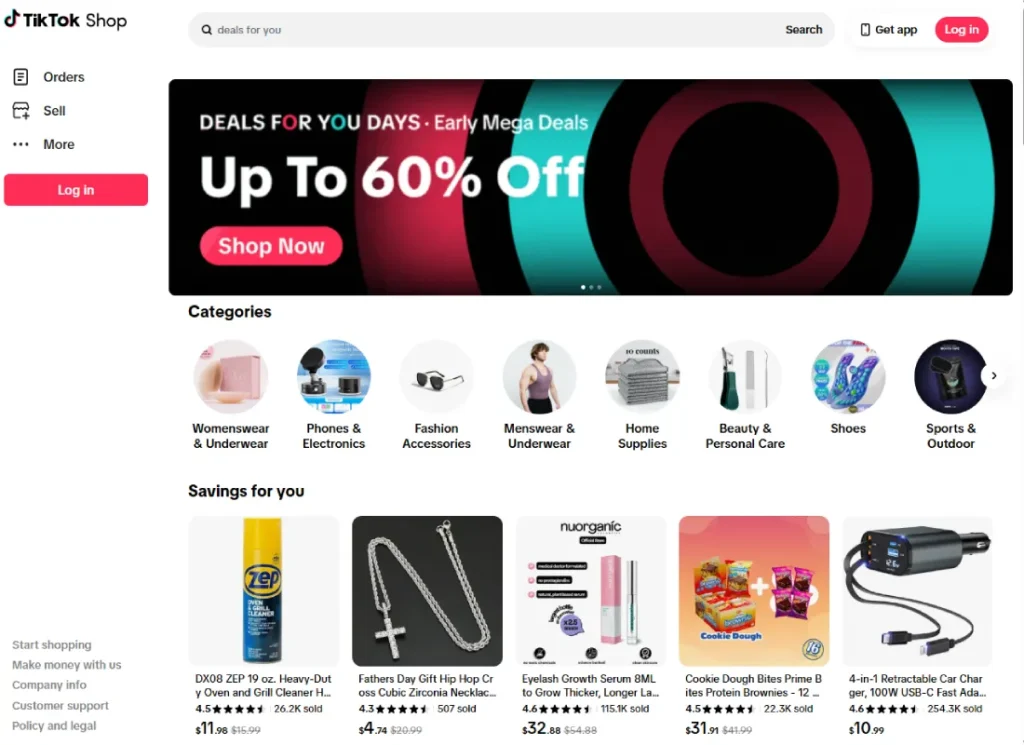
1. Sellers Ship Directly from Factories
On most traditional retail platforms, a product travels a long route before reaching you. A manufacturer produces it, sells it to a wholesaler, who sells it to a distributor, who sells it to a retailer, who sells it to you. Each step adds a markup of 20-40%, according to conga.
TikTok Shop removes most of that chain. Many sellers on the platform are the manufacturers themselves, or they work directly with factories in countries like China, Thailand, Vietnam, the Philippines, Malaysia, and Bangladesh, where production costs are significantly lower.
That $25 product on Amazon and the $8 version on TikTok Shop may come from the exact same factory. The only difference is how many hands it passed through before arriving at your door.
This is the single biggest structural reason TikTok Shop prices are lower, and it is also why the same product can appear across multiple platforms at dramatically different prices.
2. TikTok Actively Subsidises Discounts
Here is something you must know: TikTok itself funds a portion of the discounts you see on TikTok Shop.
TikTok is still in growth mode for its commerce division, and it is spending money to attract both buyers and sellers. That means TikTok sometimes covers the cost of free shipping promotions, flash sale price cuts, and “buy one, get one” offers so that sellers do not lose money on the deal, but the customers still get a lower price.
New sellers on TikTok Shop paid little to no commission in their first months as part of TikTok’s growth incentive programme. That subsidy gets passed on to buyers through lower prices.
This approach is temporary by design. As TikTok Shop matures and seller fees normalise, prices in some categories are already beginning to rise. The window for the most aggressively subsidised deals is narrowing, not expanding.
3. Seller Fees Are Lower Than Other Platforms
Every marketplace charges sellers a fee per transaction, and that fee directly affects the final price you pay.
On Amazon, referral fees range from 8% to 17%, depending on the product category, and that is before fulfillment fees, storage fees, and advertising costs are added. On TikTok Shop, the standard referral fee sits between 3% and 6%. There are no monthly store fees for most sellers, and no mandatory advertising spend to maintain visibility.
Lower platform costs give TikTok sellers more room to set competitive prices and still generate a margin. The savings that sellers keep from lower fees frequently show up as lower prices for buyers.
See exactly how much TikTok Shop will charge—try our TikTok Shop Fee Calculator.
4. Viral Content Replaces Expensive Advertising
Traditional sellers on platforms like Amazon spend heavily on sponsored product ads, display ads, and external marketing just to get products in front of buyers. That spend gets baked into the product price. If a seller spends $4,000 per month on Amazon ads to drive $20,000 in sales, that $4,000 is spread across every unit they sell.
TikTok flips that model. A single creator video can reach 2 million people without any ad spend at all, because TikTok’s algorithm pushes compelling content regardless of whether the creator paid for distribution. Sellers replace the traditional advertising budget with creator commissions (typically 10-25% of each sale), and only pay when a sale actually happens.
The result: lower marketing costs per unit sold, and a portion of that saving passed on in the price. This is why the same product sold on TikTok can legitimately cost less than on Amazon, even from the same supplier.
5. Most Products Are Unbranded
A significant portion of TikTok Shop inventory is unbranded or sold under generic factory labels. These products do not carry the cost of brand licensing, trademark registration, brand marketing, retail partnerships, or the premium that established brand names command.
When you buy a branded shampoo from a well-known company, part of that price covers the cost of years of brand-building, celebrity endorsements, and shelf space negotiations with major retailers. When you buy the same formulation from an unbranded factory account on TikTok Shop, none of those costs exist.
This is not automatically a negative. Plenty of unbranded products on TikTok Shop are well-made, functional, and a genuine value. But it does mean the product has no track record outside of platform reviews, and quality consistency is harder to verify than with established brands.
6. Packaging Is Minimal
Branded retail products invest in packaging design, protective inserts, branded tissue paper, and unboxing experiences that cost real money per unit. Many TikTok Shop sellers ship products in plain polybags or basic cardboard with no inserts and minimal labelling.

That packaging reduction can save $0.50 to $3.00 per unit, depending on the product. Across thousands of units, that is a significant cost reduction that shows up directly in the price.
If the product inside is identical to a higher-priced retail version, this is a win for you. If the product quality matches the packaging, that is a different conversation entirely.
7. High Seller Competition Compresses Prices
As of early 2026, TikTok Shop’s global seller base exceeded 15 million merchants, according to Resourcera TikTok Shop Statistics data. That level of competition creates intense price pressure in popular categories.
When dozens of sellers list nearly identical products, the ones priced highest simply do not sell. The algorithm surfaces lower-priced listings more prominently in shopping feeds, which pushes sellers to keep cutting prices to maintain visibility.
This competitive dynamic is especially visible in categories like phone accessories, kitchen gadgets, and beauty tools, where hundreds of sellers offer nearly identical products from the same factories.
For buyers, more competition generally means better prices. For sellers, it means margins are thin, which is also why some low-priced sellers cut corners on quality to maintain profitability.
8. Volume Selling Enables Thin Margins
Many TikTok Shop sellers operate on a high-volume, low-margin model. They price products low intentionally to generate fast sales velocity, which feeds TikTok’s algorithm and increases their product’s visibility in shopping feeds and creator content.
A seller making $0.80 profit per unit across 3,000 units per day generates $2,400 daily from a single product. That math works at scale in a way it cannot for a small boutique retailer, pricing for higher per-unit margins.
This volume model only works because TikTok’s platform handles the distribution side cheaply through viral content. The algorithm drives traffic cost-free, which means sellers can afford thin margins in a way that traditional retail businesses cannot.
9. TikTok Fulfillment Reduces Shipping Costs
For sellers using Fulfilled by TikTok (FBT), TikTok manages storage, packing, and last-mile delivery through its partner warehouse network. Because TikTok consolidates shipments across thousands of sellers, it negotiates significantly lower carrier rates than any individual seller could access.
Those reduced carrier rates lower the cost of shipping per unit, which allows sellers to either absorb the cost themselves or offer the free shipping promotions that buyers see on the platform. Free shipping that appears as a promotional deal is often free because TikTok’s logistics operation has already reduced the underlying cost to a level that makes it viable.
10. The 2026 Tariff Effect: Why Some Prices Are Rising
This is the factor that most articles on this topic ignore entirely, and it is the most important context for 2026 specifically.
In early 2025, the U.S. government significantly increased tariffs on Chinese imports. This directly affects TikTok Shop because a large proportion of its inventory originates from Chinese manufacturers. The de minimis exemption, which previously allowed packages under $800 to enter the U.S. duty-free, was eliminated in May 2025 for Chinese goods.
The practical impact: some TikTok Shop products that were priced at $10 in early 2025 now cost $25 to $35. Clothing items that previously retailed for $15 have jumped to $50 or more for overseas-sourced products. Many sellers have absorbed some of this increase, but the dramatic subsidised pricing of 2023-2024 is no longer universal.
If you have noticed that TikTok Shop prices are higher than they used to be in certain categories, tariffs are the primary reason. U.S.-sourced and domestically warehoused products are not affected, which is why you will still find genuine low prices on products stored in U.S. fulfillment centres but higher prices on direct cross-border shipments.
When Cheap Is a Real Deal vs When It Is a Warning Sign
Not every low price on TikTok Shop is a good price. Understanding why something is cheap tells you whether it is worth buying.
These are signs that the low price reflects genuine cost efficiency:
- The seller is verified with a blue checkmark
- Reviews include buyer photos and specific product feedback, not generic praise
- The product is unbranded but functional (a phone stand, a kitchen tool, a basic accessory)
- Multiple sellers offer similar products at similar prices, confirming the category is genuinely low-cost
- The item is warehoused in the U.S. and ships domestically
These are signs that the low price reflects poor quality or a risky seller:
- The price is dramatically below every comparable listing on the platform
- Reviews are sparse, recent, and suspiciously uniform
- Product photos are stock images with no real-use context
- The listing has no return policy or a vague one
- The seller account was created recently with no sales history
The most reliable approach: check the product on two or three platforms before buying. If TikTok Shop is 30-40% cheaper than the same product on Amazon, the price difference is likely structural (fewer middlemen, lower fees). If TikTok Shop is 80-90% cheaper, it deserves closer scrutiny before you commit.
Is TikTok Shop Safe to Buy From?
TikTok Shop is a legitimate platform operated by TikTok and built on standard eCommerce security infrastructure. Payments are processed through secure gateways, including PayPal, Apple Pay, and major credit and debit cards. TikTok offers buyer protection for undelivered orders, significantly misrepresented products, and certain return cases.
That said, TikTok Shop is a third-party marketplace, which means the platform’s safety does not guarantee every seller’s reliability. Quality and legitimacy vary by seller, not by platform. Buying from verified sellers with established review histories significantly reduces the risk of a poor experience.
The risks worth knowing: counterfeit goods in branded categories, inconsistent product quality from unverified sellers, and return policies that vary by seller rather than being platform-wide.
Useful article for you
👉 How to Get $6000 Free TikTok Ad Credit
👉 TikTok Made Me Buy It Explained
👉 TikTok Ads Manager: A Beginner’s Guide to Running Successful Campaigns
👉 TikTok Ad Formats and Specs Explained
👉 TikTok Ad Copy Best Practices
FAQs
Why is TikTok Shop cheaper than Amazon?
TikTok Shop is cheaper than Amazon primarily because sellers pay lower platform fees (6-8% vs up to 17% on Amazon), many sellers ship factory-direct without middleman markups, and TikTok’s viral content model replaces expensive paid advertising. TikTok also actively subsidises discounts to grow its platform, whereas Amazon’s cost structure is passed on in seller pricing. These structural differences make the same product consistently cheaper on TikTok Shop than on Amazon in many categories.
Is TikTok Shop cheap because it is low quality?
Not always. TikTok Shop prices are low for structural reasons, including direct factory sourcing, low platform fees, and viral marketing replacing ad spend. Many products are genuinely good value. However, some low prices do reflect lower quality, particularly for unbranded goods from unverified sellers. The safest approach is to check seller verification status, read reviews with buyer photos, and compare the product against similar listings before purchasing.
Why is everything on TikTok Shop so cheap compared to retail stores?
TikTok Shop sellers avoid the costs that make traditional retail prices high: no physical store overhead, no distributor margins, no wholesaler markups, and minimal advertising spend. Products ship directly from manufacturers to buyers, removing the 20-50% markup that each step in a traditional supply chain adds. Platform fees are also significantly lower than in traditional retail. These combined cost differences are what make the same product consistently cheaper on TikTok Shop than in a physical retail store.
Why did TikTok Shop prices go up in 2025 and 2026?
TikTok Shop prices increased in 2025 and 2026 primarily because of U.S. tariff increases on Chinese imports. The de minimis exemption, which previously allowed packages under $800 to enter the U.S. duty-free, was eliminated for Chinese goods in May 2025. Products that previously shipped cross-border without tariffs now carry import duties that sellers pass on in the form of higher prices. Products warehoused in U.S. fulfillment centres are not affected and still carry lower prices than overseas-shipped alternatives.
Is it safe to buy cheap things from TikTok Shop?
Buying cheap products from TikTok Shop is generally safe when you stick to verified sellers with established reviews and use TikTok’s in-app checkout. TikTok offers buyer protection for non-delivery and significantly misrepresented items. The main risks are inconsistent product quality from unverified sellers and counterfeit goods in branded categories. For non-branded functional products from verified sellers, TikTok Shop is typically safe and represents genuine value.
Why are TikTok Shop products cheaper than Temu?
TikTok Shop and Temu use similar factory-direct sourcing models, but TikTok Shop’s prices vary more by seller because it is a marketplace rather than a single retailer. TikTok Shop sellers set their own prices based on their costs, margin targets, and promotional strategies, which creates more price variation. Temu operates as a single platform with centralised pricing, which creates more consistency. In many categories, prices are comparable. TikTok Shop may be cheaper on trending products that sellers price aggressively to generate viral sales velocity, while Temu may be cheaper on commodity products it buys and prices centrally.
Conclusion
TikTok Shop is cheap because the system behind it is built differently from traditional retail. Factory-direct shipping removes middleman markups. Low platform fees give sellers room to compete aggressively on price. Viral content replaces advertising budgets. TikTok’s own subsidies push prices lower still, especially for newer sellers and promotional campaigns.
None of this is accidental. TikTok designed its commerce platform to grow through price competitiveness, and for buyers willing to do a small amount of research before purchasing, that design delivers real value.
In 2026, the picture is more nuanced than it was in 2023. Tariffs have pushed prices up on overseas-sourced products. TikTok’s introductory subsidies are gradually normalising as the platform matures. But the structural advantages of factory-direct selling and low platform fees remain, and those are not going away.
The deals on TikTok Shop are real. So are the risks. Knowing the difference between the two is what separates a smart purchase from a disappointing one.