
Most comparisons between TikTok Ads and Instagram Ads repeat the same claim. Instagram supposedly has a $5 daily minimum, and TikTok does not.
That number gets copied from post to post. Checked directly against Meta’s own Best Practices for Minimum Budgets page, no such fixed minimum exists.
TikTok, by contrast, does publish a hard number. Its Budget and Bidding FAQ states the minimum is $50 at the campaign level and $20 at the ad group level.
That difference in how each platform structures its budget rules matters more than most comparisons let on. It changes how you should actually test a small budget on each one.
In this article, you will learn:
- How TikTok and Instagram actually differ in budget rules, confirmed against each platform’s own documentation
- Which ad formats and placements each platform supports
- How audience behavior differs between the two platforms
- A practical framework for deciding which platform fits your business first
- How to track performance across both platforms without losing attribution
Get Free TikTok Ad Credit Up to $6000 [Limited Time Offer]
Key Takeaways
- Meta’s own minimum budget guidance does not publish a fixed minimum daily budget for Instagram ads. The requirement varies by business vertical, budget type, bid strategy, and other factors.
- TikTok Ads Manager’s budget documentation states a minimum of $50 at the campaign level and $20 at the ad group level.
- TikTok favors discovery-driven, native-feeling video content, while Instagram favors curated, trust-building visuals and retargeting.
- Neither platform is universally better. The right choice depends on your product category, creative capacity, and audience age.
- Running both platforms at once requires separate tracking to see which one is driving results.
Quick Answer
TikTok Ads tend to work better for product discovery, impulse-friendly offers, and reaching a younger audience through native video. Instagram Ads tend to work better for visual brands, service businesses, and retargeting warm audiences who need more trust before buying. Most businesses with any ad budget benefit from testing both rather than picking one permanently.
TikTok Ads vs Instagram Ads: Quick Comparison
| Factor | TikTok Ads | Instagram Ads |
|---|---|---|
| Minimum budget | $50 per campaign, $20 per ad group | No fixed minimum, varies by vertical, bid strategy, and objective |
| Median CPM | Lower than Meta platforms | Highest of the platforms Emplifi tracked |
| Median engagement rate | 35.9% peak (Q3 2025), 27.6% (Q4 2025) | Declined from ~17% (early 2024) to under 10% (late 2025) |
| Core ad formats | In-Feed, Spark Ads, TopView | Feed, Stories, Reels, Explore |
| Ads dashboard | TikTok Ads Manager | Meta Ads Manager (shared with Facebook) |
| Best fit | Discovery, impulse offers, younger audiences | Visual brands, retargeting, trust-dependent purchases |
Budget and CPM figures are sourced from TikTok For Business, Meta’s Business Help Center, and Emplifi’s 2026 benchmarks report, all linked in context below and in Sources.
What Actually Separates TikTok Ads From Instagram Ads
TikTok is built around discovery. The For You feed shows content to people who have never seen your brand before, based on behavior rather than who they follow.
Instagram is built around curation. Feed and Stories placements lean on existing follows, saved content, and a more polished visual standard.
This difference shapes what kind of ad performs well on each platform. A raw, native-feeling video fits TikTok’s feed. A more designed, on-brand visual fits Instagram’s.
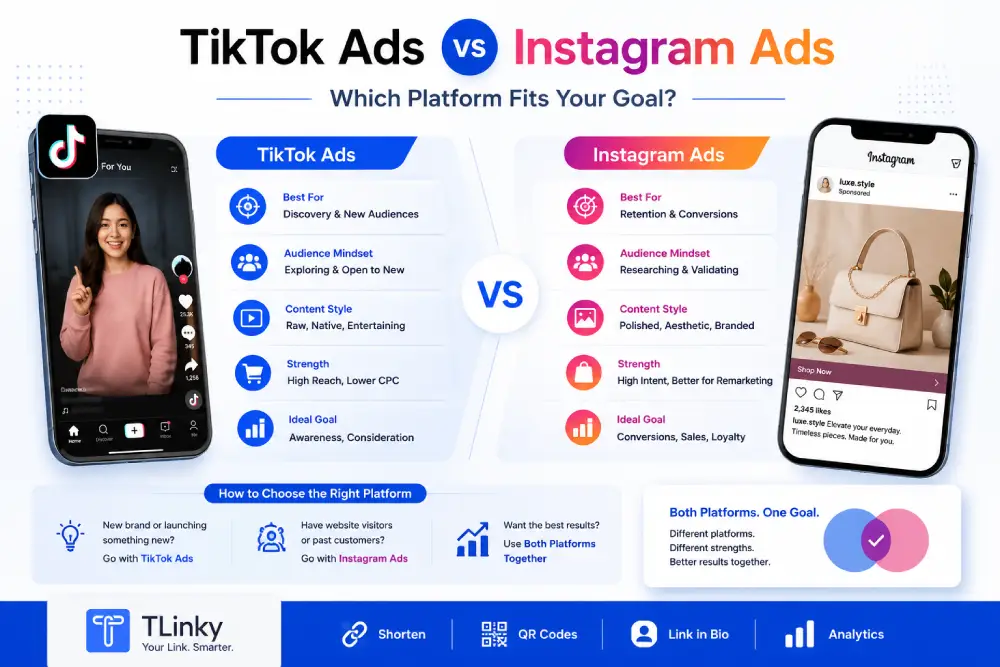
Neither approach is wrong. They are built for different moments in how someone discovers or trusts a brand.
Budget Rules and Minimum Spend, Verified
TikTok’s Budget and Bidding FAQ states its minimum spend plainly. The minimum budget is $50 at the campaign level and $20 at the ad group level.
That figure is not a soft recommendation. It is an enforced floor inside the platform’s own budget settings.
Meta takes a different approach. Its Best Practices for Minimum Budgets page states no equivalent fixed dollar minimum for Instagram.
Minimum budget requirements vary by business vertical, budget type, buying type, bid strategy, optimization, currency, and schedule.
The one concrete rule Meta does publish applies to a specific bid strategy: your daily budget should be at least five times your cost per result goal.
A low-budget Instagram test can look fine on paper and still get flagged as under-delivering. That depends on your bid strategy and objective.
TikTok’s flat floor is easier to plan around for a first test.
Ad Formats and Placements
TikTok’s core ad formats include In-Feed Ads inside the For You feed, Spark Ads that boost an existing organic post, and TopView placements that appear when the app opens.
Instagram’s core ad formats include Feed, Stories, Reels, and Explore placements. All of them run through the same Meta Ads Manager used for Facebook.
Creative: Why the Same Video Will Not Work on Both
A TikTok-native video and an Instagram-ready Reel are not the same asset, even when they start from identical footage.
TikTok’s feed rewards raw, handheld pacing and a hook in the first second. Captions should read like a real person talking, not an ad script.
Polish reads as an ad on TikTok, and TikTok users scroll past ads fast.
Instagram’s audience responds better to a steadier shot and cleaner color grading. Text overlays should match a brand’s existing visual style.
A rougher, TikTok-native clip can look like a mistake in that feed rather than an intentional choice.
A TikTok ad creative tool built for native, vertical video usually needs real adjustment, not just a resize, before it works as an Instagram Reel.
Recut the hook, slow the pacing, and rebuild the captions rather than dropping the same file into both platforms.
TikTok’s analytics tools for tracking ad performance can help confirm whether a reused, unadjusted creative is the reason a campaign is underperforming on either side.
Audience Demographics: Who You Reach on Each Platform
Half of U.S. adults use Instagram and 37 percent use TikTok, according to Pew Research Center’s Americans’ Social Media Use 2025 report.
The age gap between the two platforms is real but narrower than most marketers assume.
Roughly 8 in 10 adults ages 18 to 29 use Instagram, compared with 63 percent of that same age group on TikTok.
Instagram holds onto older users better. Pew found 62 percent of adults 30 to 49 use Instagram, versus 44 percent for TikTok in that bracket.
That TikTok figure is up from 39 percent in 2023, a real gain among a slightly older audience.
The gap widens further with age. Instagram usage among adults 65 and older sits at 19 percent, compared with just 12 percent for TikTok.
Gender skews toward women on both platforms. Pew reports 55 percent of women use Instagram versus 44 percent of men.
TikTok shows a similar pattern: 42 percent of women use it versus 30 percent of men.
Frequency also differs sharply by age. Roughly half of 18 to 29 year olds open TikTok daily.
Just 5 percent of adults 65 and older do the same, per the same Pew survey.
Which Platform Wins by Industry
Industry fit is not identical across platforms, and Emplifi’s benchmark data breaks this down by category rather than leaving it as a guess.
On Instagram, visually anchored categories lead engagement: airlines, beverages, FMCG food, and alcohol brands outperform other industries, according to Emplifi.
On TikTok, the strongest categories are airlines, alcohol, beauty, and accommodation, per that same report.
Airlines and alcohol show up as strong performers on both platforms, which suggests those categories can justify budget on either one rather than forcing a single choice.
Beauty’s strength on TikTok specifically lines up with the platform’s demo-and-discovery format, since a product that benefits from a quick visual demonstration fits TikTok’s native video style well.
Audience and Discovery Behavior
TikTok’s algorithm surfaces content based on watch behavior rather than who a person follows, which makes it stronger for reaching people who have never heard of your brand.
Instagram’s ad delivery leans more on existing follows, interests, and retargeting pools, which makes it stronger for warming up people who already know your brand somewhat.
Product categories that rely on aesthetics and trust, such as home goods, wellness, and lifestyle brands, tend to perform well on Instagram.
Categories built for fast, impulse-friendly discovery tend to perform well on TikTok, especially products sold directly through TikTok Shopping Ads.
Engagement and Cost Benchmarks, Verified
Budget rules explain how much you can spend. Engagement and CPM data explain what that spend actually buys.
Emplifi’s Social Media Benchmarks report puts TikTok’s median engagement rate at a peak of 35.9 percent in Q3 2025.
That eased to 27.6 percent by Q4.
Instagram’s median engagement rate declined over the same period, from roughly 17 percent in early 2024 to under 10 percent by late 2025, per that same report.
On cost, the pattern flips the usual assumption. Instagram carries the highest CPMs of the platforms Emplifi tracked.
TikTok delivers lower CPMs than Meta’s platforms overall.
That combination matters for planning. TikTok is both cheaper per thousand impressions and higher engagement right now.
Instagram costs more per impression for an audience that is engaging less than it did in 2024.
This does not make TikTok the automatic winner. Instagram’s engagement decline coincided with a shift toward Reels and Carousels.
Emplifi found those formats drive about 44 percent more engagement than single images on Instagram.
A brand still finding its footing on Instagram may be measuring the wrong content format, not the wrong platform.
Which Platform Fits Your Business First
Start with TikTok if your product benefits from a demo, works well as a short native video, or targets a younger buyer who discovers products while scrolling rather than searching.
Start with Instagram if your brand depends on visual polish, you already have an engaged following to retarget, or your buyer needs more trust signals before converting.
If your budget only supports one platform for now, reviewing TikTok Ads against Facebook Ads is worth doing too. Meta’s ad tools cover Instagram and Facebook from the same dashboard.
Once budget allows testing both, treat the first month as a controlled test.
A TikTok Ads launch checklist helps make sure the first TikTok campaign is set up correctly before you compare results.
Building a matching TikTok link in bio page gives that first campaign somewhere consistent to send traffic.
Researching Competitors Before You Commit a Budget
Before committing real spend to either platform, look at what is already working for similar brands.
TikTok’s Creative Center and third-party TikTok ad spy tools show which ad formats and hooks are performing in your category right now.
Instagram does not have an equivalent public spy tool built into Meta Ads Manager, but the Instagram ad alternatives worth knowing about can still inform where to test creative first.
Tracking Performance Across Both Platforms
Running ads on two platforms at once creates an attribution problem. Both TikTok and Instagram report their own in-platform numbers.
Those numbers rarely agree with each other or with your actual sales data.
A separate short link for each platform and campaign solves this.
Tag TikTok traffic and Instagram traffic with distinct links, built through a URL shortener for social media. That lets you see actual click-through behavior.
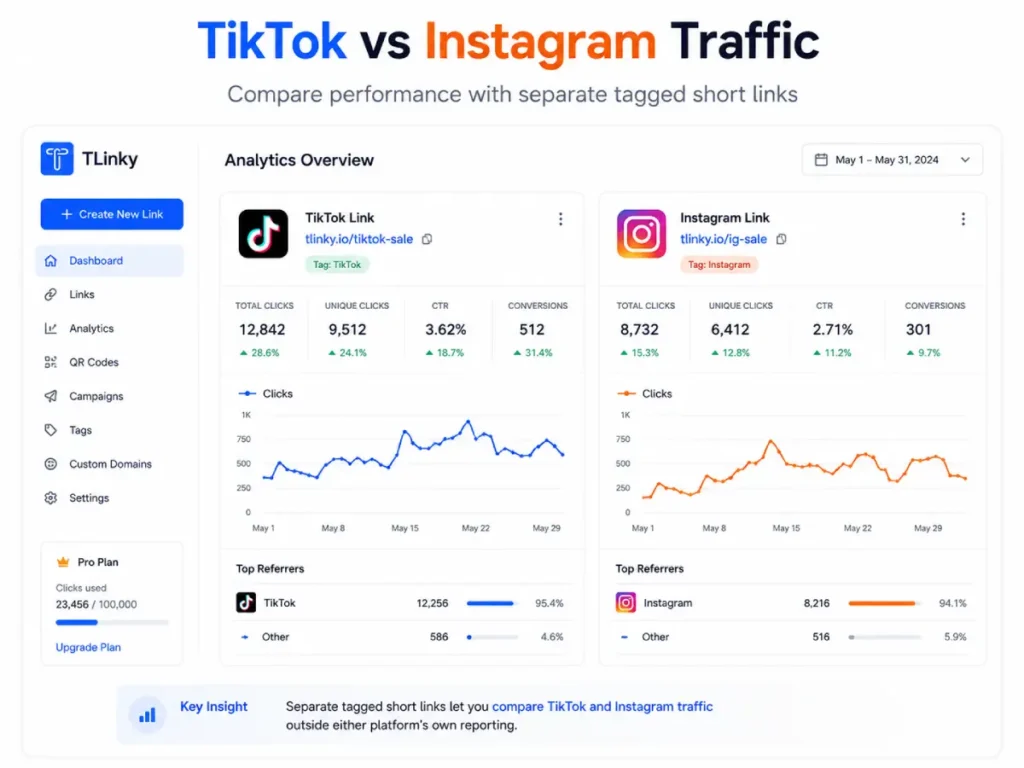
That view sits outside either platform’s own dashboard, which is the point.
From there, measuring link performance with click analytics shows which platform is sending people who click through, independent of what each ad platform claims about its own reach.
If your TikTok campaigns run through an affiliate or partner program, a URL shortener for affiliate marketing keeps that tracking consistent with the rest of your campaign links.
Common Mistakes When Testing Both Platforms
- Using the same creative on both platforms unchanged: A TikTok-native video often looks out of place as an Instagram Reel, and a polished Instagram ad can feel like an interruption in TikTok’s feed.
- Judging Instagram against TikTok’s flat budget floor: Since Meta’s minimum varies by objective and bid strategy, a budget that clears TikTok’s $50 campaign floor may still be too low for a specific Instagram objective.
- Relying only on each platform’s own reporting: In-platform numbers from TikTok and Instagram measure different things and rarely match, so cross-platform attribution needs its own tracking layer.
- Running both platforms without a content calendar to match: A social media scheduling tool helps keep organic posting consistent while paid tests run alongside it.
- Ending a test too early: TikTok’s optimization and Meta’s learning phase both need enough conversion volume before performance data is reliable, so a two or three day test on either platform rarely tells you much.
Frequently Asked Questions
Common questions advertisers ask when deciding between TikTok Ads and Instagram Ads, based on how these platforms are typically compared.
Is TikTok Ads cheaper than Instagram Ads?
Cost varies by industry, objective, and bidding strategy, so neither platform is universally cheaper. What differs concretely is the budget structure itself.
TikTok enforces a stated minimum of $50 per campaign and $20 per ad group. Meta does not publish an equivalent fixed minimum for Instagram, since its requirement shifts based on your bid strategy and objective.
Can I use the same ad on TikTok and Instagram?
Technically yes, but performance usually suffers. TikTok’s feed rewards native, unpolished video, while Instagram’s audience responds better to more curated visuals.
Reusing a TikTok-native video as an Instagram Reel without adjusting pacing or on-screen text often reads as low effort to an Instagram audience. The reverse also tends to underperform on TikTok’s feed.
Which platform is better for a small business with a limited budget?
It depends on the product and audience more than the budget size itself. A visually driven product with an existing following often does better starting on Instagram, since retargeting warm traffic is cheaper than cold discovery.
A product that benefits from a quick demo or targets a younger buyer often does better starting on TikTok, since its discovery-based feed does not require an existing following to get initial visibility.
Do TikTok and Instagram Ads Manager use the same dashboard?
No. TikTok Ads run through TikTok Ads Manager, a separate platform from Meta’s tools.
Instagram Ads run through Meta Ads Manager, the same dashboard used for Facebook. Comparing TikTok Ads Manager against Facebook Ads Manager directly is a useful reference point if you are already familiar with Meta’s interface and evaluating whether to add TikTok.
How do I know which platform is actually driving results if I run both at once?
Each platform’s own reporting only tracks activity inside that platform, so the two dashboards will not agree with each other or with your sales data.
Tagging each platform’s traffic with a separate short link, then reviewing click analytics outside either ad platform, gives you a neutral view of which one is actually sending people who click through to your site.
Wrapping Up
TikTok Ads and Instagram Ads are not interchangeable versions of the same tool. TikTok enforces a flat, published budget floor, while Instagram’s minimum shifts with your objective and bid strategy.
Match the platform to your product and audience first, then test with a real budget rather than the platform’s absolute minimum. A demo-friendly, impulse-driven product usually starts stronger on TikTok, while a visually driven, trust-dependent product usually starts stronger on Instagram.
Whichever platform you start with, TikTok Ads Manager is worth reviewing in full before your first campaign goes live. Tag your campaign links from day one so the results you compare later are your own, not just what either platform reports about itself.
Sources
- Budget and Bidding FAQs, TikTok For Business
- Best Practices for Minimum Budgets, Meta Business Help Center
- About Daily Budgets, Meta Business Help Center
- Social Media Benchmarks Emplifi
- Americans’ Social Media Use Pew Research Center