
TikTok does not publish a public rate card. There is no fixed price for a TikTok ad. The cost of advertising on TikTok is determined by a real-time auction, which means what you pay depends on your campaign objective, your audience targeting, the quality of your creative, and how much competition exists for that audience at that moment.
Understanding the factors that drive cost gives you more control over what you spend and what you get back from it.
In this guide, you will learn:
- The confirmed official minimum budgets required to run TikTok ads
- How TikTok’s auction model determines what you pay
- What factors push costs up or down
- How costs differ by campaign objective
- How to plan your budget before launching
Get Free TikTok Ad Credit Up to $6000 [Limited Time Offer]

Key Takeaways
- TikTok Ads Manager requires a minimum of $50 per day at the campaign level and $20 per day at the ad group level
- TikTok uses a real-time auction model; your final cost depends on audience competition, creative quality, and bid strategy
- Higher creative quality typically lowers your effective CPM because TikTok rewards content that earns genuine engagement
- Q4 (October through December) consistently produces higher ad costs across all platforms due to increased advertiser competition
- TikTok does not publish official CPM or CPC benchmarks; cost estimates from third parties vary widely depending on industry, market, and campaign setup
How Much Do TikTok Ads Cost?
TikTok ad costs are determined by auction, not fixed pricing. The confirmed minimums from TikTok’s official Ads Manager are $50 per day at the campaign level and $20 per day at the ad group level. Actual cost per impression (CPM) or cost per click (CPC) varies significantly based on your target audience, ad quality, campaign objective, and the competitive landscape at the time of delivery.
What Are the Official Minimum Budgets for TikTok Ads?
TikTok Ads Manager has two confirmed minimum budget requirements that apply regardless of campaign type or objective. For a detailed breakdown of TikTok ads minimum budget requirements and what you actually need to start, see our complete guide.
Campaign-level daily budget minimum: $50 USD. This is the maximum spend TikTok will allow across all ad groups within that campaign in a single day. Setting a campaign budget caps your total daily exposure.
Ad group-level daily budget minimum: $20 USD. This applies at the individual ad group level. Each ad group you run must have at least $20 per day allocated.
These minimums mean that running a single ad group costs at least $20 per day. Running three ad groups within one campaign costs at least $60 per day at the ad group level, though the campaign-level budget cap still applies.
There is no minimum spend for individual ads within an ad group; the minimums operate at the campaign and ad group levels only.
For advertisers testing TikTok for the first time, the practical starting point is one campaign with one ad group at the $20 minimum. This keeps costs low while generating enough data to evaluate performance before scaling.
How Does TikTok’s Auction Model Work?
TikTok uses a real-time auction to determine which ads are shown to which users and at what cost. Every time a TikTok user opens a piece of content, an auction runs in milliseconds among all advertisers targeting that user, and the winning ad is displayed.
The auction winner is not simply the advertiser with the highest bid. TikTok’s auction model considers a combination of:
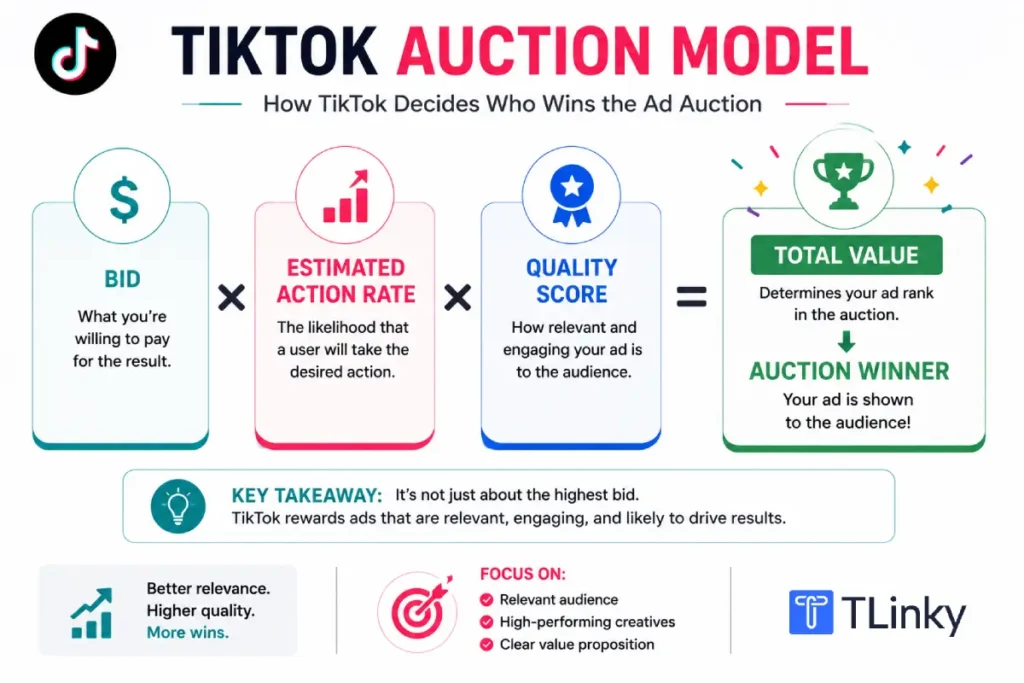
Your bid: The maximum amount you are willing to pay for a given action (an impression, click, or conversion, depending on your optimization goal and bidding strategy).
Estimated action rate: TikTok’s prediction of how likely this specific user is to take the desired action, such as a click, watch, or purchase, based on their past behavior and your creative’s historical performance.
Ad quality: TikTok rewards ads that earn genuine engagement. Creative that users watch fully, engage with, or share is assigned a higher quality score, which reduces the effective cost per action because TikTok is happy to show engaging content.
The combination of bid, predicted action rate, and quality score produces your total value in the auction. You do not necessarily need the highest bid to win; high creative quality can outperform a higher bid from a lower-quality advertiser.
This mechanic matters practically: investing in better creative is not just a brand exercise; it directly lowers your cost per result.
What Factors Drive TikTok Ad Cost Up or Down?
Several variables have a direct impact on how much you pay per impression, click, or conversion.
Creative quality: This is the highest-leverage factor under your control. Ads that earn strong watch time, completion rates, and engagement signals are rewarded by TikTok’s delivery system with lower effective CPMs. The platform wants to show content that keeps users engaged; ads that accomplish this are treated more favorably in the auction than ads that cause users to skip.
Audience targeting specificity: The narrower and more competitive your target audience, the higher the CPM. Targeting a broad audience (all adults 18-45 in the US) costs less per impression than targeting a narrow, high-intent segment (women 25-34 with a history of purchasing beauty products). The trade-off is conversion rate; narrower audiences typically convert better, which can offset the higher CPM.
Campaign objective: Awareness campaigns optimized for reach tend to have lower CPMs than conversion campaigns optimized for purchases, because the competitive pool for purchase-intent audiences is smaller and more valuable to advertisers. Video Views campaigns generally cost less per delivered view than Sales campaigns cost per conversion.
Geographic market: Advertising costs vary significantly by country. Markets like the United States, United Kingdom, Canada, and Australia are more competitive and therefore more expensive per impression than markets in Southeast Asia or Latin America.
Seasonality: Q4 (October through December) sees a significant cost increase across all digital advertising platforms, including TikTok. As retailers and e-commerce brands increase budgets for holiday sales periods, competition for audiences intensifies and CPMs rise. Planning campaigns for Q1 or Q2 with equivalent budgets will deliver more impressions for the same spend.
Bidding strategy: TikTok offers several bidding strategies: Lowest Cost (TikTok spends your budget to get the most results at the lowest cost), Cost Cap (maintains an average cost per result near your target), and Minimum ROAS (targets a specific return on ad spend). Each strategy interacts differently with the auction and produces different cost structures.
Ad freshness: Creative fatigue affects cost. An ad that has been running for several weeks to the same audience sees declining engagement, which lowers its quality score and raises effective CPM. Rotating creative regularly maintains performance efficiency.
How Do Costs Differ by Objective?
Different campaign objectives optimize for different outcomes, and the cost structure reflects that.
Reach campaigns optimize for impressions. You pay for exposure to your target audience, not for any specific action. This is typically the lowest-cost format in terms of CPM because TikTok is optimizing for a simple, easily deliverable outcome.
Traffic campaigns optimize for link clicks. Cost is measured as CPC (cost per click). Traffic campaigns are more expensive than reach campaigns because you are paying for users to take an action, not just see the ad.
Video Views campaigns optimize for 2-second or 6-second video videos. These sit between reach and traffic in cost, as you pay when a user watches beyond the first few seconds, which filters out pass-bys but is a lower-intent action than clicking.
Conversion campaigns optimize for on-site actions like purchases or form completions. These campaigns have the highest cost per action because the target audience segment is the most competitive and the optimization goal is the most valuable. However, they are designed to directly produce revenue, so the cost is evaluated against return on ad spend (ROAS) rather than CPM.
Lead Generation campaigns sit between traffic and conversion in typical cost. You pay for lead form submissions, which are more valuable than clicks but less directly revenue-generating than purchases.
How to Plan Your TikTok Ad Budget
Before launching a campaign, clarify which objective you are running and what result is worth it to your business.
For awareness campaigns: decide how many impressions or unique users you want to reach in your target market. Use the TikTok Ad Cost Estimator by Country to estimate impressions your budget can purchase.
For conversion campaigns: identify your target cost per acquisition (CPA). If your product has a $60 average order value and a 30% margin, you can afford to pay roughly $6 to $18 per purchase in ad cost before the campaign becomes unprofitable. Set your optimization goal and bidding strategy accordingly.
For testing: allocate a defined test budget before committing to scale. A common approach is running three to five ad creatives for 7 to 14 days with a controlled budget to establish baseline performance data before optimizing spend. The TikTok Ads Budget Planner helps structure this testing phase.
Use the TikTok Ads ROI Calculator to model expected return against different budget scenarios based on your product margin and target conversion rate.
How to Reduce TikTok Ad Costs Without Reducing Reach
Improve creative quality: As covered in the auction model section, better creative earns more favorable delivery costs. Test multiple creative approaches, such as different hooks, formats, and content styles, and shift budget toward the creative with the best cost per result. Strong organic content often performs better than produced brand advertising.
Use Spark Ads on top-performing organic content: Spark Ads amplify posts that already have organic engagement, which means they typically carry higher quality scores than cold ad creative. This can reduce effective CPM compared to running a standard in-feed ad with equivalent content that has no prior engagement history.
Test broader audiences first: Starting with broader targeting before narrowing lets TikTok’s machine learning identify which user segments are most likely to convert. Prematurely narrow targeting restricts the algorithm’s optimization capability and often increases CPA unnecessarily.
Avoid Q4 if your campaign is not seasonal: If you have flexibility on timing, campaigns run in Q1 and Q2 typically produce lower CPMs for equivalent audience targets. A budget that produces 100,000 impressions in October may produce 130,000 to 150,000 impressions in February.
Rotate creative before fatigue sets in: Introduce new creative variants every three to four weeks for ongoing campaigns. Ad fatigue reduces engagement quality scores, which increases effective CPM. Fresh creative resets the quality signal.
FAQ
Does TikTok charge you if your ad gets no clicks?
It depends on your bidding setup. If you are running a campaign optimized for clicks (CPC bidding), you are charged per click. If you are running CPM bidding, you are charged per 1,000 impressions regardless of whether users click. In most automated bidding scenarios on TikTok, you only pay for the specific action the campaign is optimized for.
Is TikTok advertising more or less expensive than Meta (Facebook/Instagram)?
TikTok and Meta operate in similar cost ranges for comparable audiences, but direct comparison is difficult because audience composition, creative requirements, and ad placement contexts differ significantly. TikTok generally offers a larger reach for younger audiences (18-34) at comparable CPMs, while Meta has stronger infrastructure for precise interest and behavioral targeting. The most accurate comparison is to run equivalent campaigns on both platforms and measure cost per result directly.
Do TikTok ad costs increase as you scale your budget?
Increasing budget can raise effective CPM if you exhaust your best-performing audience segments and have to reach into less engaged user pools. This is common at scale. Strategies to mitigate it include expanding creative variety, broadening targeting, adding lookalike audiences, and refreshing content regularly.
Can small businesses afford TikTok ads?
The $20 daily minimum at the ad group level makes TikTok accessible for small businesses at a basic level. Whether it is cost-effective depends on your product margins and conversion rate. A business with a $150 product and a 50% margin has more room to absorb ad costs than a business with a $25 product and a 20% margin. The TikTok shop profit calculator helps model this if you are also selling on TikTok Shop.
How much should I spend to test TikTok ads?
For a meaningful test that produces actionable data, plan to run your campaign for at least 7 days with a minimum of $140 total (one ad group at $20/day). Most advertisers planning a serious test allocate $300 to $500 for a two-week creative testing period with three to five creative variants. This produces enough data across different audiences and times of day to draw reliable performance conclusions.
Wrapping Up
TikTok ad costs are not fixed, and the numbers cited by third-party sources vary enough to be misleading for planning purposes.
What is certain is the official minimum budget structure ($50 campaign level, $20 ad group level) and the auction model mechanics that determine actual cost.
The most reliable way to know what TikTok ads cost for your specific product, audience, and market is to run a structured test with a defined budget and measure cost per result directly.
Creative quality is the single highest-leverage factor under your control, since investing in better content typically produces lower effective costs than increasing bid levels.
For a full overview of TikTok’s ad formats and how to build campaigns, the TikTok Ads Manager guide covers the complete campaign setup workflow.
The TikTok Spark Ads guide explains how to amplify organic content, which often produces better cost efficiency than cold ad creative.
Sources:
- How to Set Up a Campaign, TikTok Business Help Center
- About TikTok Ads Structure, TikTok Business Help Center
- How to Choose the Right Objective, TikTok Business Help Center