
TikTok and Facebook are two of the most widely used advertising platforms in the world, and they work very differently. Choosing between them is not a question of which is better overall. It is a question of which is better for your specific goal, your audience, and the type of creative you can produce.
In 2026, the most effective advertisers use both. But if you are starting with one or working with a limited budget, understanding where each platform excels makes the difference between efficient spend and wasted budget.
In this guide, you will learn:
- How TikTok and Facebook ads compare on cost, reach, targeting, and creative
- Which platform performs better for awareness, e-commerce, and lead generation
- What creative works on each platform and why they are not interchangeable
- When to use both together and how they complement each other

Key Takeaways
- TikTok’s average CPM is approximately $3.50 compared to Facebook’s $6.59, making TikTok roughly 47% cheaper per thousand impressions for top-of-funnel reach.
- Facebook’s conversion rates for e-commerce and lead generation typically range from 8% to 14%, while TikTok averages 3% to 6%. Facebook’s stronger lower-funnel performance reflects its more mature targeting and retargeting capabilities.
- TikTok creative fatigues fast. Most TikTok ad creatives peak within 7 to 10 days. Facebook creatives can sustain performance for weeks or months with the same assets.
- According to Pew Research Center data from March 2026, 44% of US adults aged 30 to 49 use TikTok. The platform’s audience is no longer exclusively young, though it skews younger than Facebook overall.
- Between 30% and 55% of medium to large advertisers now run TikTok, Facebook, and Google ads simultaneously, using TikTok for discovery and Facebook for retargeting and conversion.
TikTok Ads vs Facebook Ads
TikTok Ads offer lower CPMs, stronger creative reach, and better discovery-phase performance. Facebook Ads offer more precise targeting, higher conversion rates, and better lower-funnel ROI. For most e-commerce brands, TikTok works best for awareness and new customer acquisition while Facebook works best for retargeting warm audiences and scaling proven offers. The strongest results typically come from using both together.
New to TikTok Ads? Get Up to $6,000 in Matching Ad Credit
Audience: Who You Reach on Each Platform
TikTok’s Audience in 2026
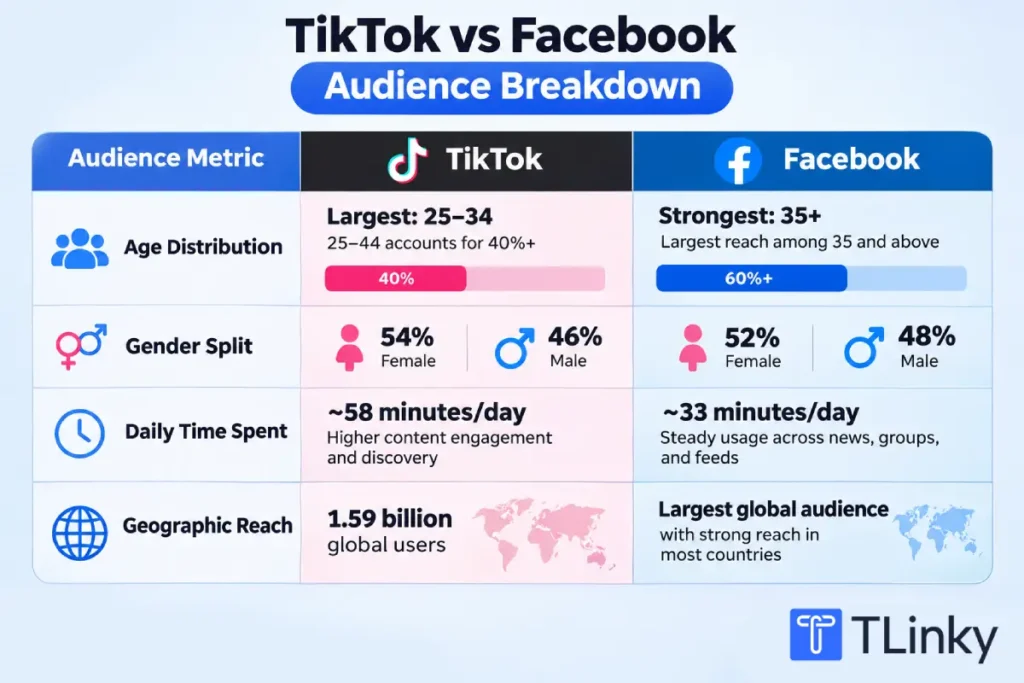
TikTok reached 1.59 billion global users as of January 2025, according to DataReportal. The platform’s demographics have shifted meaningfully since its early years. For a full breakdown of TikTok’s audience data and platform statistics, the TikTok statistics and facts guide covers the numbers marketers rely on most. Users aged 25 to 34 now represent the largest segment. The 25 to 44 age group collectively accounts for over 40% of TikTok’s user base.
TikTok skews slightly female (54% female, 46% male) and indexes heavily with mobile-first users who engage with content for entertainment and discovery. According to Pew Research Center (March 2026), 44% of US adults aged 30 to 49 use TikTok. This is not a Gen Z-only platform.
Facebook’s Audience in 2026
Facebook has the largest social media audience of any platform globally, with particularly strong penetration among users aged 35 and above. It remains the dominant platform for reaching adults over 45 and is essential for any brand targeting older demographics or professional audiences.
Facebook also benefits from the Meta ecosystem, meaning ad campaigns can extend to Instagram, Messenger, and Meta’s Audience Network automatically. This reach advantage is significant for campaigns targeting diverse age groups.
Audience Verdict
If your target customer is under 35 or is a mobile-first, discovery-oriented buyer, TikTok offers strong reach at lower cost. If your target customer is over 40 or you need to reach a very specific demographic slice, Facebook’s targeting depth and audience size give it the edge. For a full overview of TikTok’s ad formats, campaign types, and organic strategy, the TikTok for business guide covers how to build a complete presence on the platform before or alongside paid advertising.
Cost Comparison: CPM, CPC, and What You Get
Cost Per Thousand Impressions (CPM)
TikTok’s average CPM sits at approximately $3.50, compared to Facebook’s average of $6.59. This makes TikTok roughly 47% cheaper per thousand impressions for broad awareness campaigns. Lower CPM means your budget produces more eyeballs for the same spend.
The trade-off is that cheaper reach does not automatically mean more conversions. CPM measures how many people see your ad, not how many respond to it in the way you want.
Cost Per Click (CPC)
Both platforms are competitive at the click level, with average CPCs around $1.00 for each. The difference narrows significantly when you compare cost per result rather than cost per click, because the post-click conversion rates differ between the platforms.
Conversion Rates and Cost Per Acquisition
Facebook’s established retargeting infrastructure and more granular audience targeting produce higher conversion rates at the lower funnel. E-commerce conversion rates on Facebook typically range from 8% to 14%, while TikTok averages 3% to 6% for equivalent direct-response campaigns.
This means that while TikTok delivers cheaper reach, Facebook often delivers cheaper conversions for products with high purchase intent. For awareness and new audience acquisition, TikTok’s lower CPM wins. For converting warm audiences who already know your brand, Facebook’s conversion rates make it more cost-efficient per sale.
Use the TikTok Ads ROI Calculator and the TikTok Ads ROAS Calculator to model your expected return from TikTok campaigns before committing budget.
Targeting: Which Platform Gives You More Control
Facebook’s Targeting Advantages
Facebook’s targeting system is the most sophisticated in social advertising. You can target by detailed demographics, interests, behaviors, life events, income estimates, job titles, and more. Custom Audiences let you upload customer lists and target existing customers or create lookalike audiences based on your best buyers.
Facebook’s pixel and Conversions API infrastructure is mature and deeply integrated with most e-commerce platforms. Retargeting visitors who viewed a specific product, added to cart but did not purchase, or bought once and went inactive is precise and measurable on Facebook in ways TikTok has not fully matched.
TikTok’s Targeting Approach
TikTok’s targeting includes interests, behaviors, device type, geographic location, and custom audiences through the TikTok Pixel. The platform also offers a Lookalike Audience tool based on customer lists or video interaction data.
Where TikTok differs is in its algorithmic targeting. TikTok’s recommendation engine is extremely powerful at finding users who match a content profile, even without detailed manual targeting. Many advertisers running broad targeting on TikTok find the algorithm delivers relevant audiences more efficiently than precise manual targeting does.
For detailed targeting setup, the TikTok Ads Targeting guide covers all available targeting options and how to configure them in TikTok Ads Manager.
Targeting Verdict
Facebook wins on targeting precision and lower-funnel control. TikTok’s algorithm often matches Facebook for top-of-funnel discovery without requiring detailed audience setup. If you are retargeting warm audiences or need demographic precision, Facebook is the stronger tool.
Creative: What Works on Each Platform
TikTok Creative Requirements
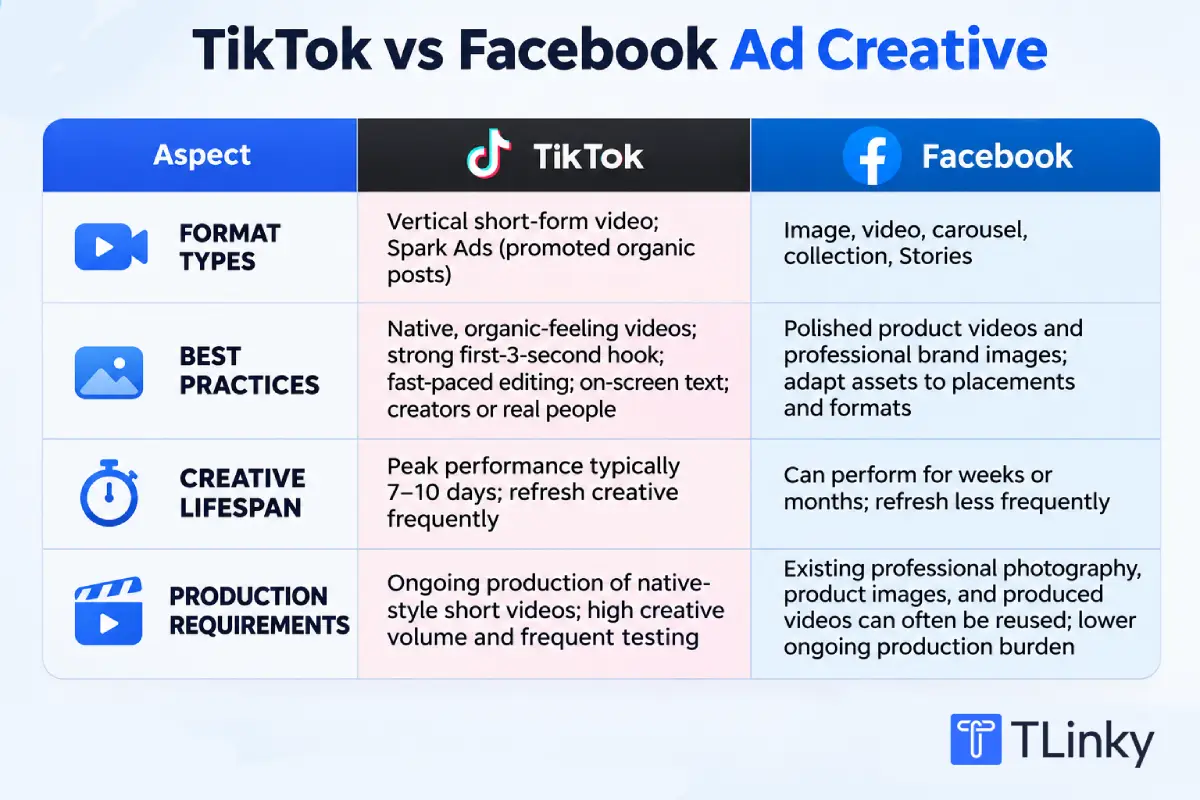
TikTok ads must feel native to the platform to perform. Content that looks like a polished advertisement is immediately recognizable as an ad to TikTok users and generates significantly lower engagement than content that resembles organic TikTok videos.
Effective TikTok ad creative is vertical, fast-paced, uses on-screen text, and often features a creator or real person rather than a studio production setup. The hook must work in the first three seconds. TikTok’s ad algorithm uses video completion rate as a quality signal for paid content as well as organic, meaning ads that hold attention receive better distribution and lower effective CPM.
TikTok ad creative fatigues quickly. Most creatives reach peak performance within the first seven to ten days. After that, performance drops and a new creative is needed. Brands that succeed on TikTok treat creative production as an ongoing operational function, not a one-time effort.
The TikTok Spark Ads format lets you promote existing organic creator posts as ads, which consistently performs better than traditional ad creatives because the content already looks and feels like native TikTok.
Facebook Creative Requirements
Facebook supports a wider range of creative formats: image ads, video ads, carousel ads, collection ads, and Stories. This format variety makes Facebook more accommodating to existing creative assets, whether professional photography, product images, or produced video.
Facebook’s audience is more tolerant of traditional advertising styles. A polished product video or professional brand image that would feel out of place on TikTok can perform well on Facebook. This means your existing brand assets are more likely to be usable without significant adaptation.
Facebook creatives can sustain performance for weeks or months. While creative fatigue does occur, the pace is slower than TikTok, which reduces the operational burden of continuous new content production.
Creative Verdict
If you have strong creative production capacity and can produce native-style short videos at volume, TikTok rewards that investment. If you have existing professional brand assets and limited creative production resources, Facebook is more forgiving. Most brands scaling on both platforms adapt their creative strategy separately for each rather than running the same assets everywhere.
Which Platform Wins by Objective
Brand Awareness
TikTok wins on awareness. Lower CPM, high daily time spent (1 hour 37 minutes average per user per day, DataReportal), and an algorithm that surfaces content to new audiences make TikTok the more efficient awareness vehicle for most product categories. An organic TikTok strategy running alongside paid campaigns reduces your effective cost per impression by letting organic content do part of the awareness work.
Direct Response and E-commerce Sales
Facebook wins for direct response. Higher conversion rates, stronger retargeting infrastructure, and deeper integration with e-commerce platforms produce more predictable cost per acquisition for most brands. TikTok Shop and its LIVE GMV Max campaigns, which TikTok made the Shop option in place of LIVE Shopping Ads in July 2025, are closing this gap for product categories that perform well in live commerce, but Facebook’s retargeting system remains more mature for general e-commerce. The TikTok live shopping ads guide covers how live commerce works as an alternative to standard conversion campaigns.
Lead Generation
Facebook wins for lead generation. Facebook Lead Ads allow users to submit their information without leaving the platform, and the targeting precision to reach specific professional demographics gives Facebook a structural advantage for B2B and high-value lead generation campaigns.
Local Business Advertising
Facebook wins for local businesses. Its geographic targeting is more precise at the local level, and its older, more settled demographic skews better toward local service business customers. TikTok local targeting is improving but Facebook’s longer history with local business advertising makes it the safer starting point.
When to Run Both Platforms Together
The question of TikTok vs Facebook is increasingly a false choice. Between 30% and 55% of medium to large advertisers now run both simultaneously, using each platform for what it does best. If Instagram is the Meta placement you care about most, our comparison of TikTok and Instagram ads covers budgets and creative for that pairing.
A common combined strategy: use TikTok to reach new audiences and build awareness at a low CPM. Users who engage with your TikTok content or visit your website become retargeting audiences on Facebook, where higher conversion rates close the sale more efficiently.
This funnel approach uses TikTok’s discovery strength at the top and Facebook’s conversion strength at the bottom. The two platforms complement each other in ways that neither matches running alone. Before committing to TikTok as part of your mix, the are TikTok ads worth it guide gives you a clear ROI framework and a list of red flags that signal when TikTok is not yet the right investment.
Budget starting point: if you are testing both for the first time, allocate 60% to Facebook (proven conversion infrastructure) and 40% to TikTok (lower CPM discovery). Adjust based on your actual CPA data after four to six weeks.
FAQ
Is TikTok advertising cheaper than Facebook?
TikTok’s average CPM is approximately $3.50 compared to Facebook’s $6.59, making TikTok roughly 47% cheaper per thousand impressions.
However, cost efficiency depends on the full conversion funnel, not just CPM. Facebook’s higher conversion rates often produce a lower cost per actual sale or lead even at a higher CPM, particularly for products with high purchase intent.
Compare cost per acquisition across both platforms rather than using CPM alone.
Which platform is better for e-commerce?
For top-of-funnel discovery and new customer acquisition, TikTok’s lower CPM and strong product discovery culture often deliver better value.
For retargeting, cart abandonment recovery, and scaling proven offers to warm audiences, Facebook’s conversion infrastructure is more mature.
Most e-commerce brands above $10,000 in monthly ad spend run both and use them at different funnel stages.
Do TikTok ads work for B2B brands?
TikTok B2B advertising is limited compared to Facebook, particularly for highly specific professional targeting.
Facebook’s job title, company size, and industry targeting make it substantially better for reaching business decision-makers.
TikTok B2B campaigns work in categories where decision-makers also consume entertainment content (technology, software tools, professional development) but require native, educational creative rather than traditional B2B advertising styles.
How different are the ad creation processes?
Facebook Ads Manager is more complex and feature-rich, with more targeting layers, placement options, and campaign objective types.
TikTok Ads Manager is simpler to navigate initially but has fewer granular controls. Both require connecting a tracking pixel to your website for conversion measurement.
The learning curve is similar for basic campaigns on both platforms; advanced campaign structures take longer to master on Facebook due to its greater complexity.
Should I start with TikTok or Facebook ads if I have a small budget?
Start with Facebook if you have an established product with proven demand and a warm audience from existing customers or website visitors.
Facebook’s retargeting capabilities make smaller budgets more efficient when you already have an audience to reach. Start with TikTok if you are a new brand without an established audience and need cost-efficient discovery.
TikTok’s lower CPM stretches a small budget further at the awareness stage. Either way, $50 to $100 per day is a realistic minimum for meaningful data collection on either platform.
Wrapping Up
TikTok and Facebook Ads serve different roles in 2026. TikTok delivers cheaper reach, stronger discovery, and native creative performance. Facebook delivers better targeting precision, higher conversion rates, and stronger lower-funnel ROI. The most effective strategy combines both, using TikTok to build awareness at scale and Facebook to convert that awareness into sales.
Start with the platform that matches your current biggest need. If you need discovery, start with TikTok. If you need conversions, start with Facebook. Once you have data showing what works, add the second platform to extend your reach or improve your conversion rate at the appropriate funnel stage.
For TikTok campaign setup from scratch, the TikTok Ads Manager guide covers the complete campaign structure. For understanding what TikTok advertising costs across different campaign types, the TikTok advertising cost guide provides current benchmarks.
Sources
- Stackmatix, TikTok Ads vs Facebook Ads Which Is Better in 2026
- Adligator, TikTok Ads vs Facebook Ads ROAS Comparison 2026
- DataReportal, TikTok Users Stats Data and Trends, January 2025
- Pew Research Center, 8 Facts About Americans and TikTok, March 2026
- eMarketer, TikTok Ad Revenue Global Forecast 2026