
TikTok is no longer a platform businesses can afford to treat as optional. With 1.9 billion users reached by TikTok’s advertising tools globally as of late 2025, according to Statista.
The platform has become one of the most effective channels for reaching adults under 45. For businesses that figure out how to use it well, TikTok offers a reach and engagement combination that other platforms struggle to match.
But TikTok for Business is not just a matter of posting more content. It requires understanding a different kind of platform, one built around entertainment, discovery, and authentic storytelling rather than polished brand announcements.
This guide covers everything a business needs to get started and grow on TikTok in 2026: account setup, content strategy, advertising, TikTok Shop, and how to measure what is actually working.
In this guide, you will learn:
- Why TikTok represents a significant opportunity for businesses in 2026
- How to set up and optimize a TikTok Business account
- What content strategy works for business accounts
- How paid advertising on TikTok works and when to use it
- How TikTok Shop can add a direct revenue channel for product businesses
- How to measure performance and refine your approach
Get Free TikTok Ad Credit Up to $6000 [Limited Time Offer]

Key Takeaways
- TikTok reached 1.9 billion users globally in Late 2025 (Statista), with 136 million active users in the US, making it one of the largest addressable advertising audiences available to businesses.
- eMarketer projects TikTok’s global ad revenue will reach $34.8 billion in 2026, reflecting the scale of business investment in the platform.
- According to DataReportal, TikTok’s average engagement rate of 2.8% to 5% significantly exceeds Instagram Reels (0.65%) and YouTube Shorts (0.40%). Content that resonates reaches further organically on TikTok than on competing short-form platforms.
- TikTok Shop generated an estimated $15.82 billion in US sales in 2025, according to eMarketer, establishing it as a major commerce channel for product businesses.
- Business accounts on TikTok get access to analytics, the commercial music library, advertising tools, and TikTok Shop, all of which are unavailable on personal accounts.
Is TikTok Worth It for Businesses?
Yes, for most businesses with a consumer-facing product or service targeting adults under 50. TikTok’s combination of organic reach potential, high engagement rates, and built-in commerce tools makes it one of the most effective platforms for building brand awareness and driving direct sales. The platform rewards authentic, entertainment-forward content over polished advertising.
Why TikTok Matters for Business in 2026
Scale and Audience Demographics
TikTok’s global user base of 1.9 billion includes a broad demographic spread. The 25 to 34 age group represents the largest segment at 35.3% of global users, followed by 18 to 24-year-olds at 30.7%.
Adults aged 35 and above represent a growing portion of the audience, with Pew Research Center data from March 2026 showing 44% of US adults aged 30 to 49 use TikTok.
This demographic reach makes TikTok relevant not just for businesses targeting Gen Z but for any brand reaching working-age adults.
The platform’s fastest-growing segments in recent years have been adults aged 30 to 50, a high-purchasing-power audience worth reaching.
Time Spent and Attention
The average TikTok user spends approximately 1 hour and 37 minutes per day on the platform, according to DataReportal.
This is significantly more time than users spend on most other social apps. More time spent means more opportunities for your content and ads to reach potential customers in a single session.
Commerce Integration
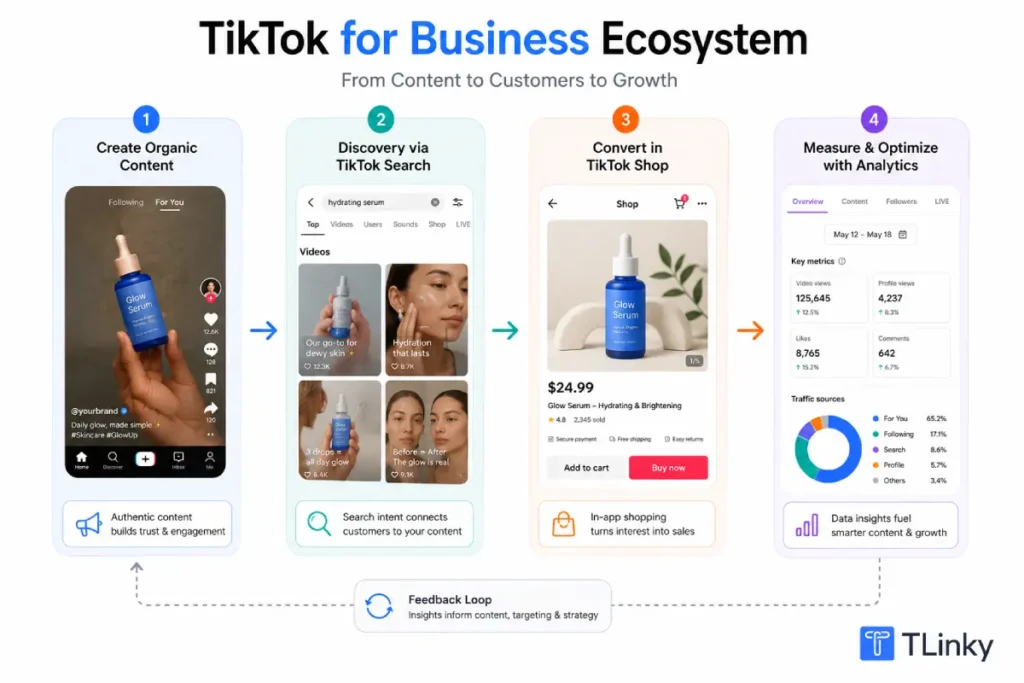
TikTok has invested heavily in making commerce native to the platform. TikTok Shop allows businesses to list products directly within TikTok, enabling in-app purchases without redirecting users to an external website.
According to eMarketer, TikTok Shop reached $15.82 billion in estimated US sales in 2025, a figure that reflects just how quickly the platform has become a serious commerce channel.
Setting Up a TikTok Business Account
Creating Your Business Account
A TikTok Business account is separate from a personal account and provides access to a different set of tools.
To create one: open TikTok, go to Settings and Privacy, select Manage Account, and switch to a Business Account. You can also create a Business account from the start if you are setting up a new profile.
Choose the appropriate business category during setup. This helps TikTok’s algorithm categorize your content correctly and match it with relevant audiences.
Optimizing Your Business Profile
Your profile is the first destination a viewer reaches after watching any of your videos. Optimize every element:
Profile name: Use your business name or the name your customers know you by. Avoid keyword stuffing. TikTok’s search algorithm processes your profile name, but stuffing keywords makes your brand look unprofessional.
Profile photo: Use your brand logo or a consistent visual identifier. This should match your branding across other platforms for recognition.
Bio: You have 80 characters. Use them to state clearly what you do and who you serve. Include a call to action and a link. TikTok Business accounts can add a clickable website link in their bio.
Link in bio: Your bio link is the only clickable link in organic TikTok content. If you are driving traffic to multiple destinations such as your website, TikTok Shop, or a product page, a link management tool helps route viewers to the right place from a single bio URL.
What Business Accounts Can Do That Personal Accounts Cannot
- Access TikTok Analytics with full data (personal accounts get limited analytics)
- Use the TikTok Commercial Music Library (licensed tracks safe for business use)
- Set up TikTok Shop and list products directly
- Run advertising campaigns through TikTok Ads Manager
- Access TikTok’s Business Center for multi-user management
Content Strategy for TikTok Business Accounts
The Entertainment-First Mindset
TikTok’s culture rewards content that entertains, educates, or tells a compelling story. Content that opens with a product announcement or a direct pitch loses viewers in the first few seconds, which is the algorithmic equivalent of burying your own reach.
The most effective business content on TikTok follows a principle TikTok itself calls “TikTok-first” content: created specifically for the platform’s culture and format rather than repurposed from Instagram, YouTube, or TV ads. This means starting with what interests the viewer, not what the business wants to say.
The TikTok marketing guide covers how to develop a content approach that aligns with TikTok’s culture while serving your business goals.
Content Types That Perform Well for Businesses
Behind-the-scenes content: Showing how your product is made, how your team operates, or what your business looks like day-to-day creates authenticity and transparency that audiences respond to. Behind-the-scenes content consistently generates strong engagement because it feels genuinely personal.
Educational and how-to content: Short tutorials, explainer videos, and step-by-step guides perform exceptionally well on TikTok and generate search traffic over time. A business that teaches viewers something useful earns trust and builds authority before any sales ask.
Product demonstrations: Rather than announcing product features, demonstrate the product solving a real problem. Show the before and after. Let the result do the persuading. This format works particularly well for TikTok Shop. The TikTok Shop guide covers how to create effective shoppable video content.
User-generated content: TikTok’s culture values authentic voices over polished brand content. Reposting or featuring customer-created videos (with permission and credit) provides social proof in the format TikTok audiences trust most.
Trend participation: Adapting trending formats to your business niche captures trend-related distribution while maintaining brand relevance. The TikTok Trends guide covers how to find trends early and adapt them without losing your content identity.
Posting Frequency for Business Accounts
For most business accounts, three to five posts per week is a sustainable starting cadence. This gives TikTok’s algorithm enough content to learn what your account produces, who your audience is, and how to categorize and distribute your videos.
Daily posting accelerates this learning process but only makes sense if content quality can be maintained at that frequency.
Quality always outperforms quantity on TikTok. A three-videos-per-week schedule with strong hooks and high completion rates will consistently outperform seven posts per week with poor retention.
TikTok Advertising for Businesses
When to Start Advertising
Organic content should come before paid advertising for most businesses. Running ads to an account with weak organic content wastes budget, because the algorithm uses your account’s content quality as part of how it evaluates and delivers ads. Build a library of organic content first, understand what resonates with your audience, and then use paid amplification to scale what is already working.
How TikTok Ads Work
TikTok advertising runs through TikTok Ads Manager, which provides campaign creation, audience targeting, budget management, and performance analytics. The TikTok Ads Manager guide covers the platform’s full interface and campaign structure.
TikTok offers several campaign types:
In-Feed Ads appear in the For You Page and look similar to organic content. They are the most commonly used format for direct response campaigns.
TopView Ads appear as the first video a user sees when opening the app. This is TikTok’s highest-visibility placement and the most expensive per impression.
Branded Hashtag Challenges are sponsored trend campaigns that encourage user participation under a branded hashtag. These work best for brand awareness goals with significant budget.
Spark Ads let you boost existing organic videos, either your own or a creator’s with permission, into paid promotion. This is often the most efficient starting point because you are amplifying content that has already demonstrated organic performance. The TikTok Spark Ads guide covers how Spark Ads work and when to use them.
TikTok Advertising Costs
TikTok advertising costs vary widely by objective, audience, and competition. eMarketer projects TikTok’s global ad revenue will reach $34.8 billion in 2026, reflecting significant and growing business investment.
For budget planning, use the TikTok Ads Budget Planner to estimate costs based on your campaign goals.
The TikTok advertising cost guide covers current pricing benchmarks, CPM ranges, and how to manage budget for different campaign types.
TikTok Shop for Product Businesses
TikTok Shop enables businesses to list products directly within TikTok, allowing viewers to purchase without leaving the app.
The impact of removing purchase friction is significant. eMarketer estimates TikTok Shop reached $15.82 billion in US sales in 2025.
For product businesses, TikTok Shop creates a direct path from content to purchase. A viewer watching a product demonstration can tap to buy immediately rather than being redirected to an external website, a journey that loses significant purchase intent with each additional step.
Key TikTok Shop features for businesses:
- Product showcase tabs on your profile
- Shoppable video overlays (product tags visible while the video plays)
- TikTok Live Shopping (products displayed and purchasable during live streams)
- Affiliate creator program (creators earn commission on products they feature)
The TikTok Shop guide covers setup and strategy for product businesses using the platform. For profit calculation and margin planning, the TikTok Shop Profit Calculator helps model your numbers before scaling.
Measuring Business Performance on TikTok
Key Metrics for Business Accounts
TikTok Analytics provides video-level and account-level data for business accounts.
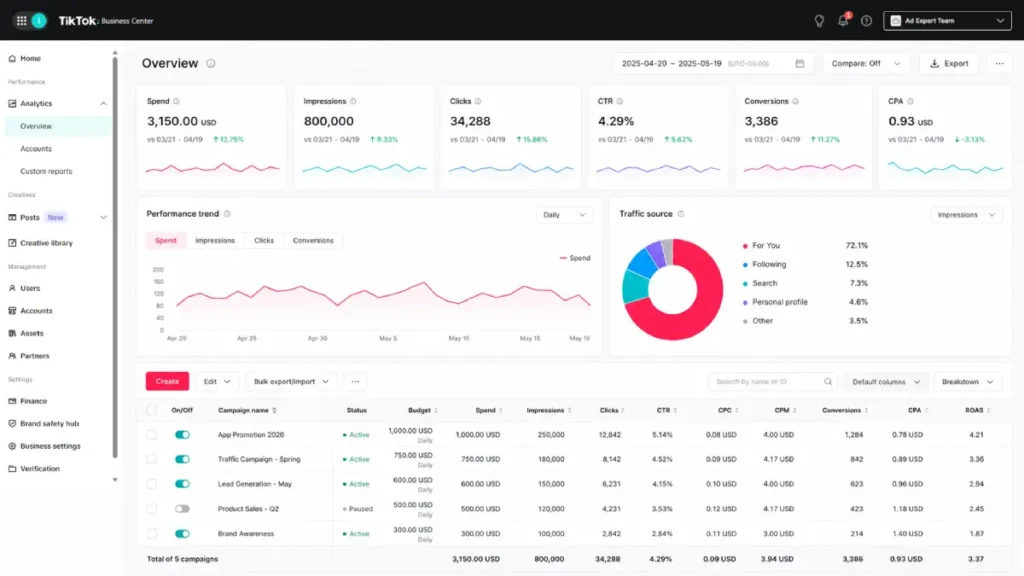
The most important metrics for business goals:
Completion rate: The percentage of viewers who watch your video to the end. This is the algorithm’s strongest quality signal and a proxy for how well your content holds attention.
Traffic source breakdown: Where your views are coming from: For You Page, TikTok Search, hashtag pages, or profile visits. Understanding your traffic sources tells you whether your content is performing through algorithmic distribution, search optimization, or direct audience engagement.
Profile visits: How many viewers clicked to your profile after watching a video. A high profile-visit rate from a specific video indicates that the content drove strong interest in learning more about your business.
Follower source: Which videos are driving the most new followers. This shows which content types are converting viewers into ongoing audience members.
Website clicks: For business accounts with a website link, TikTok tracks clicks from your bio link, giving a partial picture of traffic driven to your website.
The TikTok Analytics guide covers how to navigate the full analytics dashboard and track the metrics that matter most for business goals.
For advertising-specific ROI, the TikTok Ads ROI Calculator helps you model return on ad spend against your campaign costs and conversion rates.
Common Mistakes Businesses Make on TikTok
Treating TikTok like other platforms. Content that performs well on Instagram or LinkedIn rarely works on TikTok without significant adaptation. TikTok requires entertainment-first content, even for B2B or professional brands.
Posting only promotional content. Accounts that only post product announcements and sales messages build small audiences that do not engage. The 80/20 rule applies: roughly 80% content that educates, entertains, or tells a story, 20% direct promotion.
Ignoring organic before running ads. Running paid campaigns to an account with limited organic content history produces higher costs and lower conversion because the algorithm has insufficient data to find and convert the right audience efficiently.
Slow response to trends. Brands with long content approval processes often miss the growth window of trends they could participate in effectively. Building a fast-track process for trend-responsive content is worth the internal effort.
Not measuring traffic sources. Many businesses look only at view counts and miss the information in traffic source data, which shows whether content is building search visibility, FYP distribution, or direct audience engagement.
FAQs
Do I need a large budget to succeed on TikTok as a business?
No. TikTok’s organic algorithm distributes strong content regardless of advertising budget. Many small businesses have built significant audiences and revenue through organic TikTok content alone. A paid advertising budget amplifies organic success but is not a prerequisite. Start with organic content, learn what resonates with your audience, and introduce paid amplification once you have identified your highest-performing content types.
What type of businesses work best on TikTok?
TikTok works best for businesses with a visual, story-driven, or demonstrable product or service. Consumer goods, beauty, food, fitness, fashion, education, and entertainment are natural fits. B2B businesses can also succeed by focusing on educational content, industry insights, and behind-the-scenes storytelling, though the organic reach potential tends to be lower than in consumer categories. Service businesses can perform well by documenting client results, sharing expertise, and participating in relevant trends.
Can TikTok replace my other marketing channels?
TikTok should be part of a multi-channel marketing strategy, not a replacement for other channels. Its strengths include organic reach, entertainment engagement, and commerce integration, which complement email, search, and paid social rather than replacing them. The most effective businesses use TikTok to drive awareness and TikTok Shop purchases, then convert buyers into email subscribers or repeat customers through other channels.
How long before a TikTok business account sees results?
Most business accounts see meaningful traction within 60 to 90 days of consistent posting, assuming content quality is strong and posting frequency is at least three times per week. Early results are often variable. Individual videos may go viral while others receive minimal views. The algorithm needs time and data to identify your audience accurately. Sustained consistency produces more stable, predictable growth than trying to force early viral moments.
Is TikTok safe for advertising given regulatory uncertainty?
TikTok has faced regulatory scrutiny in the United States and other markets. As of mid-2026, TikTok continues operating in the US under ongoing discussions about its ownership structure. Businesses advertising on TikTok should maintain active campaigns on other platforms as a precaution against platform disruption, which is standard practice for any single-channel dependency. Regulatory status can change, so monitoring news developments is advisable.
Wrapping Up
TikTok for Business in 2026 offers a combination of scale, engagement, and commerce integration that makes it one of the strongest platforms available for consumer-facing businesses. The learning curve is real.
TikTok requires a different content approach than other social platforms, but businesses that invest in understanding TikTok’s culture and algorithm tend to find strong returns.
Start with a Business account, build an organic content library, use TikTok Analytics to understand what resonates, and introduce paid advertising or TikTok Shop once your organic foundation is in place.
For the content strategy that powers organic growth, the organic TikTok strategy guide covers the full planning system. For the analytics skills to measure your results, the TikTok Analytics guide explains every metric that matters for business accounts.
Sources
- TikTok Business Help Center, Business Account Setup
- TikTok Newsroom, Commerce and Creator Updates
- DataReportal, TikTok Users Stats Data and Trends, January 2025
- eMarketer, TikTok Ad Revenue and TikTok Shop Sales Forecast 2026
- Pew Research Center, 8 Facts About Americans and TikTok, March 2026
- Statista, Most popular social networks worldwide