TikTok influencer marketing has matured significantly since the platform’s early days. What started as an organic creator ecosystem has become a structured marketing channel with defined tiers, professional rates, and measurable ROI.
With 1.99 billion global users reached by TikTok’s advertising tools as of late 2025, according to Statista, and average daily usage of 1 hour and 37 minutes per person, the audience attention available through TikTok creators is substantial. The challenge for brands is finding the right influencers, not just the biggest ones.
In this guide, you will learn:
- How TikTok influencer tiers work and which tier makes sense for different goals
- How to find and evaluate TikTok influencers in your niche
- What influencer marketing costs on TikTok and how to set a budget
- How to structure a brief, negotiate rates, and measure results
Get Free TikTok Ad Credit Up to $6000 [Limited Time Offer]

Key Takeaways
- TikTok influencer marketing is not about follower count alone. Engagement rate, niche alignment, and audience quality matter more than raw numbers.
- According to DataReportal, TikTok’s average engagement rate of 2.8% to 5% significantly outperforms Instagram Reels (0.65%) and YouTube Shorts (0.40%). This makes TikTok creator partnerships more efficient per view than comparable partnerships on other platforms.
- TikTok’s Creator Marketplace provides brands with direct access to creator analytics including follower demographics, engagement rates, and past brand partnership performance.
- Micro-influencers (10,000 to 100,000 followers) often outperform mega-influencers in purchase conversion because their audiences are more engaged and more aligned with a specific interest category.
- Spark Ads, which let brands boost a creator’s organic post as paid media, typically deliver better results than standard in-feed ads because the content looks and feels like native TikTok rather than advertising.
What Is a TikTok Influencer?
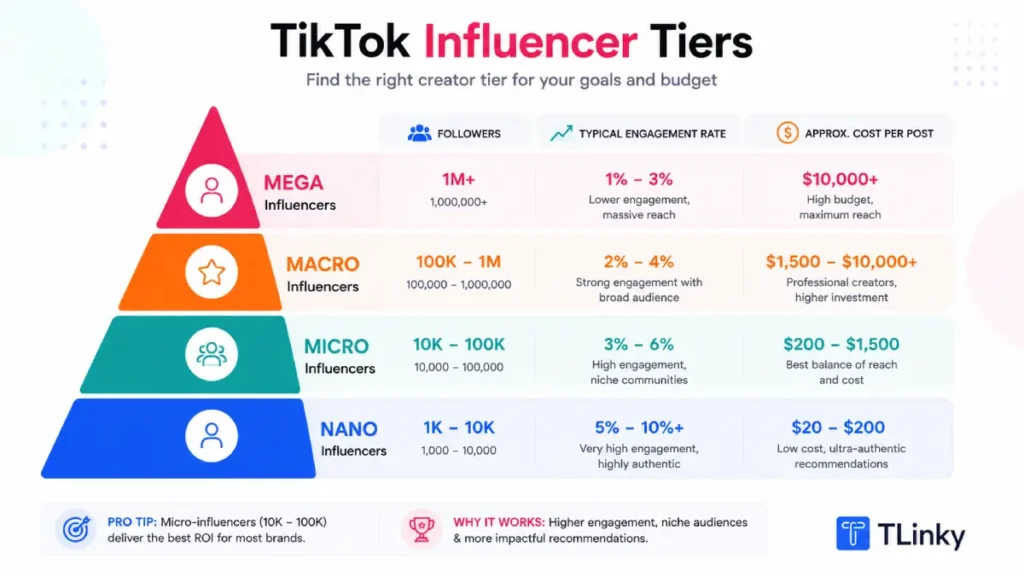
A TikTok influencer is a creator with an established audience who produces content that influences their followers’ opinions, preferences, or purchasing decisions. On TikTok, influencers are typically categorized by follower count: nano (1,000 to 10,000), micro (10,000 to 100,000), macro (100,000 to 1 million), and mega (1 million and above). Engagement rate is a more reliable performance indicator than follower count.
TikTok Influencer Tiers Explained
Nano Influencers (1,000 to 10,000 Followers)
Nano influencers have small but highly engaged communities. Their engagement rates are often the highest of any tier because their audience consists largely of people who genuinely know and follow them for their specific content.
For brands, nano influencers offer low cost and high authenticity. A product placed in a nano creator’s video feels like a personal recommendation from a friend rather than paid advertising. This works well for local businesses, niche products, and early-stage brands testing influencer marketing.
The trade-off is reach. A single nano influencer partnership produces limited raw view numbers. Effective nano campaigns typically involve five to twenty creators simultaneously.
Micro Influencers (10,000 to 100,000 Followers)
Micro influencers represent the most popular tier for brand partnerships in 2026. They have large enough audiences to provide meaningful reach while maintaining the niche focus and engagement rates that make TikTok partnerships valuable.
Engagement rates in this tier typically range from 3% to 6%, often exceeding the platform average. Micro influencers in specific niches such as fitness, skincare, home decor, and food have highly targeted audiences aligned with relevant product categories.
Micro influencer rates typically range from $200 to $1,500 per post depending on niche, engagement rate, and the complexity of the deliverable.
Macro Influencers (100,000 to 1 Million Followers)
Macro influencers offer broad reach and recognizable names within their content category. At this scale, follower counts represent genuine audience building rather than niche community.
These creators typically have professional management and established rate cards. Brand partnerships with macro influencers move more slowly, require more formal agreements, and come with higher minimum budgets.
Rates for macro influencer TikTok posts typically start at $1,500 and can reach $10,000 or more for prominent creators.
Mega Influencers and Celebrities (1 Million and Above)
Mega influencers are TikTok-native stars or cross-platform celebrities with massive reach. Partnerships at this tier involve significant budget, formal contracts, and often extended relationship terms rather than one-off posts.
These partnerships make sense for large-scale brand awareness campaigns but less so for direct-response or niche product campaigns where purchase intent matters more than raw impression volume.
How to Find TikTok Influencers
TikTok Creator Marketplace
TikTok’s Creator Marketplace is the platform’s official influencer discovery tool. It allows brands to search for creators by niche, follower count, engagement rate, audience demographics, and past brand collaboration performance.
Creator Marketplace shows verified analytics directly from TikTok, which eliminates the need to estimate or guess at audience data.
You can see exactly what percentage of a creator’s audience is in your target age range, gender, and country before reaching out.
To access it, go to ads.tiktok.com and navigate to the Creator Marketplace section. A TikTok Business account is required.
TikTok Search
Search your product category, niche, or relevant hashtags directly on TikTok to find creators who are already making content in your space. Creators who appear in search results for your category have already demonstrated that TikTok’s algorithm recognizes their content as relevant to that topic.
Look for creators posting consistently, generating genuine comments, and whose audience in the comments reflects your target customer.
The TikTok Influencer Finder Tool
The TikTok Influencer Finder helps identify potential creator partners based on niche and audience criteria. Use it as a starting point for building a list of candidates to evaluate more deeply through Creator Marketplace data.
Hashtag Research
Search the hashtags your target customers use when looking for content in your category. The creators posting frequently under those hashtags are already reaching an engaged audience interested in your product space.
Combine this approach with the TikTok Hashtag Generator to identify the full landscape of relevant hashtag communities in your niche.
How to Evaluate a TikTok Influencer
Raw follower count is the least important metric when evaluating a potential TikTok partner. Look at these indicators instead:
Engagement rate is the percentage of followers who interact with a given video. Calculate it by dividing average interactions (likes, comments, shares) by follower count.
Rates between 3% and 8% indicate an actively engaged audience. Rates below 1% suggest the follower count may be inflated or the audience has disengaged.
Comment quality matters as much as comment count. Scroll through the comments on recent videos. Are they substantive responses to the content? Do viewers ask follow-up questions? Genuine engagement is distinguishable from bot or pod activity, which produces generic comments like “great post” or single emoji responses.
Audience demographics should align with your target customer. A creator with 80,000 followers where only 15% match your target age range and geography is less valuable than one with 30,000 followers where 65% match. Creator Marketplace shows this breakdown.
Content consistency indicates professionalism. A creator who posts regularly, maintains a consistent niche focus, and has shown steady audience growth is more reliable than one with sporadic posting and inconsistent content categories.
TikTok Influencer Campaign Structures
Gifting (Product-Only Partnerships)
Gifting involves sending a creator your product in exchange for coverage, with no payment involved. This works best for nano and micro influencers who create content around product discovery and who are likely to post if they genuinely like what you sent.
Response rates from gifting campaigns vary widely. Expect 20% to 40% of gifted creators to post, and budget enough product to reach your posting goals.
Never send a product with a required post expectation unless you are paying for it; forced gifting partnerships often produce low-quality, unenthusiastic content.
Paid Sponsored Content
Paid partnerships involve a fee for a defined deliverable: typically one or two TikTok videos featuring your product within an agreed timeframe, with specific usage rights and disclosure requirements.
Deliverables should be defined clearly: video length, product mention requirements, posting timeline, caption guidance, and whether you will have approval rights before posting.
Note that TikTok requires creators to disclose paid partnerships through the platform’s branded content toggle. Partnerships without disclosure violate both TikTok’s policies and FTC guidelines.
Long-Term Brand Partnerships
Multi-month ambassador relationships produce stronger results than one-off posts because they build familiarity and credibility with the creator’s audience over time.
A creator who mentions your brand across five videos over three months is more persuasive than one who posts once.
Long-term partnerships typically involve a monthly retainer, a minimum number of deliverables per month, and usage rights for the content created.
Spark Ads Integration
Spark Ads allow brands to boost a creator’s organic post as paid media. The content runs in the regular TikTok feed and looks identical to organic content from the creator’s account. This format typically outperforms standard in-feed ads because it preserves the native TikTok experience.
The TikTok Spark Ads guide covers how to set up Spark Ads amplification for creator content, including how to request creator approval and set targeting parameters.
What TikTok Influencer Marketing Costs in 2026
Rates vary significantly by creator tier, niche, and deliverable complexity. These ranges reflect industry benchmarks:
Nano influencers (1,000 to 10,000 followers): $0 to $200 per post, often gifting-only or minimal fees. Micro influencers (10,000 to 100,000 followers): $200 to $1,500 per post. Macro influencers (100,000 to 1 million followers): $1,500 to $10,000 per post. Mega influencers (1 million plus followers): $10,000 and above, often into six figures for major campaigns.
These rates increase when usage rights extend beyond the organic post, such as for paid Spark Ads amplification or rights to use the content in display advertising.
The TikTok Ads Budget Planner helps estimate total campaign costs when combining influencer fees with Spark Ads spend.
How to Brief a TikTok Influencer
A good influencer brief gives creators the information they need without dictating every element of their content. Over-scripted partnerships produce content that sounds unnatural to the creator’s audience and underperforms.
Include in your brief: brand background (who you are and what you sell), campaign objective (awareness, sales, sign-ups), key messages to include (two to three points, not ten), product details and usage instructions, mandatory disclosures, posting timeline, approval process if any, and payment terms.
Leave creative direction mostly to the creator. They know what resonates with their specific audience better than you do. Restricting their creative approach often produces worse results than trusting their judgment.
Measuring TikTok Influencer Campaign Results
Set measurement criteria before the campaign starts, not after. Decide in advance which metrics reflect your goal.
For awareness campaigns, track total views, reach, and video completion rate. For sales-focused campaigns, use unique discount codes or UTM-tagged links to track conversions directly attributed to each creator. For brand engagement, track comments, shares, and saves.
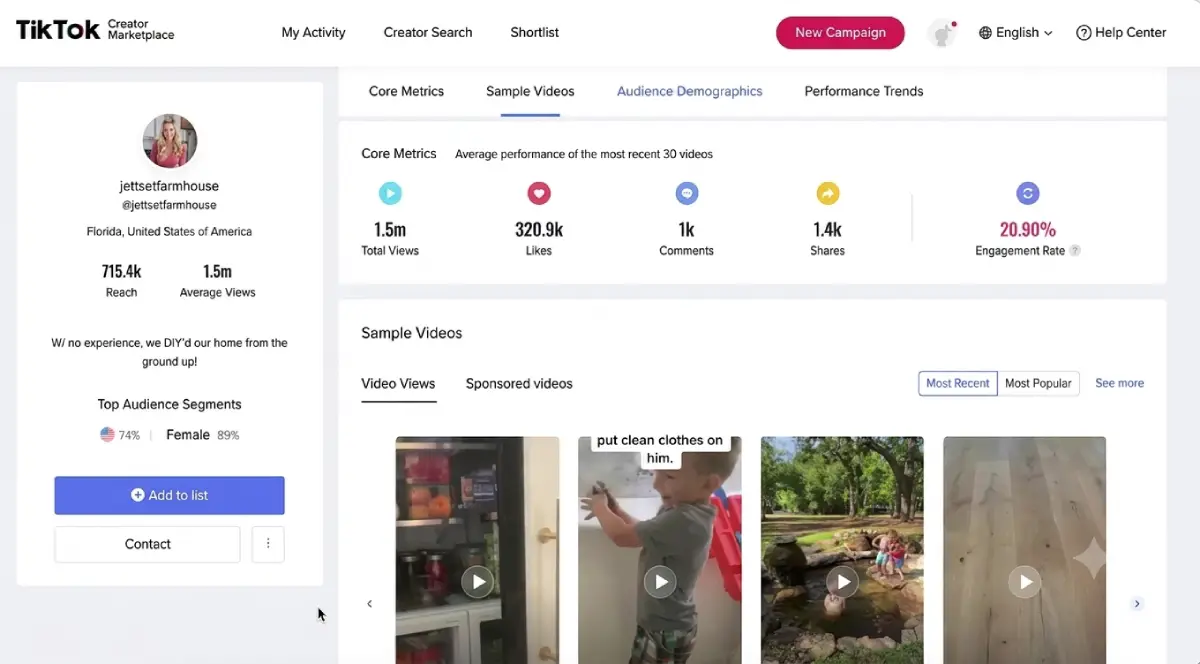
TikTok Creator Marketplace provides post-campaign analytics for sponsored content, including views, engagement, and audience data. For Spark Ads, TikTok Ads Manager provides full performance data including click-through rates and conversion tracking.
Use the TikTok Ads ROI Calculator to model expected returns before committing to a campaign budget, and to evaluate actual results versus targets after the campaign ends.
Common TikTok Influencer Marketing Mistakes
Choosing based on follower count instead of engagement is the most expensive mistake in influencer marketing.
A creator with 500,000 followers and a 0.5% engagement rate delivers fewer effective impressions than one with 50,000 followers and a 5% engagement rate.
Sending a scripted brief that removes the creator’s voice produces content that their audience immediately identifies as unauthentic.
The best-performing sponsored TikTok content sounds like the creator’s normal videos, not like an ad.
Running a single one-off post and expecting transformative results sets unrealistic expectations.
Influencer marketing builds familiarity over repeated exposures. One post rarely changes purchasing behavior significantly on its own.
Failing to use Spark Ads limits campaign potential. Every creator partnership should include a Spark Ads component that amplifies the best-performing posts with paid spend targeting a lookalike audience of the creator’s followers.
FAQ
What is the difference between a TikTok influencer and a content creator?
The terms are often used interchangeably, but there is a practical distinction. A content creator is anyone producing content on TikTok. A TikTok influencer is a creator whose content demonstrably influences their audience’s opinions or behavior, typically evidenced by high engagement, strong community interaction, and audience response to recommendations. All influencers are creators, but not all creators have built sufficient audience trust to function as effective influencers.
How do I reach out to TikTok influencers?
TikTok Creator Marketplace includes a direct messaging feature for reaching creators formally. For smaller creators not on Creator Marketplace, most include a business email address in their TikTok bio or link to a media kit. Send a short, specific message that explains who you are, what the partnership would involve, and what you are offering. Avoid vague outreach. Creators receive many generic partnership requests and respond more favorably to messages that demonstrate you actually know their content.
Should I work with one large influencer or multiple smaller ones?
For most small and mid-sized brands, multiple micro influencers outperform a single macro or mega influencer. The combined reach of five micro influencers at a lower total cost typically delivers higher engagement, more authentic endorsements, and better conversion rates than a single large creator. The exception is brand awareness campaigns where reach and name recognition are the primary goals.
How do I know if a TikTok influencer has fake followers?
Warning signs of inflated follower counts include engagement rates below 1%, generic or repetitive comments (emoji-only or “nice post”), sudden follower spikes not explained by viral content, and a large gap between view counts and comment quality. Use Creator Marketplace to check verified analytics. Third-party influencer audit tools can also help, though TikTok’s own data through Creator Marketplace is the most reliable source.
What niche works best for TikTok influencer marketing?
Beauty, fashion, fitness, food, gaming, and home decor consistently perform well for TikTok influencer partnerships because these categories have large established creator communities and audiences with clear purchase intent. That said, successful influencer campaigns exist in nearly every product category on TikTok. The more important question is whether there are creators whose niche audience precisely matches your target customer.
Wrapping Up
TikTok influencer marketing in 2026 is most effective when it prioritizes engagement quality over follower size, gives creators genuine creative freedom, and integrates Spark Ads amplification to extend the reach of the best-performing content.
Start by identifying five to ten micro-influencers in your specific niche through Creator Marketplace or hashtag research.
Evaluate their engagement rates, audience demographics, and content style before reaching out. Pilot a small campaign with two or three creators before committing to a larger budget.
For the paid advertising strategy that works alongside influencer partnerships, the TikTok Ads Manager guide covers campaign setup, targeting, and optimization.
For the organic content strategy that builds context for influencer content to land in, the TikTok marketing guide covers the full channel approach.
Sources
- TikTok Creator Marketplace, Official TikTok Brand Partnership Platform
- TikTok Business Help Center, Working With Creators
- DataReportal, TikTok Users Stats Data and Trends, January 2025
- Pew Research Center, 8 Facts About Americans and TikTok, March 2026
- eMarketer, TikTok Ad Revenue and Influencer Marketing Benchmarks 2026