
TikTok Ads ROI Calculator
The TikTok Ads ROI Calculator takes your ad spend, revenue and product costs, then shows net profit, ROI %, ROAS and a written AI summary for the niche you enter.
Grow your Business & Social Media Marketing
- Branded Link Shortener
- QR Code Generator
- Bio Page Builder
- Tracking & Analytics
- 16+ Integrations
Tools You May Also Need for TikTok Ads
ROI here means profit over everything you spent
The calculator takes revenue, subtracts ad spend and product costs to get net profit, then divides that profit by ad spend plus product costs. That matches how TikTok’s guide to ROAS and ROI frames it: ROI is net profit divided by total costs, and it includes product costs, shipping, staffing and creative production, not just advertising.
If your ROI is 50%, you kept 50 cents of profit for every dollar that went into ads and products combined. A negative ROI means the campaign cost more than it brought back. For ROI on spending beyond ads, see our guide to return on investment.
What to type in each field
The form has four required fields and two buttons: Calculate True ROI runs the numbers and Clear empties the form.
- Total Ad Spend ($): what you paid TikTok for the campaign and dates you’re judging.
- Total Revenue Generated ($): the sales from that campaign over the same dates.
- Total Product Costs / COGS ($): starts at 0. Put in everything it cost you to deliver those sales: the products themselves, packaging, shipping you paid, payment and marketplace fees, and refunds. The formula only knows the costs you type here.
- Industry / Niche: a few words such as “pet supplements” or “B2B software”. It shapes the written analysis. The math uses only the three dollar fields.
The result has two parts. First comes the Profitability Analysis Scorecard with Net Profit, ROI %, ROAS and a Rating. Below it you get an Expert Financial Summary, three Key Insights and a set of Actionable Recommendations, all written by AI.
Our outdoor gear test, figure by figure
We tested the calculator on November 3, 2026, with numbers for a fictional Colorado outdoor gear brand, Ridgeline Trail Co.: $1,200 in ad spend, $3,900 in revenue, $1,400 in product costs and the niche “Outdoor gear e-commerce”. The full result loaded in about 5.1 seconds.
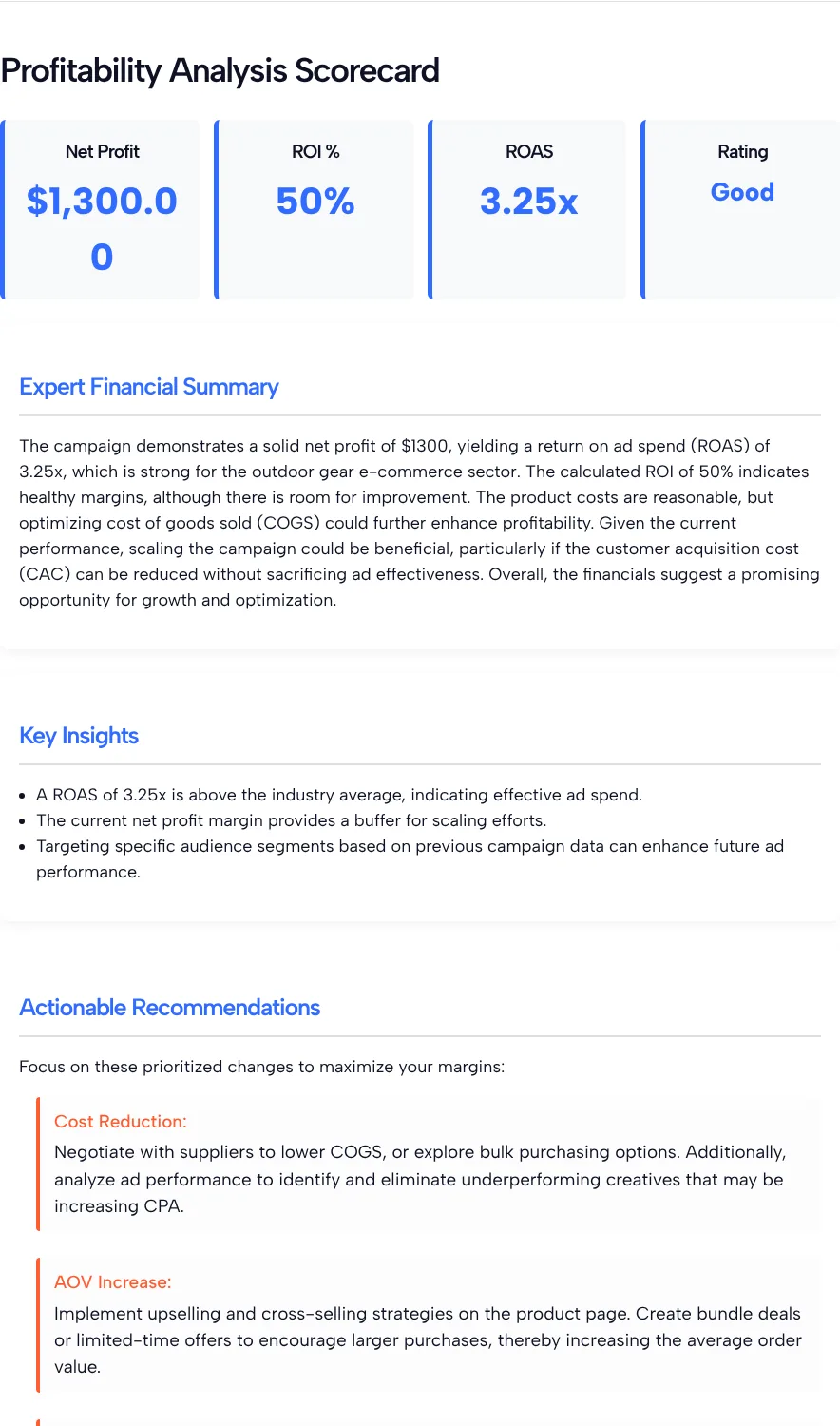
All three scorecard numbers hold up when you redo them by hand. In our test, net profit of $1,300.00 is $3,900 minus $1,200 minus $1,400, the 50% ROI is $1,300 divided by $2,600 (the ad spend and product costs added together), and the 3.25x ROAS is $3,900 divided by $1,200.
The Rating said “Good”. That label comes from the calculator, not from TikTok, and the tool doesn’t say what it would take to score higher or lower.
Reading the AI summary with a skeptic’s eye
The AI summary is useful for ideas, but it isn’t evidence. In our test it called the campaign’s numbers strong for outdoor gear, and one Key Insight said a 3.25x ROAS was “above the industry average”. It named no source for that, so treat it as the AI’s opinion and don’t quote it in a report.
The three recommendations were practical starting points: cut product costs or creatives that push CPA up, raise order value with bundles or upsells, and scale slowly. In our test, the scaling tip suggested trying a 10 to 20% budget increase. That fits TikTok’s budget guidance, which says to raise a budget by no more than 40% per adjustment during the learning phase and 30% after it, and to avoid changes more often than every two days.
The calculator also can’t settle attribution for you. It doesn’t connect to TikTok Ads Manager or your store, so the result is only as accurate as the revenue you decide belongs to the campaign.
One campaign, four ways to score it
The same campaign can look very different depending on the number you lead with:
| Measure | Formula | What it answers |
|---|---|---|
| ROAS | Revenue / ad spend | How much revenue each ad dollar brought in |
| Revenue left after ads | Revenue minus ad spend | Whether sales covered the ad bill |
| Net profit | Revenue minus ad spend minus product costs | How many dollars you actually kept |
| ROI | Net profit / (ad spend + product costs) | Profit per dollar of total cost |
In our test those four came to 3.25x, $2,700, $1,300 and 50%.
ROAS and revenue after ads ignore what the tent cost to make and ship. That’s why our TikTok Ads ROAS Calculator and TikTok Ad Spend Tracker can both look healthy while ROI tells a smaller story.
Costs you forget move ROI fast. If shipping and fees in our test added another $500 to product costs ($1,900 in total), net profit would drop to $800 and ROI to about 26% ($800 divided by $3,100), with ROAS still at 3.25x.
Pulling the three dollar figures
All three dollar figures should cover the same campaign and dates. Take spend from Ads Manager, where TikTok’s basic metrics page defines Cost as total ad spend. Pick the campaign and the date range you want to judge, then match revenue and product costs to them.
- Revenue: only the orders that came from this campaign. Store-wide sales for the week include organic and repeat buyers, and they make ROI look better than it is.
- Product costs: the cost of the units sold in those orders, not of the stock you bought that month.
- Other traffic: if a creator or your bio also sends people to the same product, give each source its own short trackable link so their sales stay out of your ad revenue.
- Creator deals: a flat fee paid to an influencer is a different cost model. The TikTok Influencer ROI Calculator is built for that.
Run the calculator once per campaign and compare ROI across them. For a repeatable way to do that over months, see our guide on how to measure ROI on TikTok ad campaigns.
TikTok Ads ROI Calculator FAQ
How does the calculator work out ROI %?
The calculator divides net profit by ad spend plus product costs. In our test, $1,300 of net profit on $2,600 of combined costs ($1,200 in ads and $1,400 in products) gave an ROI of 50%.
What should I count as product costs?
Everything it took to deliver the orders the campaign brought in: the goods, packaging, shipping you paid, payment and marketplace fees, and refunds. Creative production for the campaign can go in too.
Can I leave product costs at 0?
Yes, for a digital product or a service with no delivery cost. ROI then becomes revenue after ad spend divided by ad spend. With our test numbers and 0 product costs, that would be $2,700 divided by $1,200, or 225%.
Is the Good rating a TikTok benchmark?
No. The rating comes from the calculator itself, not from TikTok. Judge the result against your own targets, such as the ROI you need to cover overhead.
Why is my ROI so much lower than my ROAS suggests?
ROAS only compares revenue with ad spend, while ROI also pays for the products and divides by the larger total. In our test a 3.25x ROAS became a 50% ROI once $1,400 in product costs came out.
Does the industry I type change the numbers?
No. Net profit, ROI % and ROAS use only the three dollar fields. The niche shapes the written summary, insights and recommendations.
New to TikTok Ads? Get Up to $6,000 in Matching Ad Credit