
A small business chasing its first hundred customers usually starts tracking leads in a spreadsheet, then loses track of who was followed up with and who wasn’t. A CRM fixes that.
A CRM, short for customer relationship management tool, is software that stores contact details, logs communication history, and organizes deals or leads in one place instead of scattered spreadsheets and inboxes.
Most comparison guides blur which tools are genuinely free and which only offer a trial dressed up as one.
HubSpot’s free CRM plan is capped at 1,000 contacts and 2 users, according to HubSpot’s pricing page, not the unlimited contact database some older guides still describe. Limits like this change often enough that a number from last year’s roundup can already be wrong.
We checked the free-plan limits and starting prices below against each company’s own pricing page as of September 2026, and we tested every tool here that actually has a free plan to sign up for.
This list focuses on CRMs priced and built for small teams, not enterprise-tier platforms like Salesforce or Zendesk, which target larger sales organizations with dedicated CRM administrators and a much higher budget.
In this article, you will learn:
- Which CRM tools have a real, permanent free plan versus a time-limited trial dressed up as one
- The exact contact, user, and record limits on each free plan, verified against the vendor’s current pricing page
- A CRM option built entirely from a tool many small businesses already use, instead of a dedicated CRM product
- Which CRM fits a solo founder versus a small sales team versus a service business tracking client relationships
- How to connect your CRM to the channel data that shows which source is sending you leads worth tracking
Key Takeaways
- HubSpot’s free CRM caps out at 1,000 contacts and 2 users, while Bigin by Zoho CRM’s free plan is limited to a single user and 500 records, so the right free pick depends on whether you need a second seat.
- Pipedrive and Freshsales no longer offer a permanent free plan. Both are trial-only now, a real change from what several comparison sites still describe.
- Capsule CRM’s free tier tops out at 250 contacts and 2 users, tighter than HubSpot’s free plan but with a simpler interface that some very small teams prefer.
- Notion has no dedicated CRM product, but its free plan supports a genuinely usable do-it-yourself CRM built from a database template, an option the CRM comparison sites we reviewed don’t mention.
- Every tool on this list connects to email or calendar tools you likely already use, so switching CRMs rarely means giving up your existing inbox workflow.
Quick Answer
The best CRM tools for small business in 2026 are HubSpot CRM for an all-in-one free plan, Bigin by Zoho CRM for solopreneurs who want the lightest possible setup, Capsule CRM for a simple contact-first free tier, Pipedrive for visual sales pipeline management, Freshsales for AI-assisted lead scoring, and Notion for a do-it-yourself CRM built on a tool you may already use daily.
CRM Tools for Small Business: Quick Comparison
| Tool | Category | Best For | Free Plan | Starting Price |
|---|---|---|---|---|
| HubSpot CRM | All-in-one CRM | Small teams wanting sales, marketing, and service in one place | 1,000 contacts, 2 users | $7/month per seat (Starter) |
| Bigin by Zoho CRM | Lightweight CRM | Solopreneurs moving off spreadsheets | 1 user, 500 records | $7/user/month billed yearly (Express) |
| Capsule CRM | Contact management | Very small teams wanting simplicity | 2 users, 250 contacts | $18/user/month billed annually (Starter) |
| Pipedrive | Sales pipeline CRM | Visual deal tracking and sales automation | No free plan, 14-day trial | $14/seat/month billed annually (Lite) |
| Freshsales | AI-assisted CRM | Lead scoring and deal insights | No free plan, 21-day trial | $9/user/month billed annually (Growth) |
| Notion | DIY workspace CRM | Teams already using Notion for docs and projects | Full workspace, limited blocks for 2+ members | $10/member/month (Plus) |
How We Evaluated Each Tool
We signed up for each tool’s free plan and tested it directly for HubSpot CRM, Bigin by Zoho CRM, Capsule CRM, and Notion, since each of these genuinely offers a free plan to sign up for.
Pipedrive and Freshsales no longer have a permanent free plan, so for those two we verified pricing, plan limits, and features against the company’s own website, pricing page, and documentation instead.
We evaluated contact and user limits, core features, and ease of setup, and verified every current price and limit against official sources today. Rankings and best-for placements below are editorial judgment built on that combination of hands-on use and verified limits, not a separate scored test.
The 6 Best CRM Tools for Small Business
These six tools cover the range a small business actually needs: a free plan that lasts, a simple contact-first option, a visual sales pipeline, AI-assisted lead scoring, and a flexible workspace option for teams that would rather not add another dedicated app.
1. HubSpot CRM
Best for: Small businesses that want sales, marketing, and service tools under one free login.
HubSpot’s free plan includes its Smart CRM database along with lite versions of its marketing, sales, and service tools, so a small team can track deals and send basic email campaigns without paying for separate software. You can pair it with a free lead capture tool to feed new contacts directly into the pipeline.
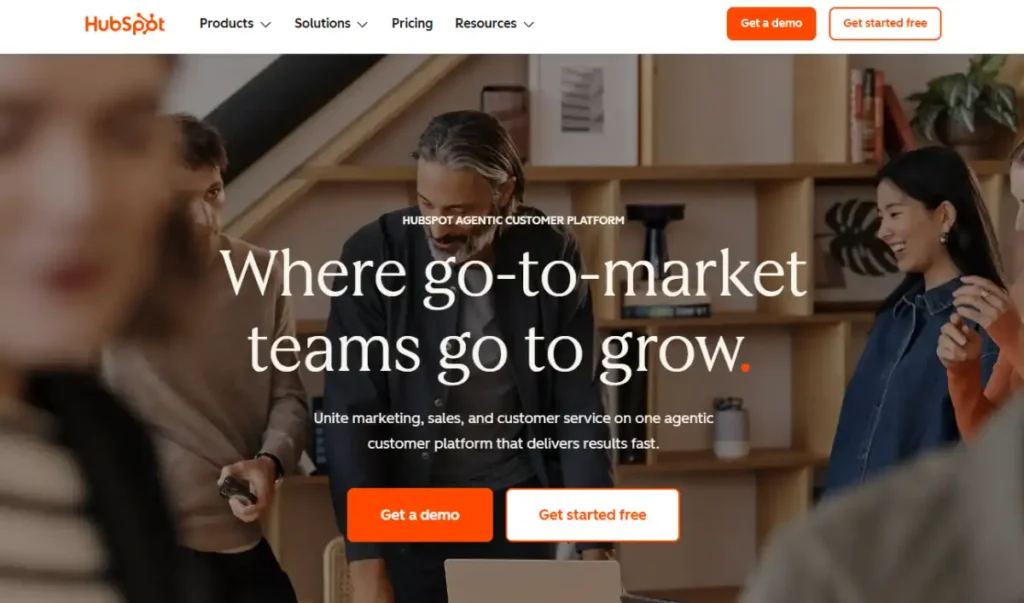
Businesses outgrow the free plan once they need more than 2 users, more than 1,000 contacts, or automation beyond the basics, which move into HubSpot’s paid Starter tier.
Key features
- Smart CRM database with contact and deal tracking
- Drag-and-drop deal pipeline with a Kanban-style view
- Email tracking and basic email templates
- Free tools for forms, live chat, and simple automation
- Mobile app for iOS and Android
- Up to 1 million records across non-contact object types
Pros
- Free plan combines CRM, marketing, and service tools instead of just contact storage
- No time limit on the free tier
- Familiar interface that most sales hires have already used elsewhere
Cons
- 1,000-contact and 2-user cap is a real ceiling, not a soft limit
- Advanced reporting and most automation require a paid Starter plan or higher
Pricing
HubSpot’s free CRM costs $0 for up to 1,000 contacts and 2 users, with no time limit. Starter plans for each HubSpot hub begin at $7 per month, according to HubSpot’s own pricing page.
Not for: Teams that already have more than 1,000 contacts or need more than 2 seats on day one.
Why we included this: HubSpot’s free plan is the only one on this list that bundles marketing and service tools with the CRM itself, so a small business gets more than contact storage for zero cost.
2. Bigin by Zoho CRM
Best for: Solopreneurs and very small teams moving off spreadsheets for the first time.
Bigin strips a CRM down to what a first-timer actually needs: one sales pipeline, contact and activity tracking, and built-in calling, without the feature sprawl of full Zoho CRM. It works well alongside a branded short link on outbound messages so you can see which outreach actually gets clicked before it becomes a deal in Bigin.
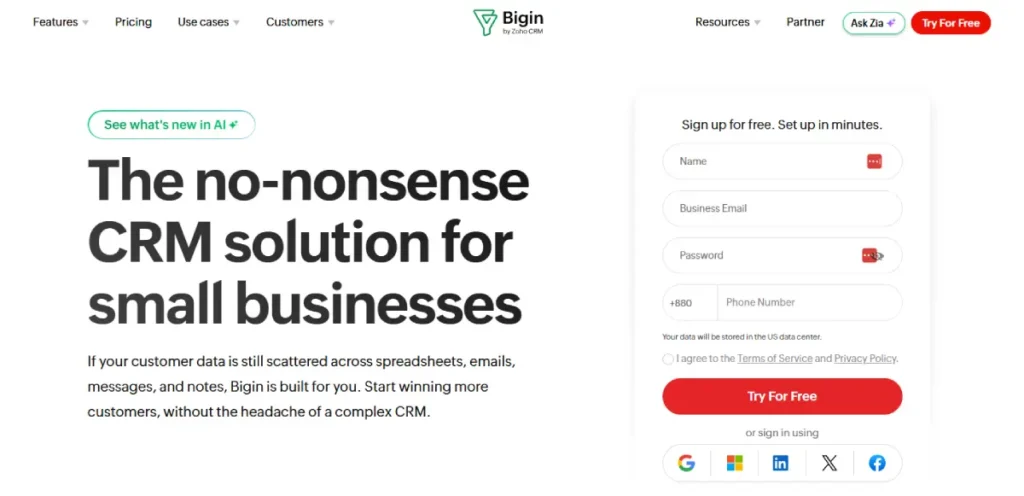
The free plan is built for exactly one person, so any additional teammate requires upgrading to a paid seat.
Key features
- Single sales pipeline with customizable stages
- 500 records across pipelines, contacts, activities, and notes
- Built-in phone calling and call recording
- No-code web forms for capturing leads
- Business card scanner in the mobile app
- Zapier, Zoho Forms, and Zoho Campaigns integration
Pros
- Genuinely usable free plan for a single user, not a stripped demo
- Business card scanner and phone calling included even on the free tier
- Simple enough to set up in an afternoon without training
Cons
- Free plan is limited to 1 user, so teams of 2 or more must pay immediately
- 500-record cap is easy to hit once you count every contact, activity, and note
Pricing
Bigin’s free plan costs $0 for a single user with up to 500 records. The Express plan starts at $7 per user per month billed yearly, or $9 per user per month billed monthly, according to Bigin’s pricing page.
Not for: Teams of two or more who need to share a pipeline from day one.
Why we included this: Most CRM comparisons default to full Zoho CRM, but Bigin is the product Zoho actually built for someone moving off a spreadsheet for the first time.
3. Capsule CRM
Best for: Very small teams that want contact management without a steep learning curve.
Capsule keeps its free plan focused on the basics: contacts, one sales pipeline, and a handful of custom fields, which makes it quick to learn for a small service business tracking clients rather than a high-volume sales team. Connecting a trackable QR code to a physical flyer or business card gives you a simple way to see how many new contacts a specific campaign actually generates.
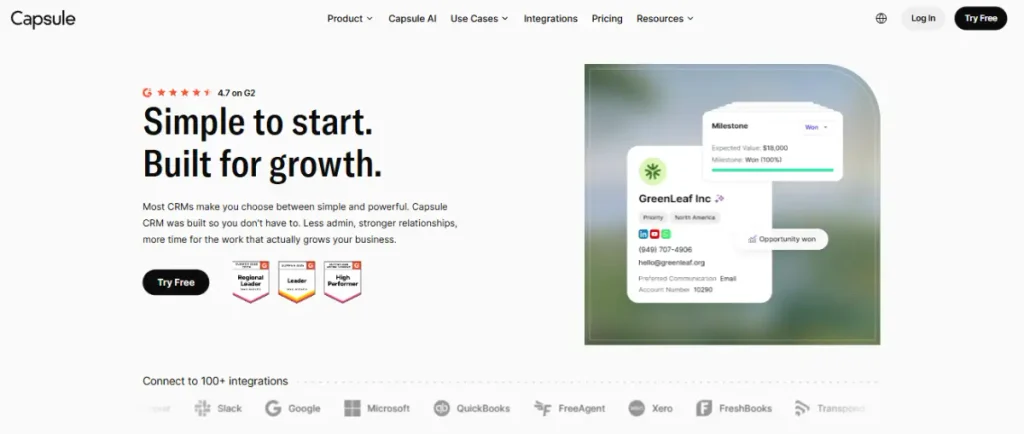
The 250-contact cap is the tightest free-tier limit on this list, so it fits best as a starting point, not a long-term home for a growing contact list.
Key features
- Contact and opportunity management in one view
- 1 sales pipeline with custom milestones
- 5 custom fields on the free plan
- Gmail and Outlook connection for sending email
- Task and activity tracking with reminders
- iOS and Android mobile apps
Pros
- Simple interface with less setup than most full-featured CRMs
- Free plan supports 2 users, not just 1
- Clear upgrade path with a 14-day trial of paid features before committing
Cons
- 250-contact limit is the smallest free-tier ceiling among the tools compared here
- Automation and advanced reporting require the paid Growth plan
Pricing
Capsule’s free plan costs $0 for up to 2 users and 250 contacts. The Starter plan begins at $18 per user per month billed annually, according to Capsule’s pricing page.
Not for: Businesses with a contact list already larger than 250 people.
Why we included this: Capsule’s free plan supports 2 users where several competitors cap free access at a single seat, which matters for a small business run by two founders.
4. Pipedrive
Best for: Sales-focused small businesses that want a visual pipeline and automation, and are ready to pay from day one.
Pipedrive has no permanent free plan, only a 14-day trial, but its pipeline view is built specifically around moving deals through stages rather than general contact storage.
Tracking which short link in an email campaign drove a reply gives a sales team another data point before a lead ever reaches Pipedrive’s pipeline.
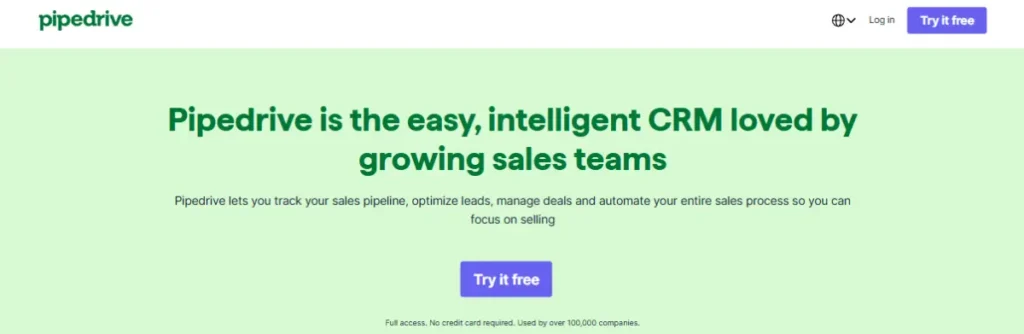
Because there is no free tier to fall back on, a lapsed trial means the account either gets upgraded or the data becomes inaccessible.
Key features
- Visual, drag-and-drop deal pipeline
- Real-time sales feed showing overdue tasks and new opportunities
- Full email sync with open and click tracking
- 500+ app integrations including Zapier and Zoom
- AI-powered report creation from text prompts
- Mobile CRM app for iOS and Android
Pros
- Pipeline view is purpose-built for sales, not adapted from generic contact storage
- 14-day trial requires no credit card to start
- Automations and email sequences available starting on the Growth plan
Cons
- Only a 14-day trial to test the product, unlike Bigin, Capsule, or HubSpot on this list, which all stay free indefinitely
- Full email sync and automations require upgrading from Lite to Growth, which costs $39 per seat per month billed annually
Pricing
Pipedrive has no free plan, only a 14-day free trial. The Lite plan starts at $14 per seat per month billed annually, according to Pipedrive’s pricing page.
Not for: Businesses that want to run a CRM indefinitely without ever paying.
Why we included this: Pipedrive’s pipeline-first design earns its cost for a small business whose main bottleneck is disorganized deal tracking, not a shortage of places to store contacts.
5. Freshsales
Best for: Small businesses that want built-in AI lead scoring without a separate add-on.
Freshsales (Freshworks CRM) also dropped its permanent free plan and now runs on a 21-day trial, but its Growth plan starts lower than Pipedrive’s entry tier and folds in contact lifecycle stages and basic workflows from the start. Pairing it with UTM-tagged links on ad campaigns makes it easier to see which channel is actually filling the pipeline Freshsales tracks.
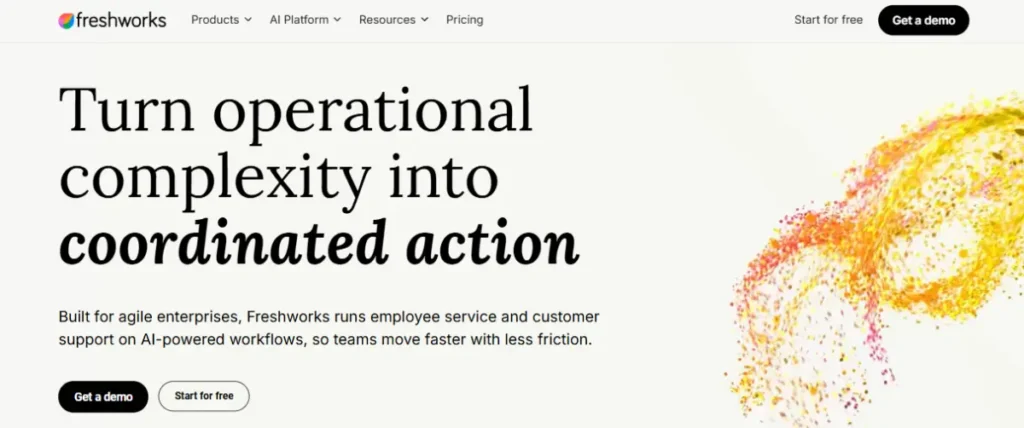
The trial gives full access to paid features for 21 days, after which the account needs a paid plan to continue.
Key features
- Contact lifecycle stage tracking
- Kanban-style deal view
- Built-in chat, email, and phone in one workspace
- Custom fields and basic workflow automation
- Email templates for repeated outreach
- Mobile apps for iOS and Android
Pros
- Growth plan pricing starts lower than most competitors’ entry-level paid tiers
- Contact lifecycle stages built in without needing a separate marketing tool
- 21-day trial is longer than Pipedrive’s 14-day window
Cons
- Account gets suspended once the 21-day trial ends unless you pick a paid plan
- Deal insights and contact scoring require the higher Pro plan
Pricing
Freshsales has no free plan, only a 21-day free trial. The Growth plan starts at $9 per user per month billed annually, according to Freshworks’ pricing page.
Not for: Businesses that specifically need a free-forever CRM rather than a trial.
Why we included this: Freshsales pairs contact lifecycle tracking with one of the lower paid entry prices on this list, which suits a small business ready to commit to a low-cost plan instead of staying on a free tier indefinitely.
6. Notion
Best for: Small teams already using Notion for docs or projects who want a CRM without adding another subscription.
Notion is not a dedicated CRM product. It is a general workspace tool, and the CRM comes from building your own contact and pipeline database, either from scratch or from a free template in Notion’s own template gallery. That flexibility is also the tradeoff: nothing about leads, deals, or follow-ups works automatically until you set it up yourself, unlike the purpose-built CRMs above.
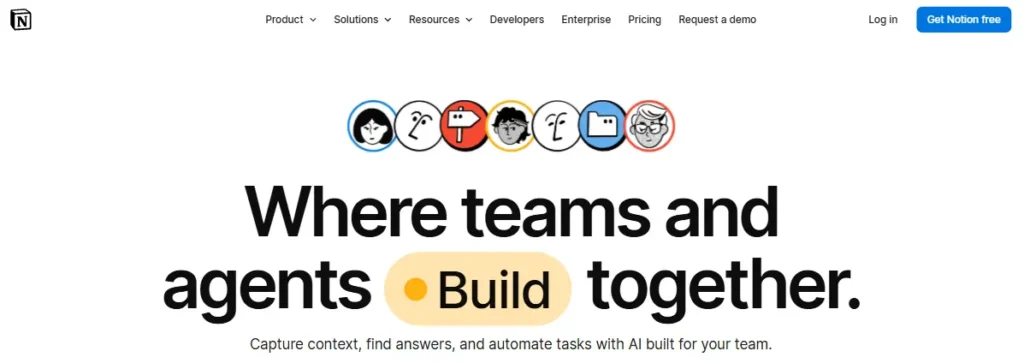
A workspace with a single member can add unlimited pages and blocks on the free plan, but a workspace with 2 or more members hits a block limit before needing to upgrade.
Key features
- Custom databases with properties, filters, and linked relations
- Free CRM templates available in Notion’s own template gallery
- Views for tables, boards, calendars, and timelines on the same data
- Comments and mentions for team follow-up on a contact or deal
- File uploads up to 5MB per file on the free plan
- iOS, Android, and desktop apps with offline access to recent pages
Pros
- No cost to build a working CRM if you already use Notion for other work
- Fully customizable structure instead of fixed CRM fields
- Doubles as the same workspace for docs, tasks, and other projects
Cons
- No native sales automation, email sync, or built-in calling like a dedicated CRM
- Multi-member workspaces hit a block limit on the free plan before needing to upgrade
Pricing
Notion’s free plan costs $0 per member per month, with unlimited pages for a single-person workspace and a block limit once a workspace has 2 or more members. The Plus plan starts at $10 per member per month, according to Notion’s pricing page.
Not for: Teams that need automated email sync, calling, or lead scoring without building it themselves.
Why we included this: The CRM comparison sites we reviewed do not mention Notion as an option, but it is a genuine zero-cost CRM for a small business that already lives in Notion for everything else.
Tool Ratings at a Glance
| Tool | Ease of Use | Free Plan Value | Sales Features | Value for Price |
|---|---|---|---|---|
| HubSpot CRM | 4 | 5 | 4 | 5 |
| Bigin by Zoho CRM | 5 | 4 | 3 | 5 |
| Capsule CRM | 5 | 3 | 3 | 4 |
| Pipedrive | 4 | 2 | 5 | 4 |
| Freshsales | 4 | 2 | 4 | 4 |
| Notion | 3 | 4 | 2 | 4 |
Scale: 5 = Excellent, 4 = Good, 3 = Fair, 2 = Limited. Pipedrive and Freshsales score 2 on Free Plan Value because neither offers a permanent free plan, only a time-limited trial. Ratings are editorial judgment based on hands-on use and verified pricing, not a separate scored lab test.
Which CRM Fits Your Situation?
| You are a… | Start with… |
|---|---|
| Solo founder replacing a spreadsheet | Bigin by Zoho CRM |
| Small team wanting marketing tools bundled with the CRM | HubSpot CRM |
| Two-person team wanting simple contact tracking | Capsule CRM |
| Sales-focused team ready to pay for a visual pipeline | Pipedrive |
| Team wanting AI lead scoring at a lower entry price | Freshsales |
| Team already living in Notion for docs and projects | Notion, built from a free CRM template |
A CRM tells you who your leads are, but not where they came from. Click data from a link shortener fills that gap, so you know which channel deserves credit before adding a paid seat for every team member.
Frequently Asked Questions
These are the questions that come up most often when a small business compares CRM tools against each other, especially now that some tools have dropped their free plans entirely.
Is a free CRM enough for a small business just starting out?
Yes, a free CRM can handle the first stretch of a small business’s contact and deal tracking without any upfront cost.
HubSpot’s free plan supports up to 1,000 contacts and 2 users, and Bigin’s free plan covers a single user with 500 records. Both are enough to organize early leads before a business needs to decide whether a paid upgrade is worth it.
Do Pipedrive and Freshsales really not have free plans anymore?
Correct, both currently offer only a time-limited trial instead of a permanent free tier, based on their own current pricing pages.
Pipedrive offers a 14-day trial with no credit card required, and Freshsales offers a 21-day trial. This is a change from what some older CRM comparisons still describe, so it is worth checking a tool’s own pricing page before assuming a free plan still exists.
Can Notion actually replace a dedicated CRM?
Notion can work as a CRM for a small business with simple needs, built from its database and template features rather than a purpose-built product.
It handles contact records, deal stages, and follow-up tracking well once set up, but it has no built-in email sync, automated lead scoring, or calling like a dedicated CRM. A team that needs those features automated is better served by one of the purpose-built tools on this list.
What happens when a business outgrows HubSpot’s free CRM plan?
A business outgrows HubSpot’s free plan once it needs more than 1,000 contacts, more than 2 users, or automation beyond the free tools included.
At that point, the account can upgrade to a paid Starter plan for the specific HubSpot hub it needs, which begins at $7 per month, according to HubSpot’s own pricing page. Contact and deal data carries over automatically since it stays in the same underlying CRM database.
Which CRM is easiest to set up for someone with no CRM experience?
Bigin and Capsule are the two easiest to set up quickly, since both focus on a single pipeline and basic contact fields rather than a large menu of configuration options.
HubSpot’s free plan is also approachable but includes more surrounding tools, like forms and live chat, which take a bit longer to explore even if you never touch them. Pipedrive and Freshsales assume more sales-process setup upfront since both are built around pipeline stages and automation from the start.
Can I use a spreadsheet instead of a CRM?
A spreadsheet can track a small number of contacts, but it has no reminders, no shared activity history, and no way to see a deal’s stage at a glance.
Once more than one person needs to update the same records, a spreadsheet also has no way to prevent two people from overwriting each other’s notes. A free CRM like HubSpot, Bigin, or Capsule solves that without costing anything until your contact list outgrows the free tier.
Wrapping Up
A CRM only earns its cost once it replaces the spreadsheet you were already maintaining by hand, and the free-plan limits above decide how long that replacement stays free. Two of the tools most commonly recommended for small businesses, Pipedrive and Freshsales, no longer offer a permanent free plan at all.
Start with whichever tool matches your team size and budget today, not the one with the most features you might use eventually. A single founder moving off a spreadsheet needs less than a five-person sales team tracking a multi-stage pipeline.
Once contacts start flowing in from more than one channel, linking your CRM to trackable short links and QR codes shows which source is actually worth the follow-up time before you commit to a bigger CRM plan.
Sources
- HubSpot, Free Tools Pricing, 2026
- Bigin by Zoho CRM, Pricing, 2026
- Capsule CRM, Pricing, 2026
- Pipedrive, Pricing, 2026
- Freshworks, Freshsales Pricing, 2026
- Notion, Pricing, 2026