
Picking between Spocket and Printify usually comes down to one question nobody answers clearly: are you reselling existing products or building your own branded line? That single distinction decides which platform actually fits, long before price ever matters.
Both tools show up in nearly every dropshipping roundup, and most comparisons stop at feature lists pulled from each company’s own marketing pages. Few check what real merchants say after they have actually paid for a subscription.
If you are still mapping out the basics before choosing a platform, how to start a dropshipping business covers the setup steps this comparison assumes you already know.
Printify holds a 4.7 out of 5 rating from 4,400+ reviews on the Shopify App Store. Spocket sits at 4.0 out of 5 from 570+ reviews on its own Shopify listing.
That gap is the first real signal, and it gets more specific the deeper you look.
In this article, you will learn:
- What Spocket and Printify actually do, verified directly from each platform’s own site
- Exact 2026 pricing for every plan, pulled straight from spocket.co and printify.com
- What live Shopify App Store reviews reveal that neither company’s marketing page mentions
- Which platform fits your specific situation, and whether you can reasonably use both
Key Takeaways
- Printify’s Premium plan starts at $39 a month, or $24.99 a month billed yearly, with a permanent free plan still available. Spocket has no free tier and starts at $39.99 a month after a 7-day trial.
- Printify’s Shopify App Store rating is 4.7 out of 5 across 4,400+ reviews, with just 2% at one star. Spocket’s is 4.0 out of 5 across 570+ reviews, with 12% at one star, verified directly from each app’s live listing.
- A recurring pattern across Spocket’s one-star reviews involves difficulty cancelling subscriptions and continued billing after cancellation requests, documented in multiple dated reviews between December 2025 and June 2026.
- Printify’s free plan includes 5 stores and unlimited product designs with no monthly fee, something Spocket does not offer at any tier.
- Spocket’s catalog is built around US and EU-based suppliers, while Printify draws from a global network of 90 or more print providers, according to each company’s own site.
- Printify has a documented policy of removing published products that have not sold, a detail confirmed directly in Printify’s own Shopify reviews and absent from its marketing copy.
Quick Answer
Choose Printify if you want to build a branded product line with your own designs, since it has a genuine free plan and the stronger review record on Shopify. Choose Spocket if you want to resell existing, ready-made products with faster US or EU based shipping and do not mind paying from day one. Neither platform is objectively better. They solve different problems for different kinds of sellers.
Spocket vs Printify: Quick Comparison
| Factor | Spocket | Printify |
|---|---|---|
| Best for | Reselling ready-made products | Custom, branded print-on-demand |
| Free plan | None (7-day trial only) | Yes, permanently free |
| Starting price | $39.99 a month | $39 a month, or $24.99 a month billed yearly |
| Product catalog | 100 million-plus listings | 90-plus print providers, thousands of customizable products |
| Design work required | No | Yes, for custom items |
| Shopify App Store rating | 4.0 out of 5 (570+ reviews) | 4.7 out of 5 (4,400+ reviews) |
| Supplier base | Primarily US and EU | Global, 90-plus providers |
How Spocket Works
Spocket connects your online store to a catalog it advertises as 100 million-plus products, sourced primarily from US and EU-based suppliers. You browse, import with one click, and Spocket forwards each order automatically.
There is no design step. You are reselling items that already exist, which makes Spocket a fit for sellers who want inventory live the same day, not sellers who want a distinct, ownable product line.
Spocket’s trending and best-selling categories change often, so sellers who lean on this platform tend to check product demand before committing to a niche.
Every Spocket plan, even the entry-level Starter tier, includes 0% transaction fees, unlimited orders, branded invoicing, and AliExpress and Amazon dropshipping integrations. Higher tiers unlock more unique and premium product slots, not new core functionality.
Spocket also connects to TikTok Shop through its Shopify dropshipping app, which matters if you plan to run TikTok Shop ads alongside a Spocket-sourced storefront. Multiple stores are supported, though each additional store needs its own separate subscription.
How Printify Works
Printify is a print-on-demand platform. You upload your own artwork onto blank products, Printify prints and ships each order after it sells, and you never hold inventory or pay for stock upfront.
The free plan supports 5 stores and unlimited product designs with no monthly cost, according to Printify.
Upgrading to Premium, at $39 a month or $24.99 a month billed yearly, adds discounts of up to 33% on new products and up to 20% on the full catalog.
Premium also unlocks Printify Connect for order management, AI-generated product mockups, and 1:1 mentorship through Printify’s Sellers Club PRO program. The Enterprise tier adds a dedicated account manager and custom API access for high-volume sellers.
Printify’s own stats page lists 90-plus print providers, 140-plus fulfillment centers, and over 1,300 customizable products across its network. That breadth is the core reason Printify suits sellers who want a genuinely branded line, not a resale catalog.
Before connecting either platform, confirm your storefront itself is ready. TLinky’s roundup of website builders for small businesses covers which platforms handle Printify and Spocket integrations cleanly.
Pricing Compared: What Each Plan Costs
The figures below come directly from each platform’s live pricing page, checked today rather than pulled from a secondary source.
Spocket Pricing
Spocket’s Starter plan runs $39.99 a month and includes 25 unique products from its full catalog. Professional jumps to $59.99 a month for 250 unique products plus 25 premium listings.
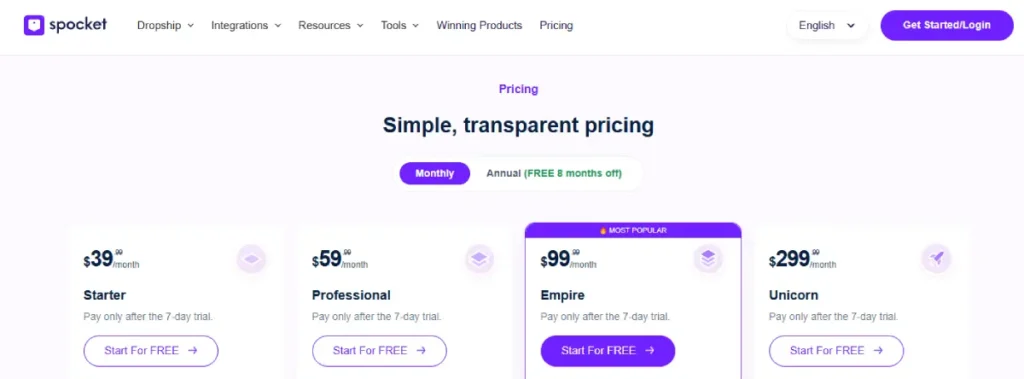
Empire costs $99.99 a month for 10,000 unique and 10,000 premium products, while Unicorn tops out at $299.99 a month for 25,000 of each. Billed annually, those same tiers drop to roughly $24, $57, and $79 a month.
Every tier includes a 7-day free trial, and Spocket allows cancellation at any time according to its own pricing page FAQ. There is no permanently free plan at any product level.
Printify Pricing
Printify’s Free plan costs nothing and includes 5 stores with unlimited designs, the standard Product Creator, and integrations with Shopify, Etsy, eBay, and other major sales channels.
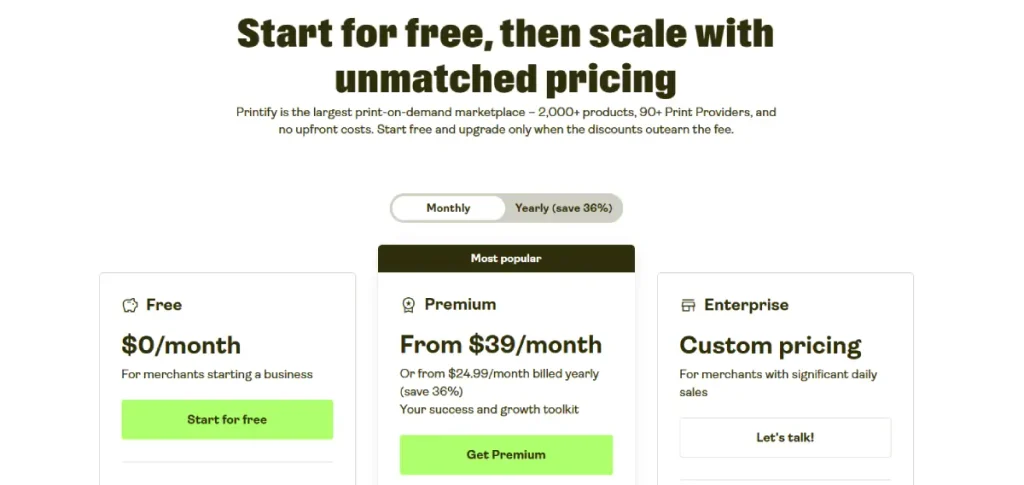
Premium costs $39 a month, or $24.99 a month billed yearly for a 36% savings, and raises the store limit to 10 while adding catalog-wide discounts. Enterprise pricing is custom and built for merchants selling at high daily volume.
Unlike Spocket, downgrading from Premium back to Free does not remove any platform functionality. You simply lose the discount tiers and pay standard product costs again.
The Real Difference: What Live Review Data Shows
Marketing pages describe features. Shopify’s App Store reviews describe what happens after someone actually pays for a subscription, and the gap between the two platforms here is larger than any feature comparison suggests.
Printify’s 4.7 rating across 4,400+ reviews breaks down to 83% five-star and just 2% one-star, based on the live rating distribution pulled directly from its Shopify App Store page. That is a tightly clustered, mostly positive record.
Spocket’s 4.0 rating across 570+ reviews tells a more divided story. 79% of ratings are five-star, but 12% are one-star, a share six times higher than Printify’s, verified from Spocket’s own Shopify listing.
Reading the actual one-star reviews explains the pattern. Multiple verified merchants describe difficulty cancelling their Spocket subscription and continued billing after they requested it.
These reviews are dated across December 2025, January 2026, March 2026, and June 2026. Spocket’s team replies to each one and apologizes, but the pattern repeats across unrelated accounts.
Printify’s complaints skew toward a different issue entirely. One August 2026 review describes Printify’s policy of deleting published products that have not sold within a set window.
The reviewer calls this a serious risk for sellers who invest hours building a catalog. A separate review flags the merchant protection window for reprints as too short.
Neither issue is disqualifying on its own, but they point sellers toward different due diligence. If you pick Spocket, read its cancellation terms before subscribing and confirm your card is fully removed after you cancel.
If you pick Printify, understand which of your unsold designs might get pruned automatically.
Whichever platform you choose, keep customers informed after checkout. Pairing either tool with one of the best email marketing tools for small businesses reduces support tickets tied to shipping confusion.
Which Platform Fits Your Situation
| You are a… | Start with… |
|---|---|
| First-time seller testing an idea with no budget | Printify’s free plan |
| Seller who wants a resale catalog with no design work | Spocket |
| Seller building a branded apparel or merch line | Printify |
| High-volume TikTok Shop seller who needs US-based shipping speed | Spocket |
| Seller who wants order automation and mentorship support included | Printify Premium |
| Agency managing multiple client stores | Printify, since store limits are more generous at each price point |
Whichever platform you start with, track how each product performs before scaling spend. Tools like TLinky’s UTM builder let you tag every product link so you know exactly which listing or ad drove the sale.
Can You Use Spocket and Printify Together?
Yes, and it is more common than either company’s marketing suggests. Many sellers run a Printify-based branded product line alongside a Spocket-sourced catalog of ready-made accessories or complementary items in the same store.
This works because the two platforms solve different problems. Printify handles anything you want printed with your own design, while Spocket fills in ready-made products that would be impractical to manufacture yourself, like electronics or premade jewelry.
Running both does mean paying two separate subscriptions once you move past free trials, so model the cost against your margins before committing to both. A dropshipping tools stack built around TikTok Shop often includes exactly this combination.
Sellers running a mixed catalog also tend to add a QR code on product packaging linking back to care instructions or a review request, regardless of which platform fulfilled the order.
Frequently Asked Questions
These are the questions sellers ask most often once they get past the marketing pages and start comparing real costs and real risk between the two platforms.
Is Spocket or Printify better for beginners?
Printify is the easier starting point for most beginners because its free plan has no cost and no time limit. You can list unlimited designs across 5 stores before ever entering a card number.
Spocket requires a paid plan after its 7-day trial ends, which raises the stakes for someone still validating a product idea. Beginners testing multiple niches often prefer Printify’s zero-risk entry point first.
Does Printify or Spocket have faster shipping?
Printify’s shipping speed depends entirely on which of its 90-plus print providers fulfills your order, since production happens after each sale and providers are spread globally.
Spocket markets its catalog as sourced primarily from US and EU-based suppliers, which generally shortens delivery for customers in those regions. Neither company publishes a single guaranteed shipping window across their entire catalog.
Can I switch from Spocket to Printify or vice versa?
Yes, switching platforms does not require rebuilding your storefront from scratch, since both connect to the same major sales channels like Shopify and Etsy. You will need to re-import products and reconnect fulfillment settings.
Expect some manual work matching product listings between platforms, since neither offers a direct one-click migration tool from the other as of 2026.
Why does Spocket have more one-star reviews than Printify?
The most common thread across Spocket’s one-star Shopify reviews involves subscription cancellation, with several merchants reporting continued charges after requesting a cancellation.
This pattern appears across multiple, unrelated verified reviews dated between December 2025 and June 2026. It does not appear with the same frequency in Printify’s review history on the same platform.
Is Printify’s free plan actually usable long-term?
Yes, Printify’s free plan has no expiration date and includes unlimited product designs across 5 stores, according to its own pricing page. Many sellers run an entire store on it indefinitely.
The tradeoff is paying standard, non-discounted product costs on every order. Sellers who scale past a certain order volume typically find the Premium plan’s discounts pay for themselves.
Do either Spocket or Printify charge transaction fees?
Spocket explicitly advertises 0% transaction fees across every plan tier, confirmed directly on its pricing page. Printify does not charge a platform transaction fee either, earning instead through its product fulfillment pricing.
Both platforms are still subject to whatever transaction fees your connected sales channel, such as Shopify or Etsy, charges separately on each sale.
Wrapping Up
Spocket and Printify are not really competing for the same seller. Spocket fits resellers who want inventory live today with no design work, while Printify fits anyone building a genuinely branded, custom product line.
The review data most comparisons skip tells its own story: Printify’s 4.7 rating comes from a mostly satisfied user base, while Spocket’s 4.0 rating carries a real, documented billing-complaint pattern worth reading before you subscribe.
Start with whichever platform matches your actual product, not whichever one ranks first in a generic list. If you are still deciding what to sell, TLinky’s guide to print-on-demand for TikTok Shop is a useful next step.
Once your catalog is live, pair it with the best TikTok marketing tools to drive traffic to it. A great product catalog with no distribution plan will not sell itself.
Sources
- Spocket Pricing, Spocket
- Pricing, Printify
- Reviews: Printify, Shopify App Store
- Reviews: Spocket, Shopify App Store